

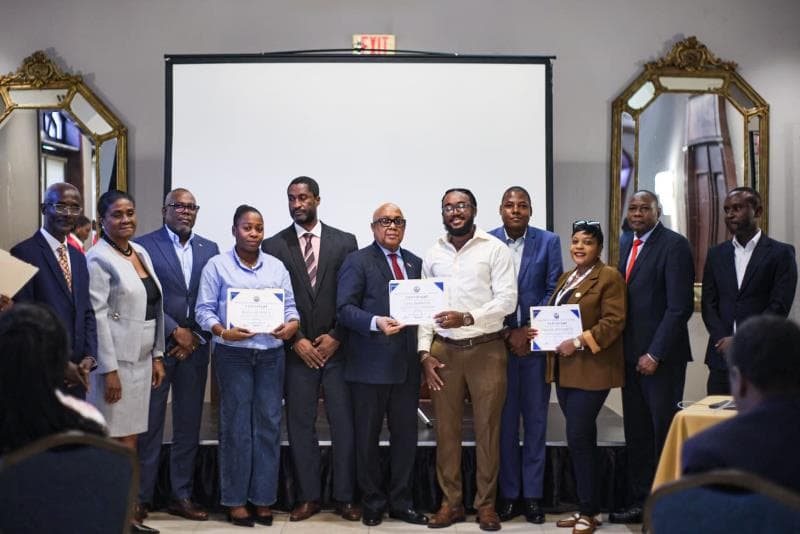
The presentation of the second issue of the scientific journal Open Economic Law was an opportunity to once again pose the question of the role of law in transforming the economy in Haiti. Gathering researchers, legal practitioners, private sector representatives, and officials from the Bank of the Republic of Haiti (BRH), the event, organized on October 6, 2026, at the Karibe hotel, highlighted several issues: financial crime, intellectual property, business law, and digital innovation.<\/i><\/p>
In presenting this new issue, the journal’s director, Dr. Johanny Stanley Joseph, emphasized the difference between creating a scientific publication and consolidating it over time. “A scientific journal is not built in an instant. It grows over time,” he explains. According to him, this construction relies on the contributions of authors, the critiques of readers, and the needs of practitioners. The goal is to make the journal a space where legal questions related to economic transformations can be examined beyond mere legislative developments.<\/p>
Economic law is presented as a particularly dynamic field, confronted with new technologies, the transformation of commercial and financial practices, and the emergence of new actors. “A new technique appears, an economic practice becomes widespread, a new player enters the artificial intelligence market, an old qualification becomes uncertain,” noted the journal’s director. In this context, doctrinal work should not only comment on existing texts but also anticipate upcoming transformations. “We do not want a doctrine that simply comments on the law as it changes. We want a doctrine that can also get ahead of the law,” he indicates.<\/p>
One of the axes claimed by Open Economic Law is openness to foreign experiences. However, according to officials, this comparison should not lead to a mechanical importation of solutions developed in other institutional environments. It is about welcoming contributions from other legal traditions while allowing Haitian research to promote its own analyses. The ambition is to contribute to the gradual establishment of a true Haitian doctrine of economic law, capable of starting from national realities while engaging in dialogue with international experiences.<\/p>
“Securing,” the Common Thread of the Second Issue<\/strong><\/h4>The president of the journal's scientific committee, Dr. Bernard Gauche, identified a transversal concept across the various contributions of the second issue: that of legal security. According to him, the security provided by law is an essential condition for the development of economic relations and fosters trust among actors. “If I had to characterize the backdrop of this issue in one word, I would use the word securing,” he believes.<\/p>
This notion appears in several areas addressed by the journal: contracts, fund deposits and management, currencies and cryptocurrencies, real estate investment, product quality, intellectual property, e-commerce, and the protection of family heritage. The issue also focuses on the securing of virtual exchanges through the recognition of the probative force of electronic documents and the introduction of phishing into criminal law.<\/p>
Other contributions discuss cryptocurrencies, professional leases, appellations of origin, and various forms of intellectual property. For the president of the scientific committee, this work illustrates a broader necessity: “constantly adapting legal instruments to the transformations of the economy.” He also called on legal professionals and corporate advisors to contribute to future issues. “The world is moving, the law is moving, let us move,” he concludes.<\/p>
Speaking in turn, the BRH governor, Ronald Gabriel, praised the journal's approach and the dialogue between law, economy, research, and innovation. He emphasized the transversal nature of economic law: a company evolves within a legal environment at all stages of its existence, from its creation to its financing, through contracts, investment, innovation, market access, taxation, competition, or liability. This interdependence becomes even more visible with technological transformations: payment methods evolve, data gain increasing economic value, and artificial intelligence transforms certain methods of production, decision, and exchange.<\/p>
In several sectors, economic practices can even precede the drafting of the rules that must govern them. For the governor, the law must then understand, accompany, but also sometimes let happen, prevent, or correct. “It must understand. It must accompany. It must, at times, let happen. Sometimes, prevent. Sometimes, correct,” stated Ronald Gabriel. This adaptability, however, requires a precise understanding of economic realities.<\/p>
Research as Economic Investment<\/strong><\/h4>The governor's speech also highlighted research and the role of institutional financing in knowledge production. He recalled the BRH's commitment to research and the BRH Fund for research and development. Beyond the financing of university work, the challenge is to strengthen the country's capacity to produce the knowledge necessary to understand its realities.<\/p>
The local production of knowledge allows for the comparison of foreign experiences, the adaptation of solutions, and the identification of those that genuinely correspond to the national context. This discernment capacity constitutes both an economic and a scientific challenge. One of the central points raised by Ronald Gabriel concerns the transformation of research results into assets that can be protected and valued. When a project leads to an invention, a process, a software, or a technical solution, the question is no longer solely in the scientific domain. It also becomes legal and economic.<\/p>
Moreover, according to Ronald Gabriel, intellectual property should not be considered as an issue that comes after research. It should be integrated into the reflection from the outset. “We cannot finance an invention and then wonder what becomes of it.” The question notably concerns the ownership of rights, transfer modalities, innovation protection, and value sharing.<\/p>
“A protected invention becomes potentially an asset. An asset can be valued. A technology can be transferred. A company can be created around it. Funding can be sought. A market can develop. Knowledge then enters the economy.” This articulation between knowledge and economy constitutes one of the major issues highlighted during the presentation of the journal.<\/p>
Facilitating Dialogue Between Jurists, Economists, Researchers, and Entrepreneurs<\/strong><\/h4>The other strong message from the meeting concerns the need to overcome barriers between disciplines. “The jurist analyzes the rule, the economist observes behaviors, the entrepreneur identifies opportunities, the financier evaluates risks and funding possibilities, while the researcher produces new knowledge,” suggests the BRH governor. However, economic phenomena do not present themselves in the form of separate disciplines. It is precisely this role that the journal intends to gradually assume: to create a space for dialogue between law, economy, research, and the concrete realities of businesses and institutions.<\/p>
International openness remains another important axis of the project. However, speakers emphasized the need to avoid automatic reproduction of foreign models. Institutions and economic policies are linked to particular histories, structures, and contexts. An effective solution in one country may therefore lose its relevance when transposed elsewhere.<\/p>
“We need knowledge from elsewhere, but we equally need knowledge produced here.” For the BRH governor, Haiti must be able to listen to foreign experiences while developing its own capacity for reflection. “We cannot let others think for us about our economy, our rights, our institutions, and our future.”<\/p>
At the end of the speeches, Open Economic Law appears less as a publication intended to provide definitive answers than as a space for research and debate. The journal aims to accompany the transformations of the Haitian economy by addressing new issues: technologies, finance, cryptocurrencies, intellectual property, innovation, regulation, e-commerce, and the securing of economic relations. Its ambition is also to contribute to the establishment of a Haitian doctrinal memory.<\/p>
For the journal’s director, the objective is that in the future a young researcher can consult the early issues and find the major questions of their time. “If a journal can contribute to that, then it will have done more than publish articles. It will have participated in establishing a doctrinal memory,” believes the lawyer. The presentation of this second issue thus marks a new step in the construction of this scientific space and in the reflection on Haiti's capacity to produce its own legal and economic analyses.<\/p>
The governor's speech also highlighted research and the role of institutional financing in knowledge production. He recalled the BRH's commitment to research and the BRH Fund for research and development. Beyond the financing of university work, the challenge is to strengthen the country's capacity to produce the knowledge necessary to understand its realities.<\/p>
The local production of knowledge allows for the comparison of foreign experiences, the adaptation of solutions, and the identification of those that genuinely correspond to the national context. This discernment capacity constitutes both an economic and a scientific challenge. One of the central points raised by Ronald Gabriel concerns the transformation of research results into assets that can be protected and valued. When a project leads to an invention, a process, a software, or a technical solution, the question is no longer solely in the scientific domain. It also becomes legal and economic.<\/p>
Moreover, according to Ronald Gabriel, intellectual property should not be considered as an issue that comes after research. It should be integrated into the reflection from the outset. “We cannot finance an invention and then wonder what becomes of it.” The question notably concerns the ownership of rights, transfer modalities, innovation protection, and value sharing.<\/p>
“A protected invention becomes potentially an asset. An asset can be valued. A technology can be transferred. A company can be created around it. Funding can be sought. A market can develop. Knowledge then enters the economy.” This articulation between knowledge and economy constitutes one of the major issues highlighted during the presentation of the journal.<\/p>




Commentaires
Aucun commentaire pour le moment. Soyez le premier à réagir.