
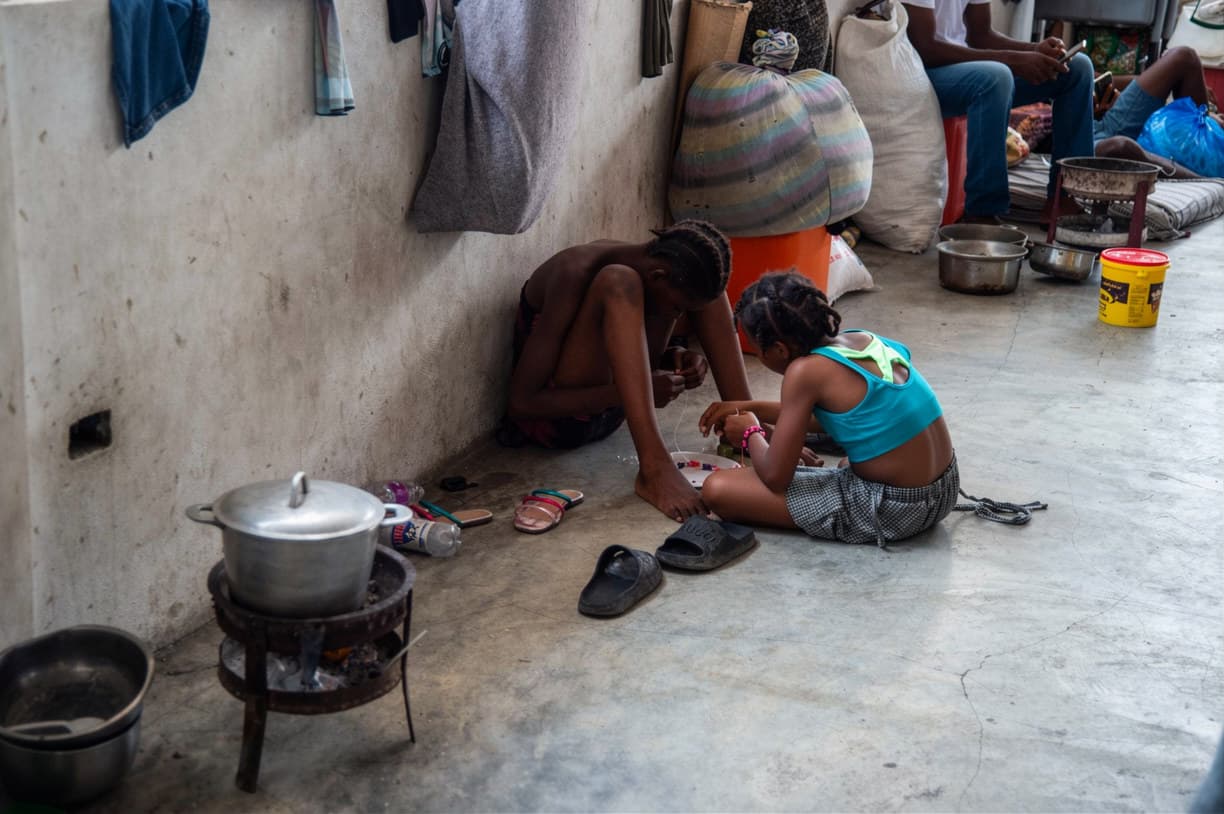
On the occasion of World Food Day, celebrated on October 16, displaced people in Haiti struggle to feed themselves. At the National School of the Republic of Ecuador, in Delmas 41, and at the Ministry of Public Works, Transport and Communications (MTPTC) premises in Delmas 33, people who fled armed violence live in precarious conditions. The lack of food, drinking water, and adequate shelter complicates their daily lives, while 5.83 million people experienced acute food insecurity between March and June 2026.<\/i><\/p>
It's barely 9 a.m. Under the scorching sun of Port-au-Prince, Marthe, 32, hangs a small black and white dress on a clothesline in the courtyard of the National School of the Republic of Ecuador, transformed into a shelter for displaced families. Despite the stifling heat, the occupants try to continue their daily activities, while meeting their most basic needs remains difficult.<\/p>
Having fled from Solino, Delmas 24, Christ-Roi, Nazon, and Carrefour de l'aéroport, these families escaped attacks from armed groups. Many sleep on the ground and lack drinking water and food. For parents, finding something to feed their children is a daily concern.<\/p>
“Many of us live here, but the aid is not enough for everyone. There are days when we have nothing to eat and we don't know how we will manage. We wait for distributions, but we can't count on them every day,” Marthe testifies.<\/p>
Junior says he feels relatively safe in the camp. However, this protection is not enough as long as residents cannot return to their neighborhoods. “Here, I am not living. Instead of distributing hot meals in the displacement camps, I would suggest that the authorities do their best to restore security. That is what matters to us,” he asserts.<\/p>
The uncertainty surrounding distributions further complicates families’ daily lives. According to people interviewed, meals are not always distributed at predictable times, and the available quantities do not systematically meet needs. “We don’t always know when meals will be distributed or if there will be enough for everyone. We have to wait, hoping to receive something. Meanwhile, the children are hungry and we don’t know what to give them,” laments Junior.<\/p>
At the MTPTC, hunger adds to poor living conditions<\/strong><\/p> In the courtyard of the MTPTC, in Delmas 33, families try to shelter under makeshift tents. Pieces of fabric spread on the ground serve as bedding, while rain seeps into some shelters. “We don’t have food, we sleep poorly when it rains,” explains a displaced man.<\/p> Beyond the lack of food, access to drinking water and sanitary facilities remains difficult. In the face of these conditions, displaced people are calling for assistance to improve their daily lives.<\/p> Another person, who prefers to remain anonymous, denounces the challenges of accessing public toilets. “There are public toilets, but we can’t use them because people force us to pay to access them,” she explains.<\/p> On site, dozens of people seek our attention to testify to their difficulties. The same problems recur in their accounts: lack of food, limited access to drinking water, and unsanitary conditions.<\/p> Even when a hot meal is distributed, families do not always manage to meet their food needs for the day. “We are grateful when we receive a hot dish, but one meal is not enough for a whole day. We need to eat regularly. Without an income and without the possibility of returning home, it becomes difficult to find enough to feed the family,” explains another displaced person.<\/p> Meals distributed, but questions about their distribution<\/strong><\/p> The Economic and Social Assistance Fund (FAES) is intervening with displaced persons through the Kantin Mobil<\/i> program. On October 2, the institution announced the preparation of 8,625 hot meals, consisting mainly of rice accompanied by stew, for displaced persons from the Plaine du Cul-de-Sac. It had already announced the preparation of 8,000 meals in this same area in early September.<\/p> The FAES also reported on the operation of community restaurants, particularly in Nazon and Impasse Chamo, as well as distribution points in Athletic d'Haiti, in Cité Soleil.<\/p> However, people interviewed at both housing sites denounce the insufficiency of meals and question the distribution of assistance. Some claim that individuals not living in the camps also benefit from the distributions, while the available quantities do not always suffice for internally displaced persons.<\/p> Food insecurity affects 5.8 million Haitians<\/strong><\/p> According to data from the Integrated Food Security Classification (IPC), reported by the World Food Programme (WFP), about 5.8 million Haitians, or 52% of the analyzed population, faced acute food insecurity at Phase 3 or higher between March and June 2026. Among them, more than 1.8 million were in an emergency phase, corresponding to Level 4 of the IPC. These people faced severe difficulties in meeting their essential food needs.<\/p> On the occasion of World Food Day, celebrated this year under the theme “Innovate Today to Feed Tomorrow,” the Institute of Technology and Animation (ITECA) warns about the consequences of armed violence for food supply. According to the organization, attacks disrupt movement, markets, and transport of goods while undermining agricultural activities. In a message published on social media, it calls on authorities, partners, and peasant organizations to support producers, protect populations, and facilitate humanitarian access to food.<\/p> In makeshift camps, displaced families continue to rely on aid to feed themselves. Between irregular distributions, lack of drinking water, and precarious shelters, their daily lives remain marked by numerous difficulties. As long as they cannot return home or regain means of livelihood, access to regular food will always remain a challenge.<\/p>




Commentaires
Aucun commentaire pour le moment. Soyez le premier à réagir.