
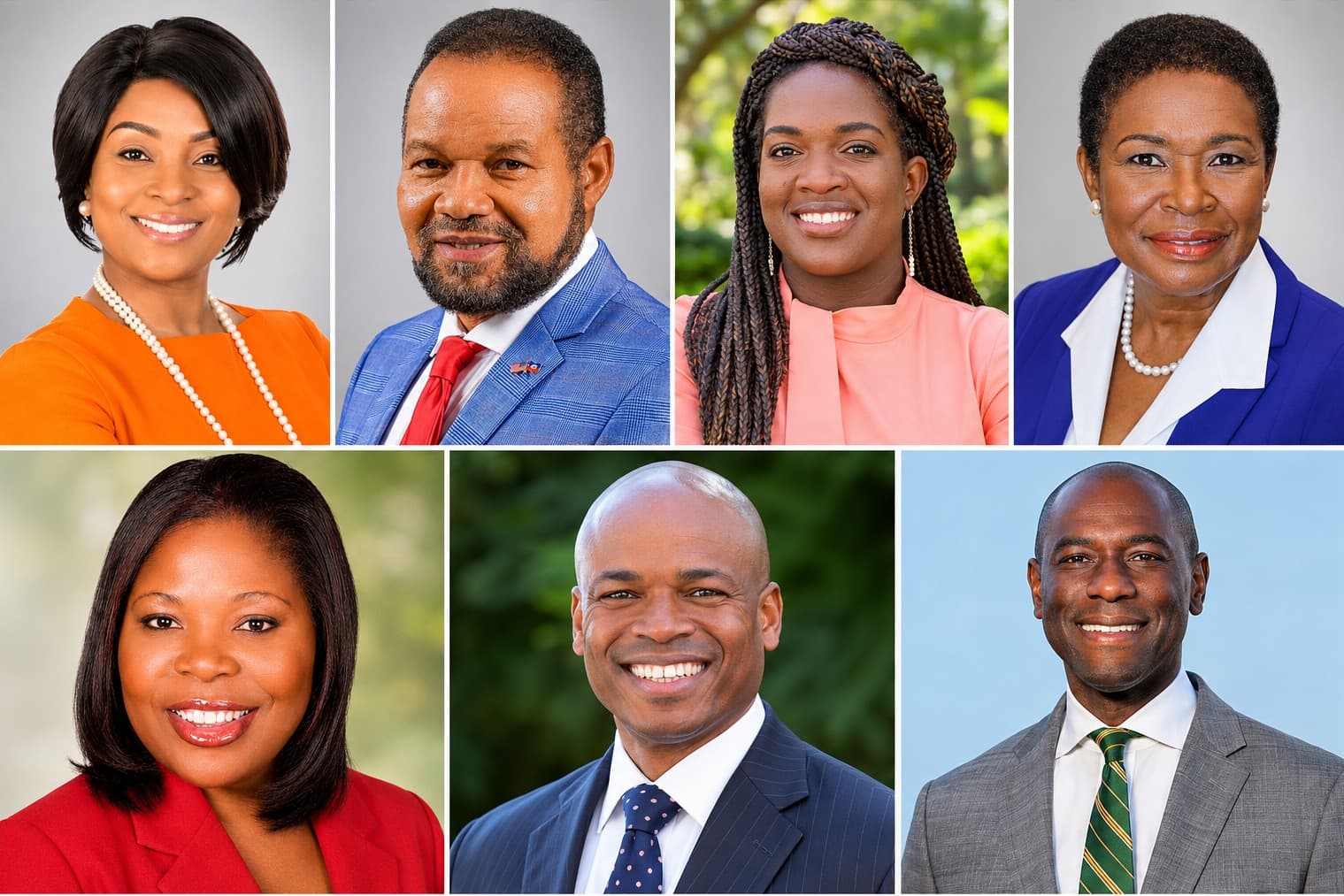
A total of seven Haitian-Americans, two school board members, four state legislators, and one mayor, born in Port-au-Prince, Cap-Haïtien, or Port-de-Paix, will sit in Florida institutions following the midterm election cycle of November 3, 2026. This is a first for the Miami-Dade and Palm Beach school boards.<\/i><\/p>
They are Berny Jacques, Mack Bernard, Daphne Campbell, Marie Woodson, Christina Romelus, Samson Borgelin, and Linda Cothiere. All were born in Haiti. All won or retained a public office in Florida following the 2026 election cycle. Indeed, six of these elected officials were declared winners after the vote on November 3. Marie Woodson, on the other hand, had no opponent and was re-elected automatically.<\/p>
This information comes from results reported by the local press and, for Marie Woodson, from the official state candidacy registry. A publication from the Instagram account CDM Caribbean, consulted by our editorial team, compiled these seven names.<\/p>
At the School Board, a Double First<\/strong><\/p> The novelty comes from the school boards. Linda Cothiere, originally from Cap-Haïtien, defeated Katrina Wilson in district 1 of the Miami-Dade school board. WLRN and Florida Politics confirm her victory, with about 51.6% of the votes according to available results. According to Le Floridien, no person of Haitian origin had yet been elected to this body.<\/p> A similar scenario unfolded in Palm Beach. Christina Romelus, born in Port-au-Prince, triumphed over Daniel Zapata for the district 4 seat. Florida Politics confirms her victory. According to Le Floridien, the former municipal official of Boynton Beach becomes the first Haitian-American to sit on the county school board.<\/p> These school boards are not symbolic bodies. They are where public school budgets are voted on and major directions are decided. The two elected officials will be accountable to families of all origins, not just to the Haitian community. Newspapers emphasized that they will be judged on concrete results: learning conditions and resources allocated to education.<\/p> In the Florida Parliament, Four Seats<\/strong><\/p> Le Floridien reports three other victories in the State Parliament. Senator Mack Bernard retains his seat in district 24 with 64.51% of the votes. In the House of Representatives, Berny Jacques is re-elected in district 59 with 53.54%. Both men were born in Port-au-Prince. Daphne Campbell, a native of Cap-Haïtien, makes her return to the House. She wins district 108 with 80.88%, the largest margin in the group.<\/p> As for Marie Paule Woodson, the incumbent Democratic candidate without opposition in district 105, according to her official biography, she was born in Port-de-Paix and moved to Florida in 1981.<\/p> North Lauderdale Keeps Its Mayor<\/strong><\/p> At the municipal level, Samson Borgelin is re-elected as the head of North Lauderdale with 57.75% of the votes, Le Floridien reports. This mayor, born in Haiti, retains a position that places him closest to the daily lives of his constituents.<\/p> Overall, none of these seven mandates are played out in Washington. They are municipal, school, and legislative institutions in Florida, not federal Congress. These elected officials also do not come from the same political party. Berny Jacques is a Republican, while Mack Bernard, Daphne Campbell, and Marie Woodson are Democrats. As for the school elections, they are nonpartisan.<\/p> However, the differences do not stop at political affiliation. Arriving legally in Florida with his family in 1994, Berny Jacques advocates a hardline stance on immigration. In January 2026, he submitted bill HB 1307 on "unauthorized immigrants" to the House. The measure included provisions for commercial driver's license exams to be conducted only in English, criminal penalties against employers who hire many undocumented workers, restrictions on remittances abroad, and the elimination of certain aids for individuals without legal status.<\/p> "Florida must protect those who arrive legally and eliminate incentives for others," he stated, according to L’Union Suite.<\/p> In committee, a Democratic legislator asked him if immigrants deprived of their TPS would also lose their benefits. He replied affirmatively: "Once they are no longer authorized, nothing holds," reported Florida Phoenix. The question is not abstract for the diaspora, as Haitian TPS has been the subject of a judicial and political battle throughout the year. The bill did not specifically target Haitians. However, its critics believed it would penalize mixed-status families, which are numerous in the Haitian-American community of South Florida. HB 1307 was passed by the Commerce committee on February 10, then died in the State Affairs committee on March 13, 2026, according to the House's website.<\/p> Patrick Saint-Pré<\/i><\/p> Combined Sources<\/i><\/p>



Commentaires
Aucun commentaire pour le moment. Soyez le premier à réagir.