
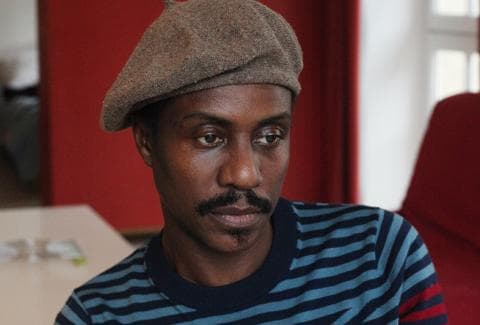
Under the direction of Guy Régis Jr, "My Standing Cities" is among the theatrical creations scheduled for the 23rd 4 Paths festival, running from November 23 to December 5, 2026. This creation explores social and human realities and the construction of our cities. With the text from the SIR Collective, contributions from Frankétienne, and visual creation by Maksaens Denis, this play provides a channel for youth facing violence, poverty, and injustice, while highlighting human dignity and the strength of solidarity.<\/p>
Cities tell stories that the facades of buildings do not always reveal. Behind every movement in the streets, the crowd flowing and the noise of everyday life, there is a fragile life under the weight of inequality, dreams wasted in a community seeking other possibilities to cross into tomorrow. It is in this complex space, marked by wounds yet full of potential, that "My Standing Cities" finds its place. It is a spectacle that uses poetry and theater to help us understand the contemporary world.<\/p>
This creation does not limit the city to a mere backdrop. It delves into the depths of social tensions, wounds, and the resilience that exists within the cities. It is particularly interested in the lives of youth confronting insecurity, violence, poverty, and political uncertainty, without reducing them solely to the difficulties they are experiencing. Their stories are the stories of women and men who can imagine other possibilities, preserve their dignity, and invent other ways to live together.<\/p>
A multiple voice to tell the realities of cities<\/p>
One of the greatest riches of "My Standing Cities" is the diversity of writings that form the dramatic universe. The text from the SIR Collective, where Nichanda Préval, Manah-Issa Pierre, Esodora Keats André, Sendy Neika Simillien, and Ricardo Boucher contribute their perspectives, brings forth various sensitivities on the issues affecting urban societies. Frankétienne's contribution, one of the great figures in Haitian literature, enriches this literary material with a poetic and visual dimension that brings its own uniqueness.<\/p>
This plurality of voices allows the spectacle to present the city as a collective experience, without erasing what is special in each person's life. The texts provide space for those who are often sidelined in grand social discourses to speak up. They raise questions about the conditions in which people live, the possibilities they have to build their future, and the roles they can occupy in society.<\/p>
They do not use violence, poverty, and political tension merely as secondary themes. The use of these terms reveals the shortcomings of a social environment where access to opportunities, security, and recognition are not equally distributed. When the spectacle gives these realities an artistic form, it invites us to move beyond mere observation to reflect on our collective responsibilities.<\/p>
Guy Régis Jr: a director who turns voice into words, words into voice.<\/p>
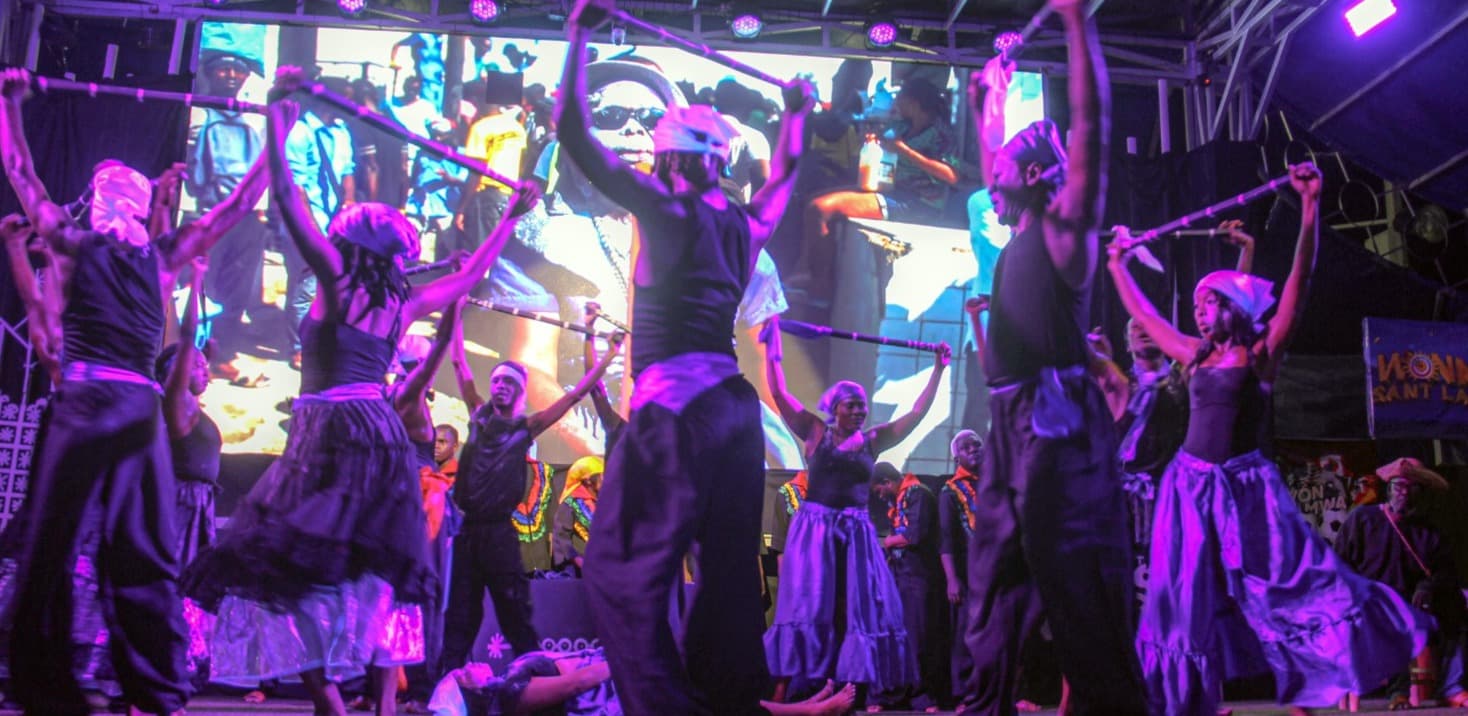
The direction by Guy Régis Jr focuses on a tight dialogue between words, bodies, and the public. The performers, positioned facing the audience, form a living choir where individual voices respond to one another and take on a collective dimension, allowing words to find their place in the listening ears.<\/p>
This arrangement gives the texts a special sonority. A personal voice can become a reflection of an experience many people share; a problem that concerns one person can reveal an issue that affects an entire community. Thus, the stage becomes a meeting space between personal stories and questions that concern the whole society.<\/p>
The proximity to the audience reinforces this approach. The moments of interaction, when they enter into the performance, diminish the traditional distance that separates the stage from the audience. Spectators are invited to engage in a reflection that does not remain confined within the limits of the spectacle.<\/p>
This direct relationship gives the representation a civic dimension. It raises questions about our place in society and our ability to recognize the realities of those living experiences that too often remain invisible.<\/p>
Frankétienne and Maksaens Denis: a dialogue between words and images<\/p>
In "My Standing Cities," the visual universe is intertwined with the narrative. Maksaens Denis's video projections engage in dialogue with the texts and performances. They weave together in a long-lasting harmony. They open a space where images extend the words and invite us to discover other meanings within them.<\/p>
Frankétienne's poetic imagery brings another dimension to the construction of the scene. The writing is not limited to what is merely spoken: it finds an extension in the form, texture, and atmosphere of the projected images. This encounter between literature and audiovisual creation enriches how the audience receives the subjects addressed in the spectacle.<\/p>
The images are not merely used to illustrate the texts. They contribute to creating an atmosphere, stirring emotions, and making certain tensions more visible, especially when words alone are not sufficient to express them. Together with the performers' work and the lighting, these elements create an immersive experience that engages both the eyes and ears of the spectators.<\/p>
This approach reflects a vision of theater where multiple artistic disciplines collaborate to renew the ways of storytelling. The stage becomes a creation space where poetry, images, and performances engage in dialogue.<\/p>
Youth amid fragility and aspiration<\/p>
At the heart of the spectacle is a fundamental question about the place of youth in environments marked by instability. When poverty, violence, and lack of opportunities reduce their possibilities, young people are forced to confront constraints that weigh on both their present and future.<\/p>
However, "My Standing Cities" does not present youth solely through the difficulties they face. It highlights their capacity to invent, their aspirations, and the ways they continue to maintain solidarity in difficult circumstances.<\/p>
This perspective invites us to consider human dignity not as a mere abstract concept, but as a social requirement. It calls for living conditions that enable every person to learn, create, participate in collective life, and prepare their future.<\/p>
Solidarity and the ability to place ourselves in others' shoes thus emerge as essential elements for building a more just society. It is not enough to admire the courage of those facing difficulties; we must also reflect on ways to lessen the inequalities that keep them in fragile situations.<\/p>
Thus, the spectacle reminds us that it is impossible to understand the realities of cities without considering the relationships between people, the politics that organize collective life, and the opportunities that society offers new generations.<\/p>
Theater as a space of awareness<\/p>
With this creation, theater transcends its entertainment function to become a space for social observation and reflection. It allows words to circulate, different perspectives to confront one another, and the audience to reflect on the mechanisms shaping life in cities.<\/p>
"My Standing Cities" does not claim to offer immediate solutions to all the crises it addresses. Its contribution lies primarily in its ability to make certain realities more visible and create conditions for a better quality of listening. By bringing together various writings, a choral staging, and an audiovisual proposal with its own identity, the spectacle gives social concerns a form that one can feel and understand.<\/p>
In a society where economic and political emergencies occupy much space, artistic creation remains an indispensable space of freedom and imagination. It allows us to question what we have taken for granted, to change the way we perceive reality, and to imagine other ways of living together.<\/p>
Art does not replace public policy or the necessary institutional transformations. However, it can contribute to facilitating the debate, enhancing mutual understanding, and reminding us that reflections on the city must place people at the center of their concerns.<\/p>
An invitation to reflect on the city in a different way<\/p>
The title "My Standing Cities" conveys a vision that is not limited to the social fractures of cities. It makes us think about the possibilities of rebuilding connections between people, valuing cultural resources, and creating new futures from the experiences people live.<\/p>
A city is not defined solely by its buildings, infrastructure, or economic activities. It also takes shape in the relationships that exist among the people living within it, in the shared spaces they create, and in the place it offers each person.<\/p>
With "My Standing Cities," poetry becomes a lens through which we can see the city differently: not only through the crises it is undergoing, but also through the aspirations of those living within it, their creativity, and their desire to build another way.

Commentaires
Aucun commentaire pour le moment. Soyez le premier à réagir.