
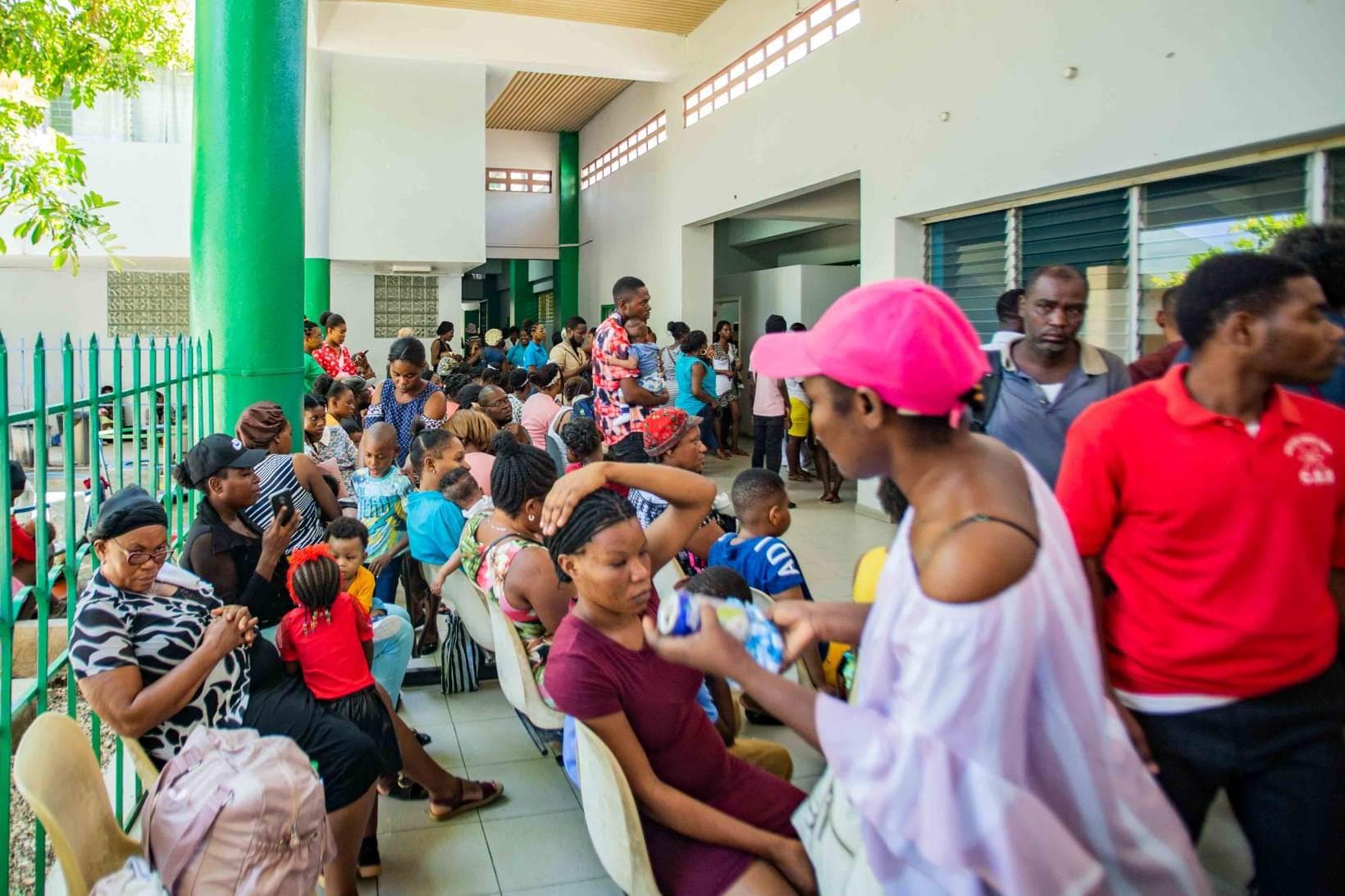
In Port-au-Prince, accessing medical care can sometimes feel like a real obstacle course. In public hospitals, a consultation costs about 100 gourdes, compared to 1,500 to 5,000 gourdes in certain private facilities. However, the cost of care is not the only barrier. Long waiting lines, the closure of several establishments, and the lack of resources in the still-functional hospitals further complicate the care of patients.<\/i><\/p>
Since Monday, this woman has been going to the La Paix University Hospital (HUP), hoping to see a doctor. Although she has already paid the consultation fees, she is still waiting to be seen. "I came here since Monday, I paid the medical fees but I still can't get examined. Starting at 11 o'clock, they send you home for the next day," she testifies.<\/p>
Due to financial constraints, she cannot consider a consultation at a private clinic. Therefore, she must continue going to this public hospital, despite the trips and days of waiting. Her case illustrates a difficulty faced by many patients: even after paying the required fees, obtaining a consultation can take several days.<\/p>
Prices that vary widely from one establishment to another<\/strong><\/p> The price of a medical consultation largely depends on the type of facility visited. In public hospitals, the fees can be around 100 gourdes, while some private clinics and health institutions charge between 1,500 and 3,500 gourdes. A significant gap for families with limited incomes.<\/p> In addition to these fees, costs related to medications, medical exams, and transportation often add up. The bill can thus quickly increase, well beyond the amount initially expected by the patient.<\/p> Julio experienced this when he fell ill. In less than a week, he claims to have spent more than 25,000 gourdes, or about 200 US dollars, on clinic consultations, medical exams, and purchasing medications. An important sum for a household that must also cover its daily expenses.<\/p> This situation is particularly concerning in a country where a significant portion of the population lives in extreme poverty. According to data from the World Bank and the United Nations Development Programme (UNDP), approximately 2.5 million people in Haiti live on less than $1.23, or about 160 gourdes per day. For these families, financing a consultation, buying medications, and paying for medical exams represents a heavy burden.<\/p> Community health centers also offer care options in certain areas. However, their services, prices, and capacities vary from one facility to another. While public hospitals are generally more financially accessible, the waiting times sometimes limit their ability to meet patients' needs.<\/p> Hospitals facing increasing patient flows<\/strong><\/p> In the metropolitan area, armed violence has further weakened the healthcare provision. Several health facilities have closed their doors or reduced their activities. Others continue to operate with limited resources. This situation concentrates a large portion of demand in the facilities that remain operational.<\/p> Located respectively in Delmas and Pétion-Ville, La Paix University Hospital and Eliazard Germain Hospital continue to receive patients despite the challenges in the healthcare sector. However, the number of patients showing up each day puts their services to the test. At HUP, the accommodation capacity is notably exceeded. "The hospital is currently saturated in terms of bed occupancy, with enormous needs," confides a source from the establishment.<\/p> Every day, dozens of people come to the hospital seeking care. Access to the facility is open to all, but medical staff organizes triage to determine which 50 patients can be treated. Those whose condition is not urgent are invited to return another day.<\/p> The closure of several hospitals, particularly the State University of Haiti Hospital (HUEH), has also contributed to this situation. This major hospital-university center in the country is still struggling to be relocated. Its absence shifts part of the demand to other establishments, already dealing with operational difficulties.<\/p> The hospitals that remain open must thus accommodate more patients without necessarily having the staff, equipment, and infrastructure needed. For the sick, the consequences are concrete: consultations postponed, long waits, and difficulties in obtaining the required care.<\/p> Medical staff facing a lack of resources<\/strong><\/p> In these conditions, healthcare professionals try to meet patients' needs with often insufficient means. Doctors, nurses, and other medical staff must cope with a lack of materials, supply difficulties, and a high demand for services.<\/p> When the number of patients exceeds the capacity, teams must set priorities. Some patients return several consecutive days before being able to see a doctor. Others are forced to seek another facility, not always having the means to pay the prices set in the private sector.<\/p> This pressure on healthcare institutions also complicates the work of medical staff, who must ensure patient care within a context marked by material and organizational constraints.<\/p> Getting treatment, a difficult burden for families<\/strong><\/p> Between public hospitals, private clinics, and community centers, care options remain unevenly accessible. Public facilities offer more affordable prices, but their capacities do not always suffice to meet demand. In the private sector, consultations are generally more expensive and remain out of reach for many households.<\/p> Insecurity further complicates the patients' journey. In several neighborhoods, travel to hospitals has become difficult. Some postpone their consultations or give up medical exams due to a lack of means or transport options.<\/p> The testimony of this woman met at HUP summarizes the difficulties faced by some patients. Despite paying the consultation fees, she is still waiting to see a doctor.<\/p> In Haiti, accessing care thus depends not only on the price of a consultation. It is also necessary to find a functional facility, be able to travel there, and have the time needed to be seen. For many families, illness thus becomes a double ordeal: facing health issues and finding the necessary resources to obtain care.<\/p>


Commentaires
Aucun commentaire pour le moment. Soyez le premier à réagir.