
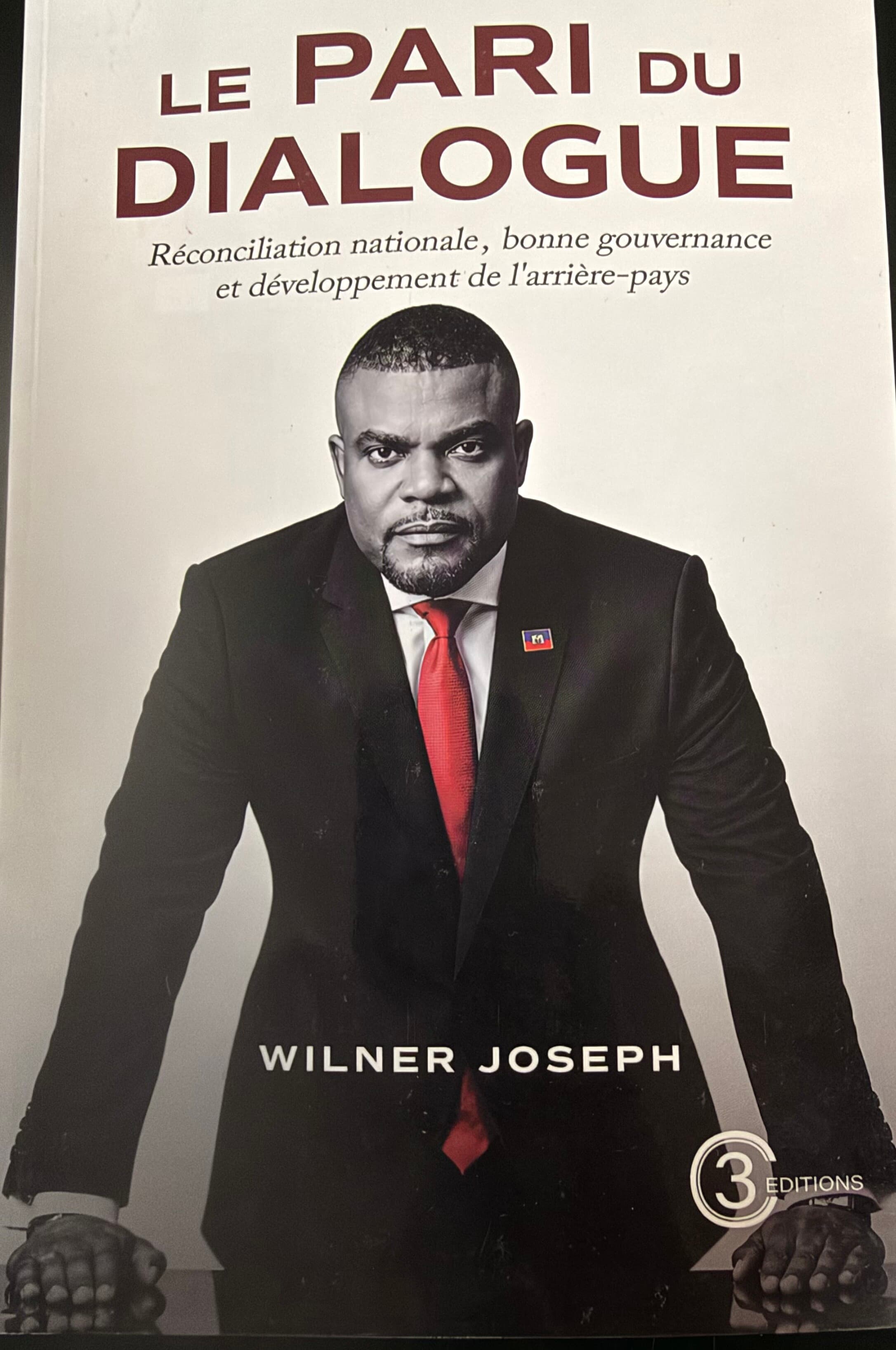
Presidential candidate under the VIKTWA banner, Wilner Joseph presents his book "The Bet of Dialogue." He advances three reasons to read it and advocates for konbit, mutual aid among farmers, as a model for a politics of dialogue. The book signing event is scheduled for November 18 at the Montana hotel.<\/i><\/p>
In a two-minute and 42-second video presenting his work, the author begins with an observation: as citizens, Haitians form a single nation. They share the same territory and have the same aspirations. "Yet, we spend our time tearing each other apart," he laments, to the point of compromising our own future. It is for this reason that he invites the public, particularly young people and teachers, to read his book.<\/p>
The author puts forward three reasons to read his book. The first is a duty of truth. Wilner Joseph speaks of a duty to the Haitian people: to explain who they are, where they come from, what they carry in their "djakout," and what vision they defend. The preface clarifies the approach. Selected on September 10, 2026, he states that he did not want a campaign book in the usual sense, but a book "where one can verify." Each piece of data presented is accompanied by its source, and the author mentions addressing topics that might trouble him, including conflicts of interest faced by any entrepreneur engaged in politics.<\/p>
The second reason is to show that politics can be practiced differently. He cites as proof the choice of his preface writer, Jacky Lumarque, rector of Quisqueya University, who is also aspiring to the presidency. Wilner Joseph views this as an example of reconciliation to offer young people in a country long marked by a deficit of tolerance and mutual respect. "One can be a competitor without being an enemy," he states in the video. The preface writer himself notes the "unusual" nature of the request. He clarifies that writing a preface to a book is "neither subscribing to a program nor forming an alliance."<\/p>
The third reason is to reflect on the consequences of division. The author mentions the divides inherited from 1804: the ones from above and those from below, the rich and the poor, the city and the countryside. For 222 years, he says, the country has remained stagnant on these fractures, and what they have produced is what he sees today. Dialogue is, according to him, "the only option" for building Haiti tomorrow.<\/p>
The konbit, from field to political project<\/strong><\/p> The preface opens with a rural scene. When a field is too vast for a single family, neighbors are called. They come with their hoes, someone brings a drum, a woman prepares the meal, and the plot is cultivated in one day rather than one season. The next day, they go to another's field. The elders summarize: men anpil, chay pa lou, with many hands, the burden is not heavy, he explains.<\/p> Everyone, the author reminds us, remains attached to their land, to their boundary disputes, to their preferences. But during work time, everyone moves forward together. Born in the hills of Léogâne, where the konbit is still practiced, Wilner Joseph says he thinks of it every time he is asked what he means by national reconciliation. The image, he writes, conveys better than many treaties what a politics of dialogue could look like in a country worn down by its divisions.<\/p> He also highlights its limits. A konbit only works if everyone knows why they are there, what they will receive in return, and who will ensure that the promise made is kept. "Dialogue cannot remain a slogan. It must be proven by concrete actions that demonstrate a real willingness," he insisted in the video.<\/p> A dialogue that the reader must experience<\/strong><\/p> Jacky Lumarque's preface clearly outlines the stakes. The word "dialogue" has been used so often since 1986, and so often contradicted, that the author knows it raises suspicion. He therefore defends it as a method, not as a virtue: a dialogue that leads to decisions accompanied by accountable individuals, resources, timelines, and public follow-up. The book distinguishes what can be negotiated, such as the timeline and modalities of reforms, from what cannot be, namely the application of the law.<\/p> The preface writer also highlights the questions the book leaves open. How to finance such a vast program with a State that collects so little? In what order to act when part of the territory escapes public authority? Who will prevent dialogue from being captured by those it brings together? The book proposes avenues, local assemblies, departmental roadmaps, contracts between the State and the territories, but does not claim that they have already proven successful. Jacky Lumarque invites readers to differentiate the reasoned diagnosis from the results that remain to be demonstrated.<\/p>




Commentaires
Aucun commentaire pour le moment. Soyez le premier à réagir.