Effectiveness could be considered as the ability to produce the maximum results with the minimum efforts and resources. In the field of public policies, it denotes the degree to which the set objectives are achieved, regardless of the cost of the resources mobilized. According to the ISO 9000:2015 standard, it is the "level of achievement of planned activities and obtaining expected results." A policy is thus considered effective when it produces the effects for which it was designed.
In Haiti, the notion of effectiveness remains largely theoretical. As the state struggles to fulfill its sovereign missions (security, education, health), the question arises: who truly measures the effectiveness of public action? Is there a national body tasked with systematically evaluating policies and institutions? Do control structures actually exist with the capacity for action?
This article offers a reflection on this subject and is part of a civic and intellectual approach aimed at understanding how effectiveness is (or isn't) measured in Haiti, and to formulate ideas for an administration more focused on results.
From control institutions to limited results
The Haitian state formally has structures responsible for controlling public action. However, their impact remains weak, if not nearly invisible.
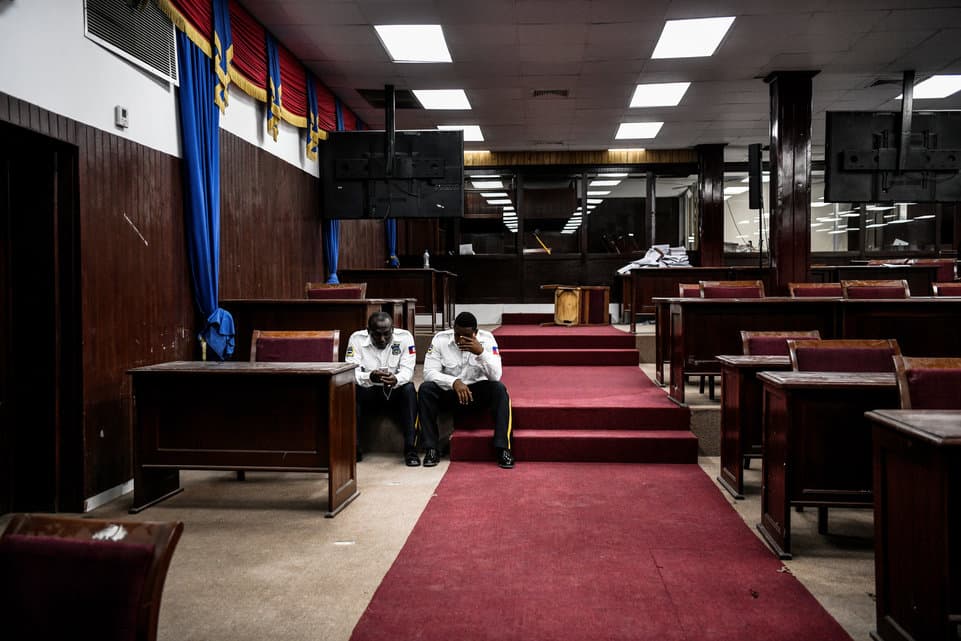
The Parliament is, in principle, the primary body controlling the executive. However, since January 13, 2020, under the presidency of Jovenel Moïse, it has been dysfunctional. Since that date, the actions of the government have escaped any effective parliamentary oversight. The absence of legislative counterpower already constitutes a major flaw in the accountability system.
The Court of Auditors and Administrative Disputes (CSCCA) has a threefold mission: jurisdictional, consultative, and administrative control. It is the latter that should assess the quality of public management. In practice, the CSCCA mostly conducts financial audits and regularity checks a posteriori. It does not carry out impact assessments or methodological meta-evaluations that could shed light on the real effectiveness of public policies.
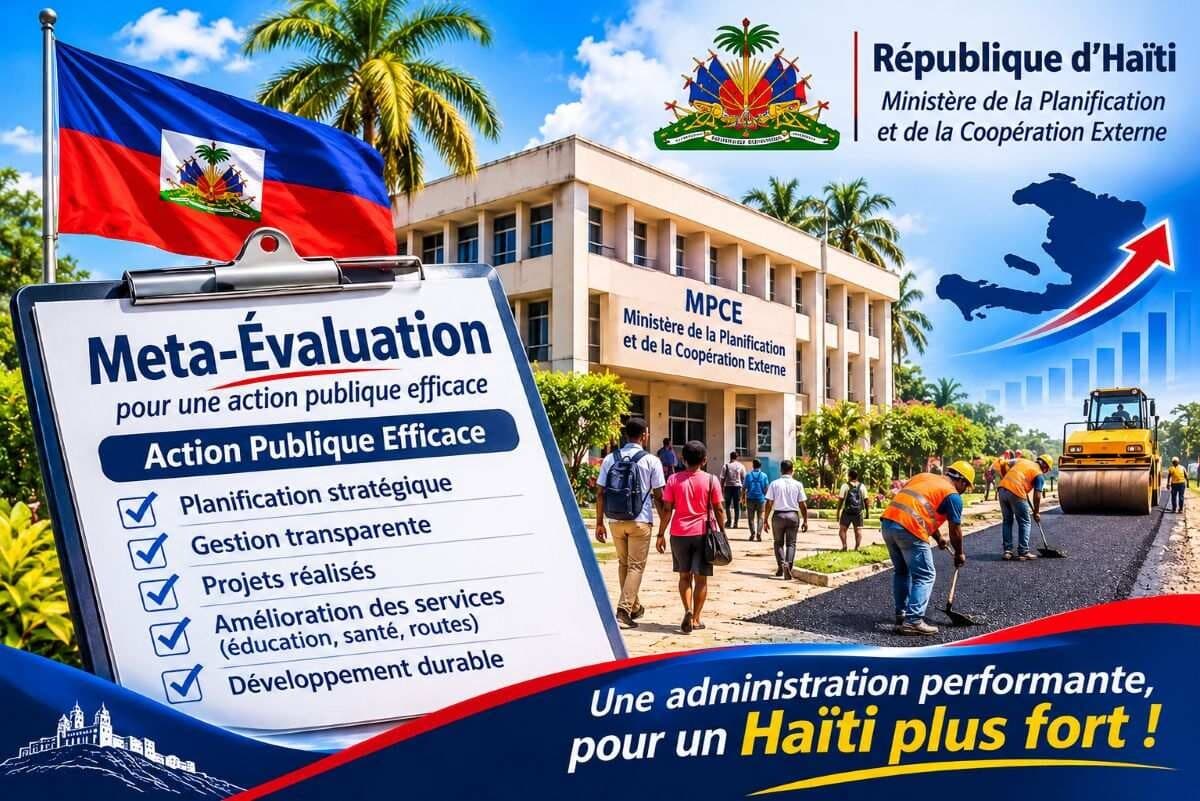
The Ministry of Planning and External Cooperation (MPCE) has a strategic mandate regarding planning, coordination, monitoring, and evaluation of development. In practice, it oversees some project evaluation processes but lacks a unified reference framework, standard methodology, or clearly defined criteria. (Borgella, 2024). Its actual capacity to steer public performance, measured against citizen satisfaction, remains limited.
The Office of Management and Human Resources (OMRH), under the authority of the Prime Minister, aims to lead and coordinate government action regarding the organization, functioning, performance, and efficiency of the administration and public service. Theoretically, it could establish a performance logic within the state apparatus. In practice, no clear system or precise methodological elements have been put in place to systematically evaluate the effectiveness of institutions.
The Ministry of Economy and Finance (MEF) is involved in the evaluation of certain major projects in connection with technical and financial partners. But it also lacks a unit or directorate dedicated to evaluating public policies.
An evaluative culture still absent
To measure effectiveness, evaluation is necessary. However, evaluation remains poorly institutionalized in Haiti. It is often perceived as a constraint imposed by donors rather than a governance tool (Khenniche and Henriot, 2021). Several studies highlight that, in countries like Haiti, the evaluative culture is still in its infancy (Dahler-Larsen and Boodhoo, 2019). The few evaluations conducted primarily focus on financial and compliance aspects, to the detriment of impact analysis.
As Barbier and Matyjasik (2010) remind us, political will is crucial to establish evaluation sustainably within public administration. However, this will is lacking. Legally, there is neither a framework law nor a general decree regulating public policy evaluation. Only the framework decree on environmental management of January 26, 2006, created the National Office of Environmental Evaluations (BNEE), without this experience being generalized.
In this vacuum, it is mainly international donors (World Bank, IMF, UNDP, USAID, AFD) that fulfill the role of evaluators. They define the indicators, fund evaluations, and publish reports on aid effectiveness. This external control creates a paradox: effectiveness is measured to meet the funders' requirements, not to guide national public policy in service of Haitian citizens.
Civil society, the media, and some academics are trying to shed light on the debate. However, their analyses remain consultative and lack binding power over governmental decisions.
A shared diagnosis
A study by the Citizen Observatory for the Institutionalization of Democracy (OCID) from November 2021 already concluded that public policies in Haiti seem to be ineffective and that the country lacks an evaluative culture. Research and interviews conducted with administration actors confirm the same weaknesses: low technical capacity, political and institutional instability, limited access to reliable data, and absence of a national framework for steering evaluations.
Several reports, including the OECD report on governance in Haiti, have recommended establishing a formal institutional framework for managing public policy evaluations. These recommendations have remained dead letters.
For a national evaluation system
It is illusory to expect real effectiveness from public action without a credible and integrated national mechanism for monitoring and evaluation. Today, effectiveness remains fragmented, sporadic, and largely outsourced.
Like other countries, Haiti must equip itself with a national evaluation steering system, based on a unified methodology and clearly defined criteria. This requires:
- the adoption of a framework law on public policy evaluation;
- the creation of a national evaluation structure, ideally attached to the Prime Minister's office or the MPCE, endowed with resources and independence;
- the strengthening of technical capacities within the administration;
- the institutionalization of a culture of performance and accountability, focused on results for citizens rather than on mere donor satisfaction.
Without this national appropriation of evaluation, the measurement of effectiveness will remain an external exercise, disconnected from Haitian priorities. And without serious measurement of effectiveness, the improvement of public governance will remain a mere wish.
Bibliography
Barbier, Jean-Claude, and Nicolas Matyjasik. 2010. "Assessment of public policies and quantification in France: ambiguous and contradictory relationships between disciplines." French Review of Socio-Economics, no. 5 (1): 123-140. https://doi.org/10.3917/rfse.005.0123.
Borgella, Pauliana. 2024. "Institutional and organizational barriers to integrating program evaluation into the culture of public organizations in Haiti." University of Ottawa. http://hdl.handle.net/10393/45850.
Dahler-Larsen, Peter, and Adiilah Boodhoo. 2019. "Evaluation Culture and Good Governance: Is There a Link?" Evaluation 25 (3): 277-293. https://doi.org/10.1177/1356389018819110.
Khenniche, Samia, and Julien Henriot. 2021. "Steering overall performance in public organizations: An analysis through the lens of perspectives." Management & Future, no. 124 (4): 129-150. https://doi.org/10.3917/mav.124.0129.
OMRH, consulted on November 9, 2026
MEF, consulted on November 9, 2026




Commentaires
Aucun commentaire pour le moment. Soyez le premier à réagir.