Reading this morning in the columns of the daily Le Nouvelliste, the article signed by Michelson Césaire titled "Trial of Magalie Habitant and Others: Defense Requests Judge's Recusal, Case Continues," a reflection on the complexity but also the greatness of the teaching profession deeply moved me. After more than 42 years of official teaching, served uninterruptedly, one question arises in my mind: is the teacher not, in reality, one of the greatest common denominators of human society?
I specify that I speak of 42 years of official teaching because my pedagogical vocation dates back much further. From my lower secondary class II, now called sixth fundamental year, to my secondary studies at Collège Notre-Dame de Lourdes (CNDL) in Port-de-Paix, and at Nouveau Collège Bird (NCB) in Port-au-Prince, I already played the role of substitute teacher several times, both in my own classroom and in others, when some of my teachers were absent. Teaching was therefore not just my job; it had already been a vocation since my adolescence.
But what makes this profession so complex and, at the same time, so fascinating? It is precisely its universal dimension: the teacher shapes men and women destined to take different paths, defend sometimes contradictory interests, and occupy positions that can even stand in blatant opposition to the institutions of the Republic.
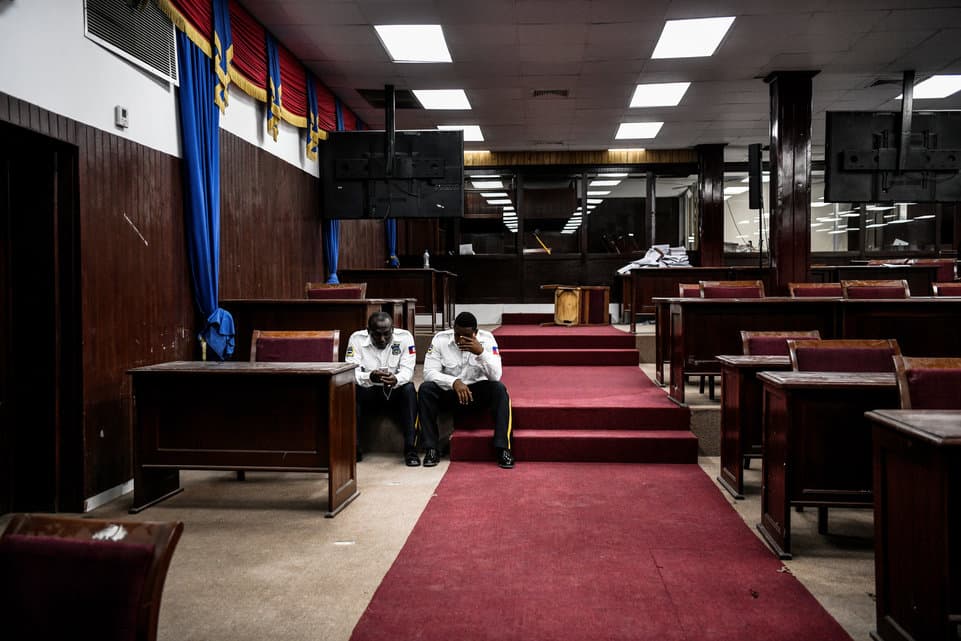
The opening, on Friday, November 13, of the trial of the former director general of the National Solid Waste Management Service (SNGRS), Magalie Habitant, the former member of parliament for Petite-Rivière de l'Artibonite, Profane Victor, and their co-defendants, before the criminal court sitting without a jury, provides a particularly striking demonstration of this.
Following this case, I was surprised, but also moved, to find several of my former students in the same judicial space, with completely different responsibilities and positions.
The presiding judge of the criminal court, Me Kléberson, is among my brightest former students from the senior class at the Institution Saint-Louis de Gonzague. One of the defense lawyers, Me Arnel Rémy, was also my student in philosophy class at that same institution. Even more surprisingly, the two main defendants, Magalie Habitant and Profane Victor, also attended my classes in first and final year at Collège Le Bachelier.
What an extraordinary paradox! A former teacher, still teaching, thus meets, in the context of the same trial, their former students: one presides over the discussions in the role of judge, another defends, while two others appear as defendants. The courtroom becomes, in a way, a place of unexpected reunions between the fruits of the same educational institution, now engaged in profoundly different roles.
This situation highlights the complexity of the teaching profession. In class, the teacher imparts knowledge, develops critical thinking, instills values, and contributes to the formation of civic consciousness. Yet, once they leave school, their students become autonomous adults responsible for their choices, actions, and orientations. Some become magistrates, lawyers, parliamentarians, political leaders, entrepreneurs, or civil servants. Others may, unfortunately, find themselves facing justice.
The teacher does not choose the fate of their students. They cannot guarantee their moral success or be held accountable for any missteps. Their role is to provide them with the intellectual and civic tools necessary to make informed choices. Individual freedom begins where the educational action of the teacher partially ends.
However, there is a fundamental lesson to be drawn from this scene: justice and education are two complementary pillars of building a responsible society. The school prepares citizens to know their rights and duties; justice ensures that no one is above the law. The judge must judge with complete independence, the lawyer must defend their client professionally, and the defendant must benefit from the presumption of innocence until their guilt is legally established.
All in all, this experience reminds me that the teacher does not work only for the present: they shape, consciously or unconsciously, the actors of tomorrow's society. They may find their former students at the heights of institutions or before the courts, in opposing functions, but always with the same memory of a shared classroom.
Such is the greatness and the vertigo of the teaching profession: one teaches all, but masters the fate of no one.


Commentaires
Aucun commentaire pour le moment. Soyez le premier à réagir.