
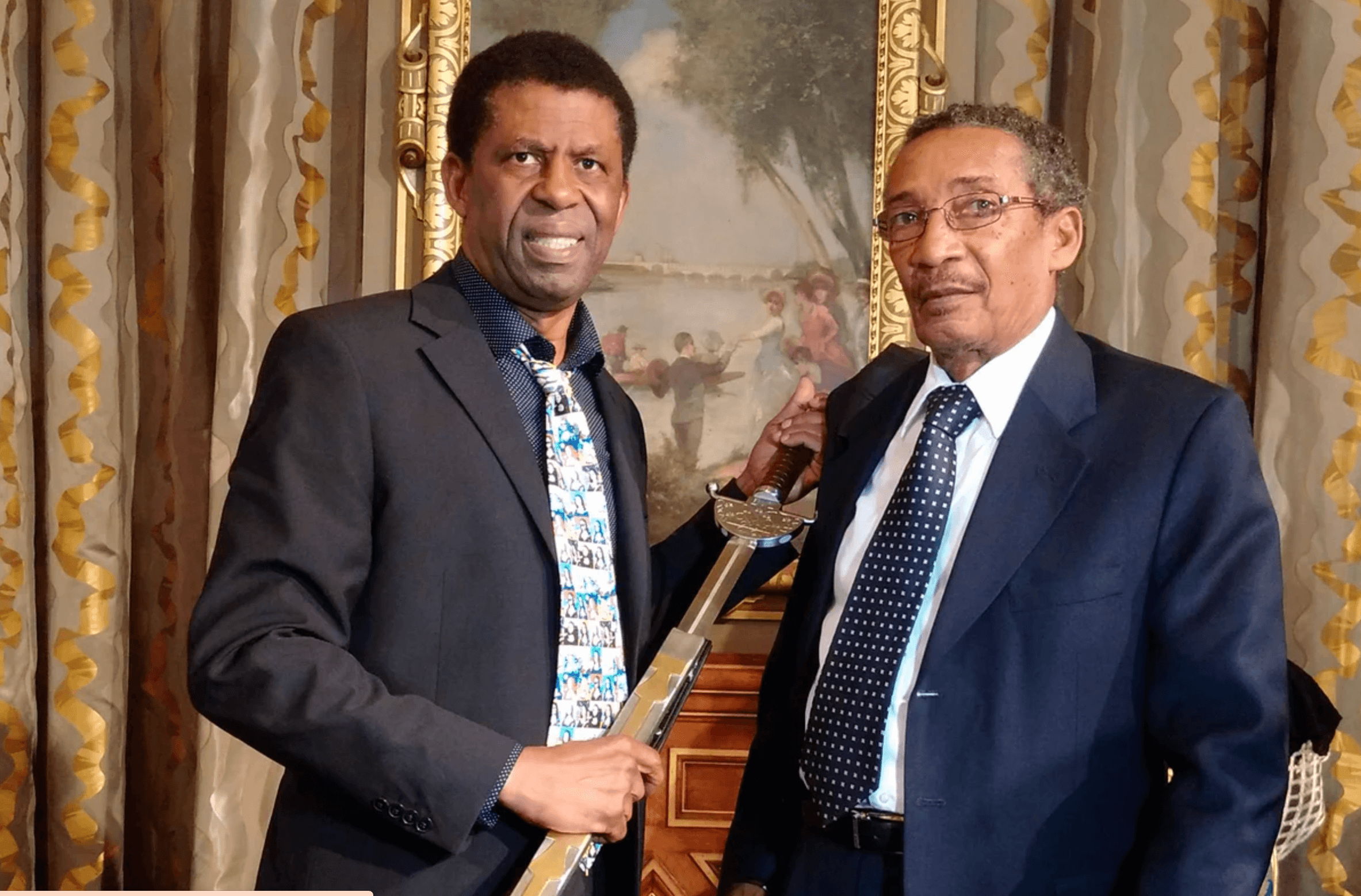
I no longer quite remember when I first crossed paths with Patrick Vilaire, perhaps at Poto Mitan with Frido, with whom he was bringing color to everyday life at the time. Or later at an exhibition, here or elsewhere, with Tiga. Vilaire-Tiga, a duo of skinny men. Those two skinny men set Port-au-Prince ablaze. When Will-o’-the-Wisp danced the tango with Quicksilver. Both moved so quickly, yet with such graceful gestures, that they themselves were the show. Tiga seemed to have already found something while Vilaire was still searching. Patrick Vilaire is curiosity incarnate. Long legs, short torso, head perched like a pin on narrow shoulders. Two marbles constantly in motion in a finely drawn face. This Vilaire takes you by the arm, even upon a first meeting, and plunges you into the heart of a problem he has been trying to solve for decades. You listen to him and discover a country you knew nothing about—the country of water, public health, heritage preservation or the transformation of waste into renewable energy. He has no tolerance for anecdotes or easy answers. His face closes like a fist as his thoughts sharpen like flint. And without warning, he changes the subject to talk about art, painting, sculpture, ceramics, Georges Liautaud or Jacques Stephen Alexis. Do not think we have moved from his social concerns to culture. It is the same thing; one feeds the other. There is no pause with Vilaire. A sprint toward a sudden stop whose form we cannot predict. He is convinced that it will all happen in Haiti. I feel no discomfort talking about death with Vilaire, or even about his own death, because death is an obsession in his work (Baron Samedi, The Gravedigger). The various representations of death—and Vodou is full of them—are a godsend for someone so curious. This curiosity makes him impatient, lively, quick, always in motion, and in a sense keeps him in childhood. All of this brings us here. Patrick Vilaire is a child over 80 years old. Is that why time seems to have no hold over him? One need only look at his smiling or grave face to know how his city is doing, or rather his country—for he extends this passion across the entire national territory. His vision, even though intellectual and nourished by metaphysical, sometimes mystical reflection, proves to be very concrete. He distrusts inspiration and favors work. Work that demands physical effort, often a hand-to-hand struggle with nature. He likes to get his hands dirty, one of the reasons he chose ceramics over painting as it is understood in Haiti. He likes to feel forms being born beneath his hands. To sweat in order to see beauty. Always involved in several projects, he moves from place to place.
The Work



Commentaires
Aucun commentaire pour le moment. Soyez le premier à réagir.