
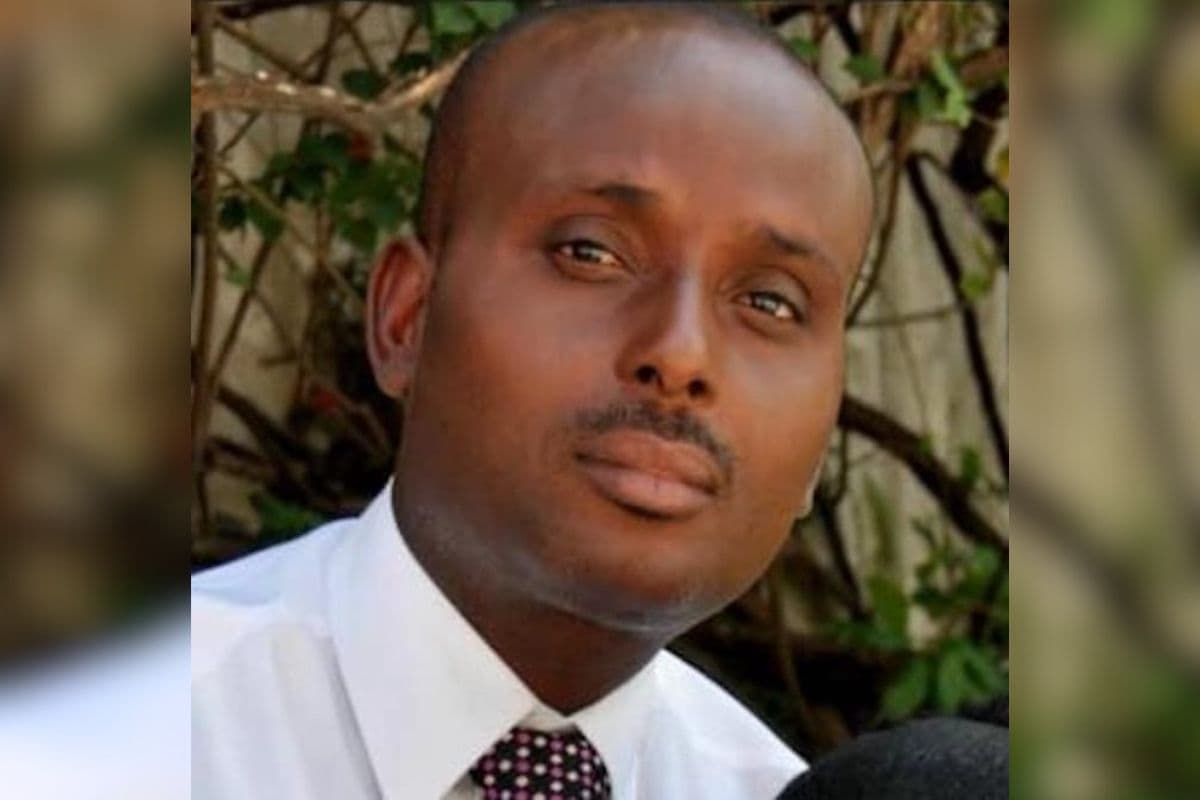
There are deaths that cannot be left to silence, lives that violence snatches away from existence without managing to erase their imprint in the collective memory. Haitian poet Georges Schultz Laurent Junior is one of those. A year after his murder in Philadelphia, as the suspect appears before the American justice system on Wednesday, October 28, 2026, Pradel Henriquez, poet, writer, and former Minister of Culture, lends his pen to pain, indignation, and hope. In this text of memory and conscience, he summons words to express the absurdity of a life cut short, a family's dreams shattered by exile and violence, but also the demand for justice that survives despair. Through his tribute, Henriquez refuses to let Schultz Laurent Junior become just another name in the long inventory of our tragedies. He reminds us that behind the murdered poet remains a man, a work, a family, and a promise of life interrupted. To write here is to remember; to remember is to resist erasure. And as long as poetry carries his name, Schultz Laurent Junior will not be completely gone.<\/strong><\/p> The alleged assassin of Haitian poet Georges Schultz Laurent Junior appears this Wednesday, October 28, 2026, before a court in Philadelphia, United States, to stand trial.<\/p> Meanwhile, a trial is underway in Florida concerning the infamous assassination of Haiti's former President, Jovenel Moïse. Indeed, President Moïse was humiliated, brought down, and, so to speak, massacred in his private residence in Pèlerin 5 on the night of July 6 to 7, 2021.<\/p> At this precise moment in the trial in Florida, unable to be present physically, we experience, through an exercise of memory or a profound thirst for justice, the painful necessity to transport our minds and hearts to Philadelphia, Pennsylvania, in search of justice for a murdered poet.<\/p> I learned this news as if I were reading a Kafka work, somewhere between The Trial<\/i> and The Metamorphosis<\/i>, or an Albert Camus novel, like The Plague<\/i> or The Stranger<\/i>.<\/p> Absurd.<\/p> Unjust.<\/p> Ridiculous. Useless. Inexplicable.<\/p> Indeed, it is before a Philadelphia court that the suspect in the case of Schultz Laurent Junior’s murder appears this Wednesday, October 28, 2026, exactly one year after the crime, which was committed on October 28, 2025.<\/p> The suspect, Scott Hilton, was reportedly identified and arrested on October 29, 2025, the day after the tragedy, while he was still in possession of the murder weapon.<\/p> He is also accused of endangering others and, of course, of the murder of our dear friend, our former collaborator and colleague.<\/p> This suspect is named Scott Hilton. Aged 48, he is an American citizen whose criminal past is said to be particularly heavy and whose record is troubling. It reportedly includes several arrests and various charges for harassment, serious threats, thefts, physical assaults, and much more.<\/p> Such cases, according to reports, would make him a suspected recidivist, with legal troubles dating back to 2011. A succession of events and misfortunes raises an essential question: how could an individual with such a background continue to circulate freely, without sufficient consideration of the potential risks to those around him?<\/p> After about fifteen years marked by a concerning reputation and conflicts with law enforcement and judicial authorities, his family and close ones may have also been aware of his presumed dangerousness.<\/p> Just as one would not release a tiger in a city as one might in a mill, one can wonder how a man with such a troubling past could find himself free, only to cross paths one early morning with that fallen angel: Georges Schultz Laurent Junior.<\/p> A dreamer and poet by nature, on that morning of October 28, 2025, Schultz Laurent Junior had, in truth, no reason to meet that assassin's gaze that would take his life and tear him away from his family forever. He also had no reason to lose his life like this, he whom his friends considered a model young man.<\/p> There are people who are exemplary at home but become thugs elsewhere; others are irreproachable in society but behave differently in their family environment. Georges Schultz Laurent Junior, far from such pretenses and double-faced personalities, was a man without a mask. A model of humanity wherever he went, wherever he passed.<\/p> Born on July 15, 1974, in Port-au-Prince, Georges Schultz Laurent Junior was a teacher of literature and citizenship education. A former collaborator of the newspapers Le Nouvelliste<\/i> and Le National<\/i>, he published several poetry collections, including:<\/p> His fifth title is Sur les traces de l’aube<\/i>. It is his rare collection of short stories, published in 2013.<\/p> Like all our wounded, hurt, torn, and daily tested generation, our poet experienced a difficult existence.<\/p> His house, spectacularly burned down in Delmas, a commune that has become particularly dangerous for several years, forced his family to take the path of exile to the United States, in search of a better life.<\/p> He ultimately left with his loved ones, his wife and very young children, to try to settle in Philadelphia. He wanted to improve his English, teach at the university, and find work to provide for his small family in a completely different environment from that of Haiti: the United States of America.<\/p> In a country where the climate remains constantly tense and worrying for families raising children, Haiti lives at the rhythm of stress, anxiety, and panic.<\/p> Our children encounter gang violence as if they were in a classroom. For a segment of our youth, criminal gangs seem to have become the only visible models of power and governance.<\/p> Let us keep our eyes wide open to what is happening to us.<\/p> No school. No cinema. No leisure. No culture. Even traversing the streets becomes a perilous adventure, as life is constantly exposed to danger. No real educational supervision for children. No adequate healthcare. No future.<\/p> In short, there is not even time left to love, to reunite, and to live with dignity, as every human being should be able to do.<\/p> Lucid in the face of this reality, the Schultz Laurent Junior couple chose to seek elsewhere, far from daily insecurity and anxiety, for a better future for their family. They had to leave to try to save what was essential: life, love, children, and hope.<\/p> And there you go, you know the story.... How did misfortune end up tracking them down?<\/p> They leave. They are forced to flee insecurity in Haiti. But it is to find themselves, this time, face to face, in the United States, with another reality. A land of dreams and opportunities, which undoubtedly makes considerable efforts to support children and offer them better prospects.<\/p> They found themselves... face to face... with death. An absurd death, a brutal death, a death without compromise.<\/p> One morning, the poet walks slowly toward his modest workplace.<\/p> A man approaches him. He does not know him and has never known him. There apparently was no altercation, no settling of scores, no fight, no confrontation. These two men do not know each other at all. Nothing suggests they had loved or hated each other.<\/p> And yet, the poet is stabbed multiple times.<\/p> He collapses, bleeding in his own blood.<\/p> Then comes death.<\/p> Beyond the suffering caused by these stabs, it is the entire memory of a world that collapses. It is a wasted life, projects that fly away like dry leaves, broken dreams, and a destroyed family.<\/p> Before the eyes of those who discover his body lying in a street in Philadelphia, an entire existence seems brutally interrupted.<\/p> In our homeland, Haiti, we would call this:<\/p> Chèche lavi.<\/p> Detwi lavi.<\/p> And the ancient Greeks would say, for their part:<\/p> To fall from Charybdis to Scylla.<\/p> In a word, death is already, in itself, a mystery.<\/p> But that of poet and cultural journalist Georges Schultz Laurent Junior is downright a bottomless pit.<\/p> An unfathomable mystery.<\/p> In the end, when American justice decides, a year later, to take over to shed light on the circumstances of this heinous crime, I sincerely hope that the family and friends of the poet can find the strength to get through this terrible ordeal.<\/p> I would like them to remember this biblical phrase that my mother taught us at home when we had to face such pain:<\/p> "The Lord has given.<\/p> The Lord has taken away.<\/p> Blessed be the name of the Lord!"<\/p> Pradel Henriquez<\/strong><\/p> October 27, 2026<\/i><\/p>




Commentaires
Aucun commentaire pour le moment. Soyez le premier à réagir.