
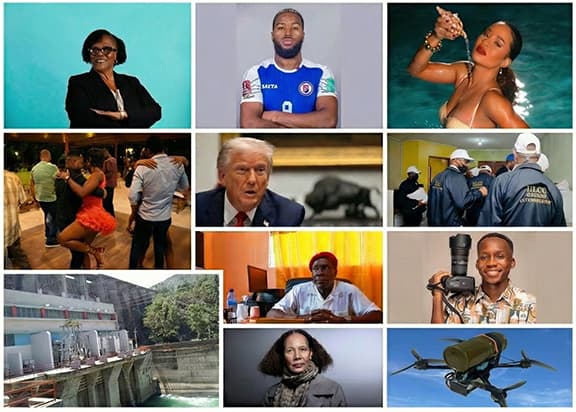
Monique André
It is the first time a woman has led the highest body of football in Haiti. After joining the Haitian Football Federation in 2012, Monique André is now President of the Normalization Committee of the Haitian Football Federation. Not elected, her contribution has nonetheless been among the most significant, whether as a member or as head of this body, which led three national teams to the pinnacle of world football. In 2023, the women’s national team competed in the World Cup in Australia and New Zealand. In 2025, the men’s U-17 team played in the World Cup in Qatar and, soon, the senior national team will take part in the FIFA World Cup 2026 to be held in the United States, Canada, and Mexico. Of the seven appearances by a Haitian team at a FIFA World Cup, Ms. André has been present, in one capacity or another, in our finest adventures since 2018—first in France with the U-20 women and then in 2019 with the men in Brazil. Monique André embodies experience and calm at the helm of Haitian football—along with results.
Compas
Compas—Haiti’s music and dance genre—was inscribed in early December 2025 on UNESCO’s List of Intangible Cultural Heritage in Need of Urgent Safeguarding. Haitian officials opted to register “Compas of Haiti” because “Compas direct,” the exact term used by maestro Nemours Jean-Baptiste to identify his rhythm, is protected by the musician’s family. Be that as it may, from 1955 to the present day, hundreds of contributors have expanded the legacy and enriched Nemours Jean-Baptiste’s project, as the brilliant maestro himself did during his lifetime. The designation “Compas of Haiti” brings together all variations of the rhythm under a single umbrella. In UNESCO’s definition: “Compas is a genre of popular music and dance of great cultural importance to practicing communities. A strong marker of identity, it brings together people of all ages, genders, and backgrounds. The music is characterized by a syncopated rhythm and is accompanied by instruments such as guitars, keyboards, and drums. Compas combines African, European, and Indigenous influences and often addresses themes such as love, freedom, peace, and resistance. Compas dance, a rhythmic walk, is marked by pelvic movements, alternating steps, and physical connection between dancers. It is a means of expression, often used in couples therapy and shared among family members and friends.” In this 70th anniversary year of compas, the inscription comes at just the right time.

Commentaires
Aucun commentaire pour le moment. Soyez le premier à réagir.