
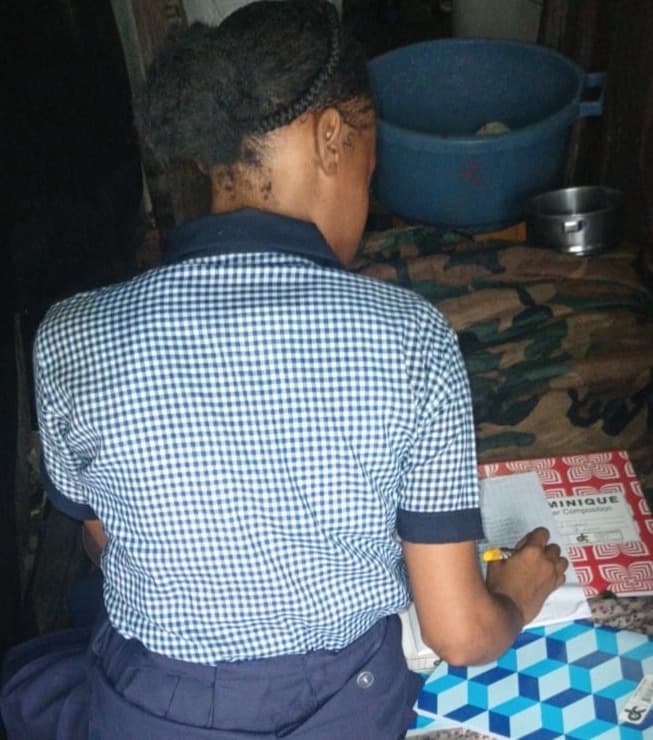
At a time when many displaced children continue to attend school despite their difficult living conditions, daily life in the camps is marked by noise, lack of space, and economic difficulties. For some students, these conditions complicate concentration, homework preparation, and lesson learning. Valdo Philistin It is 1 PM when I arrive at the site. I find Stéphanie still dressed in her school uniform, just back from school. Settled in a small corner on a bed, she explains the difficulties she faces in doing her homework in the camp. Due to the lack of a suitable space, this bed serves as both a resting place and a workspace. At 17 years old and a 7th-grade student, Stéphanie struggles to continue her studies under these conditions. "In the camp, there is constant noise and insults, even when we try to study," she testifies. On top of these difficult conditions are her family's financial problems. Some mornings, her mother doesn't even have a bottle to give her for school. Despite her desire to learn, Stéphanie sometimes finds it hard to concentrate on her lessons. The ambient noise and tensions cause her headaches and prevent her from working in good conditions. When she doesn't understand an exercise, she seeks help from her mother or her older brother, who is in a higher grade than she is. The teenager believes she could study more peacefully if she lived in a calm environment. Her wish is simple: to find peace and be able to learn under better conditions, away from the noise and tensions of the camp. Like Stéphanie, Jouly, 17 years old, also faces difficulties related to his living environment. A NS1 student at the Claude Frantz Dhivert College located in Bourdon, he has lived in a camp for a long time. "To go to school, I walk. I get up early in the morning, just like when I have to come back. In class, I carefully follow the teacher's explanations to try to understand the lessons. But once in the camp, I can't find any suitable place to study. There is too much noise, we are constantly distracted, and we can’t concentrate," he explains. To try to learn his lessons, Jouly has to settle under the tent where he lives. Despite his efforts, it sometimes takes him a long time to memorize his courses. Some days, he feels unwell and feels the need to isolate himself. When he doesn’t have a book, he must borrow one from another student. The 17-year-old says that his study conditions were better before he arrived at the camp. Faced with this situation, he calls for help for the students living in the Mormon camp. He wants these children to receive school supplies and have an environment that allows them to focus better on their studies. On her side, Berline, 18 years old and a student at the Carrefour-Feuilles high school, has lived in the Mormon camp for almost two years. Again, the lack of privacy, noise, and absence of a conducive learning environment complicate her studies. "In the morning, to go to school, I have to wait for everyone to wake up before I can wash up. As long as the others are still asleep, I can't prepare to go to class," she explains. Studying in the camp is a real challenge. Between insults and radios blasting throughout the day, Berline struggles to find a moment of calm to revise her lessons. She often has to wait for the noise to stop to focus. When night falls, she uses a flashlight to continue studying. However, due to the lack of means to buy certain school books, she sometimes finds herself unable to continue her revisions. Despite her desire to succeed in school, the young girl acknowledges that she almost never manages to concentrate in this environment. She believes that the living conditions in the camp can discourage students, even those who like to learn. "What I want is for us to be helped to leave the camp. When I lived at home, I was able to concentrate better on my studies," she says. An unfriendly environment for learning For educator and teacher Peguy Noël, the difficulties faced by children living in shelters are not limited to their material conditions. The lack of suitable space to study, noise, and crowding can also disrupt their concentration and learning. Added to this are the traumas related to the violence and displacements they have experienced. The educator observes that these experiences can manifest in different ways in class. Some children become silent and struggle to participate, while others may be more restless or have difficulty staying focused. In this context, children need support that is not only academic but also takes into account their emotional and psychological situation, he believes. For him, parents, teachers, and educators all have a role to play in helping these children continue their schooling despite the difficult conditions in which they live. Conditions that also affect learning According to clinical psychologist Jacqueline Baussan, the lack of personal space also constitutes a significant obstacle for children living in camps. Overcrowding, noise, discussions, fights, and other forms of violence can disrupt their concentration and make it difficult to prepare homework and study lessons. Physically and psychologically, the child needs minimal conditions to learn, including enough food, sleep, feeling safe, and evolving in a reassuring environment. However, in the camps, these conditions are not always met. According to the clinical psychologist, constant stress can also affect certain capacities necessary for learning, including attention, concentration, and memory. When a child is constantly exposed to noise, agitation, or difficult situations, they may struggle to fully mobilize their abilities to understand and retain what they learn. "Everyone can learn," emphasizes the clinical psychologist. But learning requires an environment that allows the child to remain attentive and focused, she specifies. These difficulties can also manifest in behavior. A restless, disobedient child, or one who seems less attentive can be perceived as a child misbehaving when their attitude may sometimes reflect a situation of distress or stress. For the psychologist, adults, especially in the school environment, must be able to recognize these signs in order to support children more appropriately. In this context, psychological support appears necessary to help displaced children face the difficulties they experience and continue their schooling under better conditions. Students, particularly those in NS1 and NS2, continue to make efforts to stay in school despite their situation. But attending school does not mean that their learning takes place without difficulty. Even when they manage to adapt to their new reality, the living conditions in the camps continue to weigh on their well-being, concentration, and educational journey.



Commentaires
Aucun commentaire pour le moment. Soyez le premier à réagir.