
During a Council of Ministers held on September 30, 2026, the government adopted the 2026-2027 budget totaling 401 billion 200 million gourdes, according to a statement from the Ministry of Economy and Finance (MEF). This represents an increase of 40.9 billion gourdes compared to the revised budget of 2025-2026, which was estimated at 360.3 billion gourdes.<\/strong><\/i><\/p> In a demanding national context, this budget must simultaneously address the need to gradually restore public security, accelerate the electoral process, provide essential services to the population, maintain macroeconomic balances, and support a still fragile economic recovery.<\/p> Through this new budget of 401.2 billion gourdes, the Haitian government sets three main priorities: public security and national defense, the organization of elections and institutional restoration, and then economic recovery associated with social protection and territorial revival.<\/p> Public security and national defense <\/strong>remain the central priority of the 2026-2027 budget,<\/strong> according to the MEF statement. The government intends to strengthen the operational capabilities of the National Police of Haiti (PNH) and the Armed Forces of Haiti (FAd’H), secure major roadways, intensify the fight against criminal armed groups, and create the minimum conditions for the resumption of economic activity.<\/p> The Ministry of Justice and the Ministry of Defense benefit from a budget of 73 billion gourdes, or 18% of the total budget, the statement reads. This amount covers the payroll and associated costs for the personnel of the PNH and FAd’H, as well as the necessary operational goods and services for the functioning of law enforcement, including food, fuel, equipment, maintenance, logistics, communication, and operational support.<\/p> “These credits will allow for the continuation of the P-4000 program, aimed at the recruitment and intensive training of 4,000 new police officers, to honor the contractual tranches related to the acquisition of equipment for the PNH, to support the gradual scaling-up of the FAd’H with a view to the government’s objective of 15,000 soldiers over three years, and to finance the construction of a prison, essential for strengthening the penal chain and combating impunity.”<\/p> The second priority<\/strong> of the 2026-2027 budget concerns the continuation of the electoral process and the gradual return to the regular functioning of democratic institutions. The budget incorporates the necessary needs for conducting the electoral process, securing operations, logistics, institutional communication, and supporting the structures involved in organizing elections. To this end, a budget allocation of 8.6 billion gourdes is dedicated to exceptional expenses related to electoral activities and support for political parties, compared to 5.9 billion gourdes in the revised budget of 2025-2026, representing an increase of 2.7 billion gourdes.<\/p> The new budget also provides additional budgetary credits to ensure the regular functioning of state institutions, including Parliament, which comprises the Chamber of Deputies and the Senate, as well as the Presidency, due to the renewal of political personnel following the elections. This programming, according to the statement, aims to prevent the restoration of democratic institutions from leading to unforeseen expenses not covered by the budget.<\/p> The third priority<\/strong> involves supporting a gradual economic recovery focused on projects capable of producing results.<\/p> The 2026-2027 budget draft is built around a delicate balance between revenue mobilization efforts, security and electoral imperatives, social protection, investment needs, and macroeconomic discipline.<\/p> “The budget for the fiscal year 2026-2027 reflects the Government’s commitment to respond to national emergencies while preserving the conditions for sustainable stabilization. It relies on rigorous trade-offs in a context of limited resources and seeks to reconcile the immediate needs of the population with the requirements of budgetary discipline, transparency, and accountability. It also constitutes an instrument of continuity of the State, of strengthening institutions, and of preparing for a gradual return to a more robust growth,” concludes the MEF statement regarding the adoption of the 2026-2027 Budget.<\/p>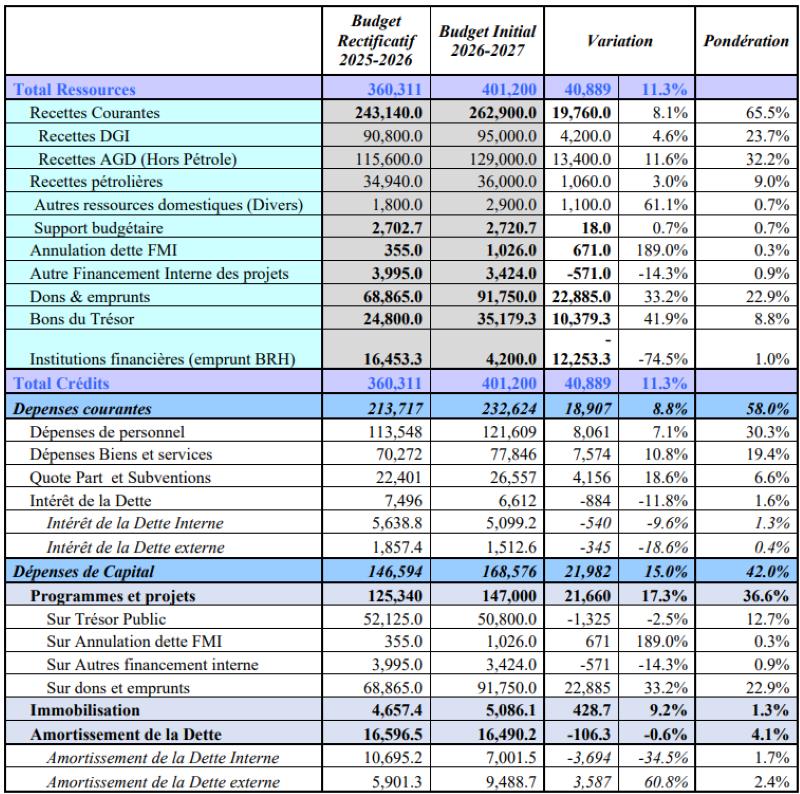 <\/figure>





Commentaires
Aucun commentaire pour le moment. Soyez le premier à réagir.