
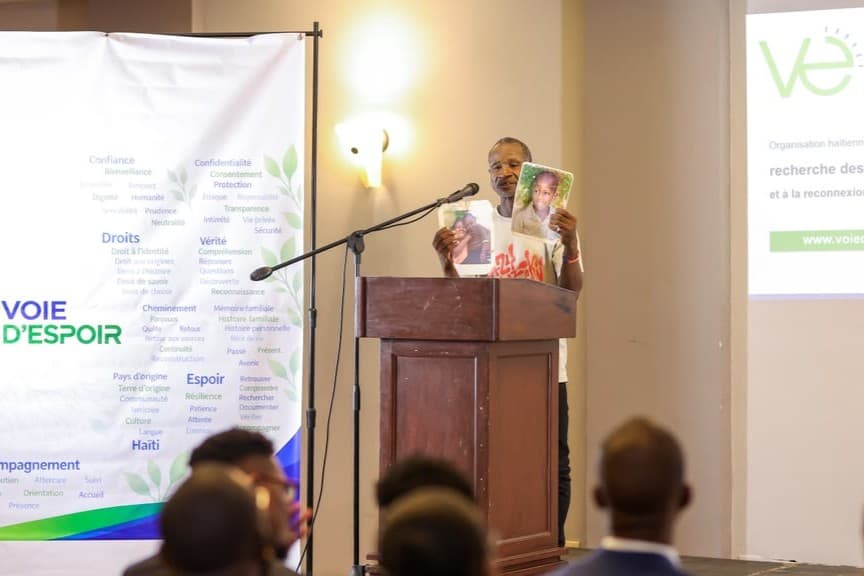
About six years after its creation, the organization is making available to the public a new digital platform dedicated to connecting families. A new milestone achieved by this organization that aims to "enable adopted individuals to better understand their origins and support biological families in their searches." It was Voie d'Espoir's president, Michel Joseph, who presented this new platform during a ceremony dedicated to showcasing the actions carried out by the institution, organized this Wednesday, October 7, 2026, at the Karibe hotel.<\/p>
The event was held in the presence of the Minister of Haitians Living Abroad (MHAVE), Kathia Verdier, the Minister of Commerce and Industry, James Monazard, the head of the UNESCO office in Port-au-Prince, Eric Voli Bi, the director of the Institute of Social Welfare and Research (IBESR), Arielle Jeanty Villedrouin, the general director of the Office of Citizen Protection (OPC), Jude Jn-Pierre, and representatives from several civil society institutions.<\/p>
The tool is designed to facilitate the connection between biological families and their adopted children. "The platform will allow adoptees to check the profiles of their biological parents," explains Michel Joseph. It also enables users, both adopted children searching for their origins and parents looking for their children, to create a profile. There are already about a thousand profiles on the platform. "This is truly a new tool that will serve biological families or the search for origins," he exclaims.<\/p>
The platform should allow Voie d’Espoir to amplify its actions throughout the country and beyond, fulfilling its mission of reconnecting families. Since its creation in 2020, the organization has processed 160 cases, facilitated 79 reunions between adopted children and biological families, and conducted 200 DNA tests between 2024 and 2026. It currently has a database of nearly 2,000 families.<\/p>
Two projects serve as frameworks for the institution's mission. These complementary projects enable Voie d’Espoir to strengthen its search actions, family registration, and its presence in Haitian communities, according to explanations from Ms. Sheilla Louis Joseph, co-founder of the organization. On one hand, the Rapwoche/Konekte project, developed with Plan Kiskeya, "combines field research, family registration, and DNA testing." On the other hand, the Rasin project strengthens the institution's presence in the country, particularly in the Palmes region. Voie d’Espoir even has an office in Petit-Goâve.<\/p>
A cooperation protocol signed with MHAVE and honored personalities<\/strong><\/p> During this ceremony, a cooperation protocol was signed between the organization and the Ministry of Haitians Living Abroad. This agreement, the contents of which have not been made public, aims to "pool strengths, resources, and skills so that the search for origins and family reconnection of our compatriots in the diaspora becomes a secure, dignified, structured, and fully supported process," according to the master of ceremonies, Sony Lamarre Joseph.<\/p> Moreover, the ceremony provided an opportunity for the officials of Voie d’Espoir to honor personalities and institutions that have supported or continue to support the institution in its mission and work. The agency HaitiBrand, the Radio Télévision Caraïbes, host and journalist Marc Anderson Brégard, founder of Banj Marc Alain Boucicault, psychologist Ruth Dorméus, and writer Johanne Elima were notably among the personalities honored during this ceremony.<\/p>



Commentaires
Aucun commentaire pour le moment. Soyez le premier à réagir.