
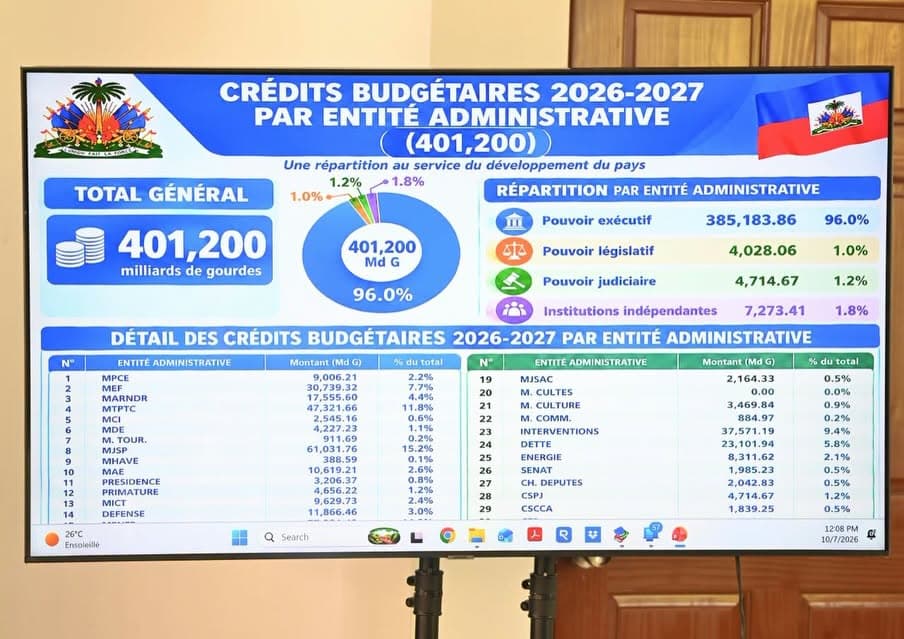
One week after announcing the adoption of a budget for the fiscal year 2026-2027, the government, represented by the Minister of Economy and Finance, Serge Gabriel Collin, and the Budget Director, Michel Silin, presented the main budgetary outlines. The figures, orientations, priorities, and challenges related to the new budget, which amounts to a total of 401.2 billion gourdes, were presented and explained. <\/i><\/p>
In terms of expressed priorities, the budget 2026-2027 returns with the same ones that were formulated for the previous fiscal year: the restoration of security, continuing with the electoral process, and the economic recovery. "There are budgetary forecasts for expenses related to the organization of elections and the salaries of new elected officials who will emerge from the upcoming elections. Security, being the top priority, has led the government to allocate the largest portion of the budget to the Haitian National Police (PNH). The Armed Forces of Haiti (FAd'H) will also absorb part of the expenses planned for the restoration of security. Regarding the economic recovery, one of the major points of this budget, the government opts for investments in the northern and southern regions, which are the least affected by the current insecurity crisis," indicated Serge Gabriel Collin, highlighting that the Ministry of National Education and Vocational Training (MENFP), which inherits the largest budget after that of the PNH, is also one of the government's priorities.<\/p>
Restoring security to reconnect with economic growth represents the greatest challenge to be faced through this budget, according to the holder of the Ministry of Economy and Finance, Mr. Collin. The government anticipates a recovery of economic growth around 0.5% by the end of the current fiscal year. "What allowed us to project a return to growth during the budget preparation was the guarantee of a gradual improvement in the security climate throughout the current fiscal year. An improvement in security will foster job creation in the economy and the arrival of investors with fresh capital for the creation of new wealth. Thus, the State expects to collect more taxes, duties, and levies," affirmed the Treasurer of the Republic.<\/p>
Another challenge identified by the government is the control of current expenditures, said the Minister of Economy. "What we observe year after year is that the State employs more people because of the multidimensional crisis that is currently affecting the country. Every day, more people wish to find a job in the public sector. Everyone needs to know that current expenditures cannot contribute to the country's development. Only investment expenditures can lead the country toward development. In fact, to pave the way for development, the establishment of basic infrastructures like roads, hospitals, etc. is essential. Haiti has enormous potential in terms of tourism; infrastructure is also needed for the development of this particular sector," declared Serge Gabriel Collin, confident that the country will return to the path of development if the objectives are met.
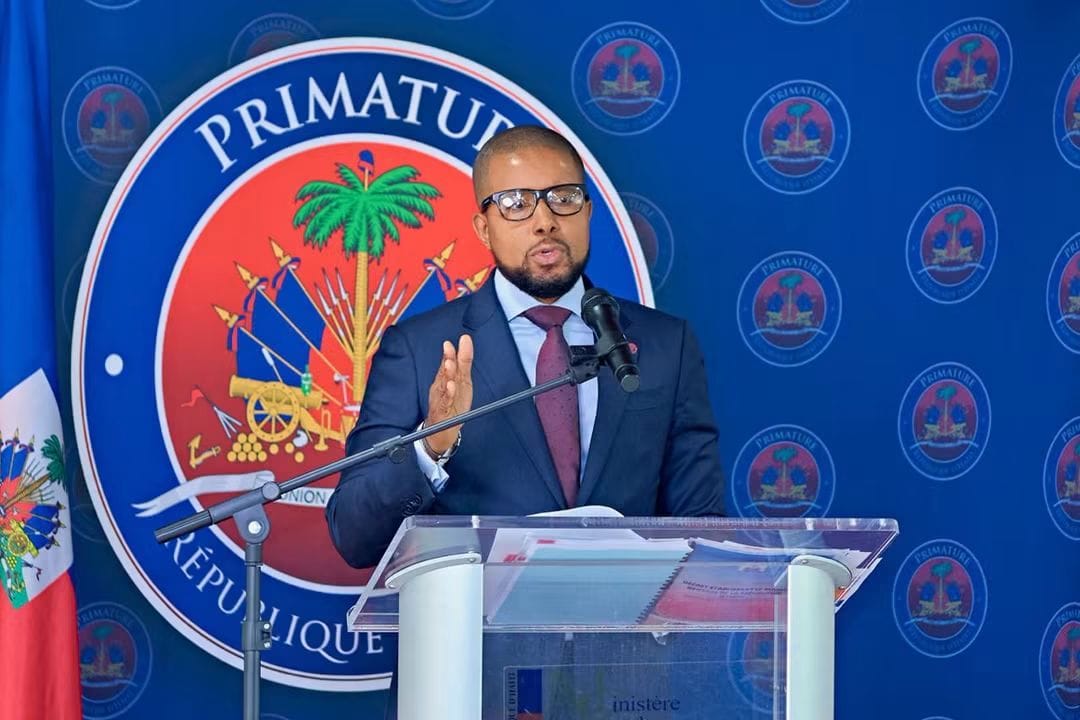
During the press conference, the Budget Director, Michel Silin, spoke about the macro budgetary aggregates and the resources planned in the budget for this fiscal year. He also highlighted the observations made during the budget preparation. "The observation is alarming; the country will experience an eighth year of contraction in its gross domestic product (GDP). Haiti closed the fiscal year 2025-2026 with negative growth of -1.5%. A decline in GDP implies a reduction in state revenues. In this case, the planned resources are not on schedule. However, the State must face its expenditures, hence the budget deficit recorded this year, for which financing from the central bank has become inevitable," explained Mr. Silin. The monetary financing from the Bank of the Republic of Haiti (BRH) reached 16.5 billion gourdes during the past fiscal year. At the beginning of that fiscal year, the government had planned not to resort to this type of financing before including it in the budget rectification of June. At that time, a level of monetary financing around 16 billion gourdes was planned.




Commentaires
Aucun commentaire pour le moment. Soyez le premier à réagir.