
At the National School Republic of Ecuador, the 2026-2027 school year has begun far from the building the students were used to. For nearly two years, the public institution has been functioning in reception sites, after its premises in Delmas were used to shelter people displaced by armed violence.<\/i><\/p>
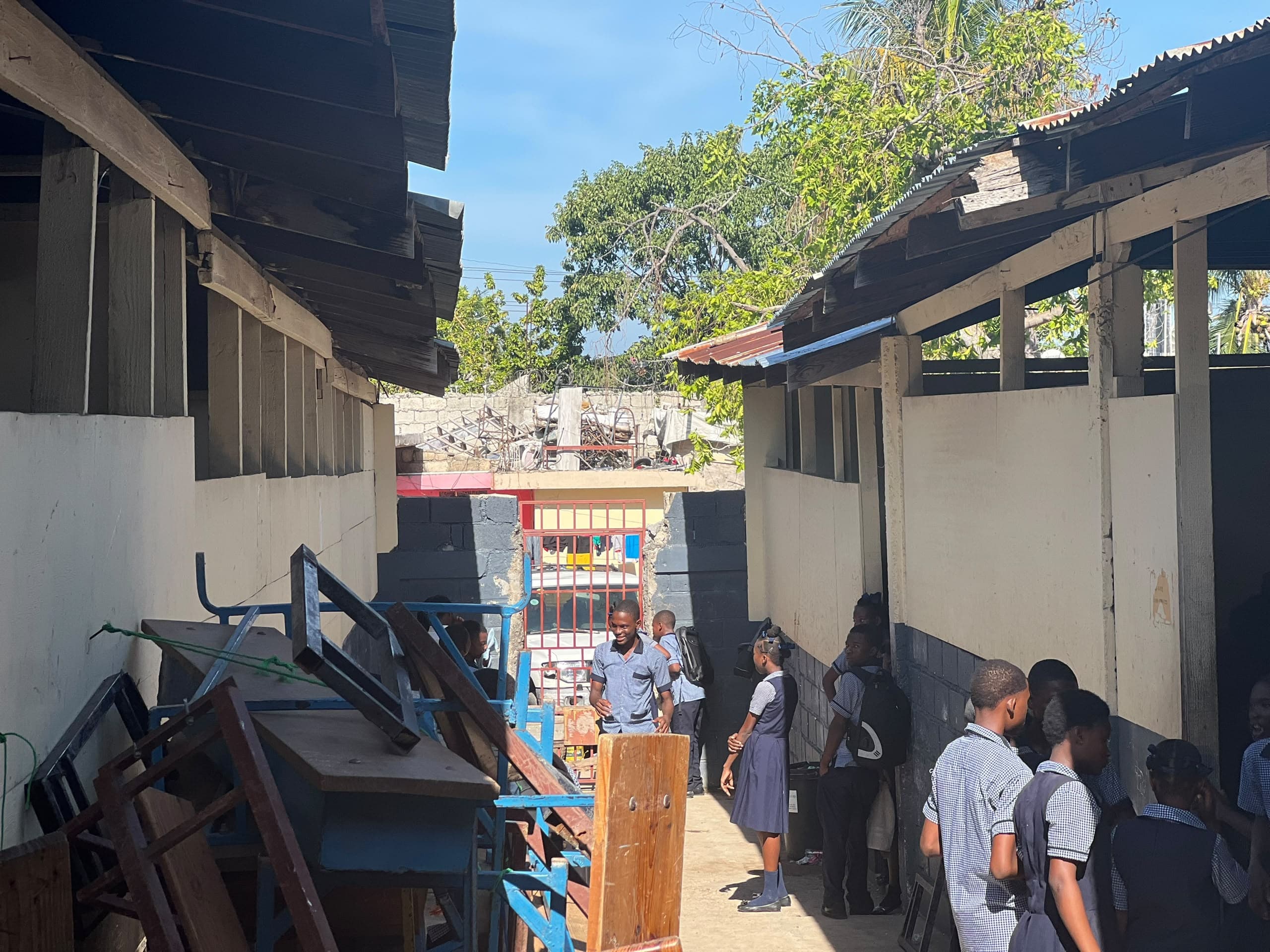
At the back of the Horatius Laventure high school, in Delmas 75, a small red barrier opens onto a narrow alley. Four metal classrooms and a space reserved for administration accommodate students in the fundamental third cycle of the school. About fifteen benches occupy each room, with little room to move around.<\/p>
During recess, lacking a courtyard, the students go out for a few moments into the available space before resuming classes. Inside the classrooms, the heat and noise add to the lack of space. Benches designed for three students often seat more, forcing some to squeeze together to follow the lessons.<\/p>
The situation dates back to December 2024, when the former premises of the school began to serve as a refuge for families who had fled, notably from Nazon, Solino, and surrounding areas. Since then, the institution has continued its mission in two other public schools.<\/p>
One school, two addresses<\/strong><\/p> For the 2026-2027 school year, students from the 1st to the 6th fundamental year are welcomed at the Lélia Lhérisson National School, in Delmas 65. Those from the 7th to the 9th year attend the Horatius Laventure High School, in Delmas 75.<\/p> At the high school, four classrooms are allocated to third cycle classes: one for the 7th year, one for the 8th AF, and two for the 9th AF. Another room is used for administration. This organization differs from that of the previous year, where two rooms were reserved for the 8th year.<\/p> Despite this arrangement, difficulties persist. Séjour Emann, the director of the morning shift, believes that the loss of the premises has severely disrupted the operation of the institution. “We are functioning with difficulties after losing our premises,” he explained to Nouvelliste<\/i>.<\/p> The displacement also had consequences on enrollment. By the end of December 2024, the school had only about twenty students. For this school year, the school has about 350 students in the AM shift for the three classes, according to the director.<\/p> The situation remains fragile in both the first and second cycles. Last year, some afternoon shift classes only operated three days a week. This year, classes have resumed regularly, but the grouping of certain classes remains necessary due to the low number of students and available premises.<\/p> In overcrowded classrooms<\/strong><\/p> In the third cycle, the constraints take on another form. A teacher mentions classes that can exceed 50 students in rooms designed for about thirty. “The environment is not conducive to education. There is too much noise, too many students, and not enough resources,” he laments.<\/p> Isabelle, a pseudonym for a student in the last cycle, describes a similar reality. According to her, the density of students forces everyone to remain particularly attentive to not lose track of the lesson. “Probably, the rooms are built to accommodate about 30 students, but we count about 70. When there is a class, the teacher has to speak loudly and you must be very attentive to grasp what he says,” she testifies.<\/p> Under these conditions, the maintenance of classes does not mean a return to a normal school life. For the administration, returning to the original site thus becomes necessary.<\/p> A still uncertain return<\/strong><\/p> The return to the former premises, however, remains without an official schedule. During the reopening ceremony held on September 7 at Horatius Laventure High School, some teachers regretted the absence of a visit from the Minister of National Education, Vijonet Déméro, to the spaces occupied by the displaced school.<\/p> Séjour Emann states, on his side, that the institution hopes to recover its site between November and December 2026, or even in January 2027. “According to the information we have, we could recover the premises by the end of this year, or even in 2027, to resume classes. But on the MENFP side, it's radio silence. We have no communication with the ministry or with the departmental directorate of the West of Education on this issue,” he laments.<\/p> For the director, however, the return will need to be accompanied by renovation work. Cleaning, painting, reorganization of spaces, and expansion of the metal structure are among the listed needs. The school also wishes to implement a laboratory project discussed with a French organization and to have a well-equipped library.<\/p> These projects remain linked to the recovery of the building. In the meantime, the students continue their schooling in the reception establishments, with the hope of soon regaining the environment that was theirs.<\/p> A school among many others<\/strong><\/p> The National School Republic of Ecuador is a sample of a crisis that far exceeds the walls of this institution. According to UNICEF, about 1,606 schools had closed or suspended their activities during the 2024-2025 school year, affecting more than 243,000 students and over 7,000 teachers. More than 90 institutions had also been used as shelters for displaced persons.<\/p> In the West, more than 700 schools had been affected. For the Republic of Ecuador, nearly two years after its displacement, the challenge is therefore not only to maintain classes but to regain a school capable of welcoming its students in dignified conditions.<\/p>



Commentaires
Aucun commentaire pour le moment. Soyez le premier à réagir.