
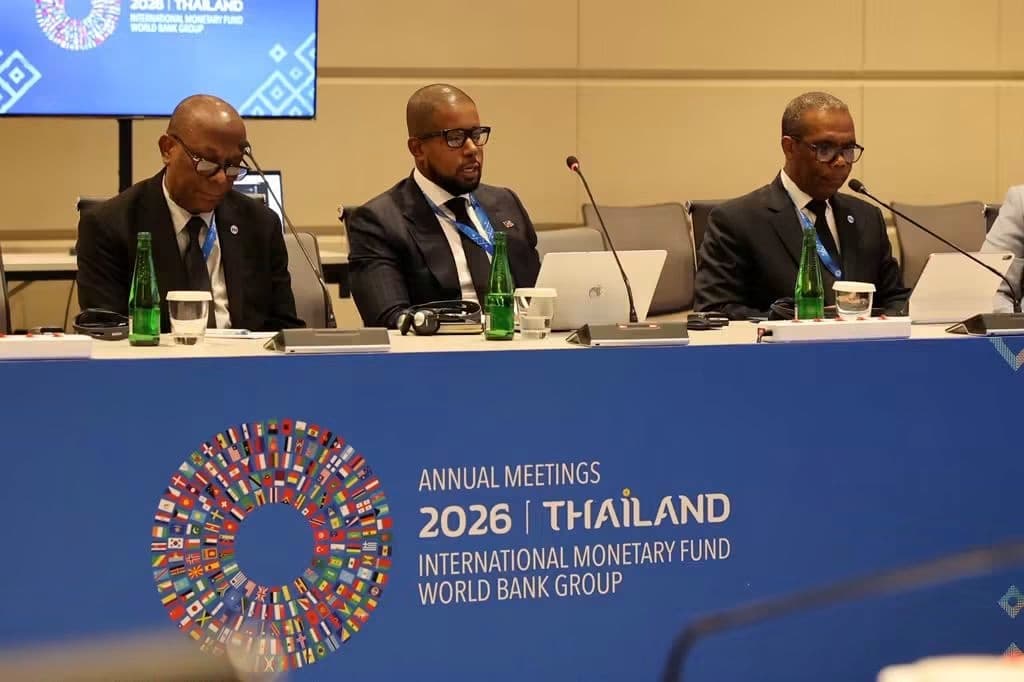
The Minister of Economy and Finance, Serge Gabriel Collin, and the Governor of the BRH, Ronald Gabriel, participated in the Annual Meetings of the IMF and the World Bank Group from October 12 to 18, 2026, in Thailand. They presented Haiti's economic priorities, sought increased support from international partners, and emphasized the need to reconcile macroeconomic stability with social investments.<\/i><\/p>
The economic recovery, funding for social programs, and the preservation of macroeconomic stability were at the heart of the Haitian participation in the Annual Meetings of the International Monetary Fund (IMF) and the World Bank Group, held in Bangkok. Minister Collin and the Governor of the Bank of the Republic of Haiti (BRH), Ronald Gabriel, met with officials from the IMF, the World Bank, and the U.S. Treasury Department. They also held discussions with the Brazilian Minister of Finance and representatives from other international financial institutions.<\/p>
These meetings addressed the security, humanitarian, and economic challenges facing the country, as well as the mobilization of external funding to support the government's priorities.<\/p>
Funding for Security and Investments<\/strong><\/h4>In light of the significant needs, Minister Serge Gabriel Collin called on technical and financial partners to intensify their support, accelerate disbursements, and expedite the implementation of projects funded with external resources. He also advocated for better alignment of international aid with national priorities. The discussions placed significant emphasis on social programs and the restoration of security, two issues deemed essential for stabilizing the country and creating the necessary conditions for organizing credible general elections.<\/p>
The energy project in Les Cayes was also highlighted among the investments promoted by Haitian authorities. The Minister advocated for mobilizing funding estimated at 30 million U.S. dollars. The project aims to involve the private sector and seeks to improve electricity supply, enhance business competitiveness, and support economic activity in the Grand South.<\/p>
The International Finance Corporation (IFC), a member of the World Bank Group, could contribute to structuring the project and mobilizing private capital. However, this financing remains a request from Haitian authorities: its acquisition is not confirmed at this stage.<\/p>
The BRH Defends Macroeconomic Stability<\/strong><\/h4>For his part, Governor Ronald Gabriel presented the results achieved by the Central Bank under the reference program concluded with the IMF. According to him, the BRH's quantitative objectives have been met, while structural reforms are ongoing. He notably mentioned the slowdown in inflation, the relative stability of the exchange rate, and the level of international reserves, which are estimated to be around two billion U.S. dollars. He also mentioned the completion of the audit of the financial statements for the 2023-2024 fiscal year and the measures taken to enhance the security of the institution's IT systems.<\/p>
However, for Ronald Gabriel, economic stabilization should not be an end in itself. "Without investments, without the creation of wealth and jobs, the macroeconomic stability we seek cannot be sustainable," he stated during his meeting with Nigel Clarke, Deputy Managing Director of the IMF. He thus advocated for an approach that takes into account the fragility of the country, marked by insecurity, social tensions, and prolonged contractions in economic activity.<\/p>
Social Spending at the Heart of Concerns<\/strong><\/h4>At a ministerial meeting of Caribbean nations with the Managing Director of the IMF, Kristalina Georgieva, Ronald Gabriel also stressed the consequences of global shocks and natural disasters on the economies of the region.<\/p>
The pursuit of macroeconomic balance in Haiti, according to the governor, must consider the magnitude of social needs. "Macroeconomic balance should not come at the expense of social spending and investments essential for resilience," he asserted. The governor also drew attention to the emigration of youth and skilled workers, which he sees as a hindrance to the country's growth potential. He called for strengthening investments in national capacities, multiplying economic opportunities, and engaging the diaspora more effectively.<\/p>
At the conclusion of these Meetings, Haitian authorities reaffirmed their commitment to continuing economic reforms and strengthening their cooperation with international financial institutions. It remains to solidify the financing efforts initiated in Bangkok, in a context where needs regarding security, social protection, and productive recovery remain considerable.<\/p>
For his part, Governor Ronald Gabriel presented the results achieved by the Central Bank under the reference program concluded with the IMF. According to him, the BRH's quantitative objectives have been met, while structural reforms are ongoing. He notably mentioned the slowdown in inflation, the relative stability of the exchange rate, and the level of international reserves, which are estimated to be around two billion U.S. dollars. He also mentioned the completion of the audit of the financial statements for the 2023-2024 fiscal year and the measures taken to enhance the security of the institution's IT systems.<\/p>
However, for Ronald Gabriel, economic stabilization should not be an end in itself. "Without investments, without the creation of wealth and jobs, the macroeconomic stability we seek cannot be sustainable," he stated during his meeting with Nigel Clarke, Deputy Managing Director of the IMF. He thus advocated for an approach that takes into account the fragility of the country, marked by insecurity, social tensions, and prolonged contractions in economic activity.<\/p>



Commentaires
Aucun commentaire pour le moment. Soyez le premier à réagir.