
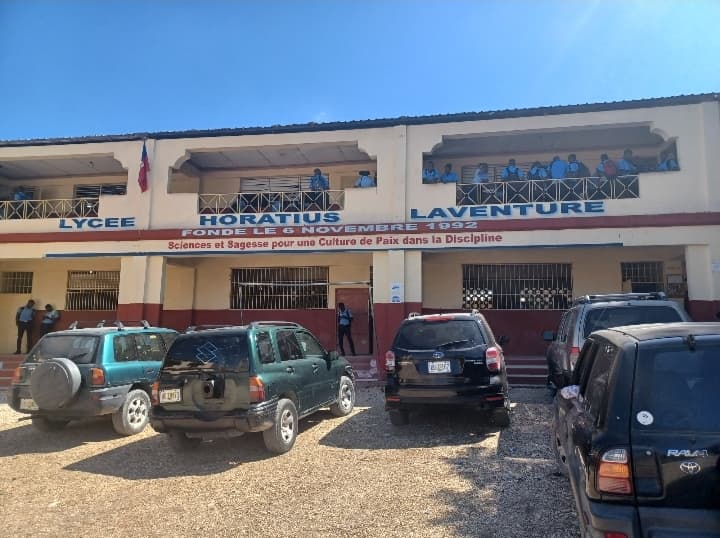
Having survived the violence in Martissant, the Centre de formation pour l'école fondamentale (CFEF), an institution of higher education under the Ministry of National Education and Vocational Training (MENFP), is temporarily hosted at Horatius Laventure High School in Delmas 75.<\/p>
After a long journey that took it to the Guillaume Manigat National School on Chareron Street, and then to Toussaint Louverture High School, the center specialized in training teachers for fundamental education has finally found refuge at Horatius Laventure High School. This is its second year in the facilities of this institution.<\/p>
"The director of the high school is a former of the CFEF. When he learned that the center was homeless, he offered us his hospitality. He made three classrooms available to operate the CFEF," said the center's director, Jacques Ronald Jean, when interviewed by Le Nouvelliste.<\/p>
This year, however, the high demand at Horatius Laventure High School has led to a reduction in the number of classrooms available to the CFEF, Mr. Jean emphasized. Three classrooms were already insufficient; two are even more so. In Martissant, the center had fifteen classrooms.<\/p>
To compensate for the lack of space, the CFEF is multiplying solutions. Some classes are organized online. Teachers also offer students the opportunity to attend classes at their own institutions. On Saturdays and Sundays, classes are held at Horatius Laventure High School to make up for lost hours during the week.<\/p>
However, these solutions have their limits, explained the pedagogical director of the CFEF, Alfred Delanaud. To attend online classes, students and teachers do not always have access to a reliable Internet connection or regular electricity supply. Traveling between different teaching locations also complicates class attendance.<\/p>
"Sometimes, students have a class in Delmas 75, then are forced to travel to another class held in Lalue," Mr. Delanaud pointed out.<\/p>
"Students are willing, but conditions are not suitable," he lamented.<\/p>
The current operation of the CFEF disrupts the academic calendar and the monitoring of the teaching process, continued Alfred Delanaud. Due to the lack of classrooms, programs are now shortened and extend over six to eight months, compared to ten months previously.<\/p>
To inform about which courses are actually taught by teachers, management says it must refer to student committees.<\/p>
Evaluations are also affected by these constraints. According to Mr. Delanaud, 80% of evaluation work takes the form of research and production exercises. The rest is conducted in-person, either in Delmas 75, at Bojeux, in Pétion-Ville, or in Lalue, where CFEF students also attend classes.<\/p>
For the current academic year, the center has 25 teachers for nearly 300 students. The CFEF is facing a shortage of teachers for the new subjects required in the third cycle of fundamental education. Jacques Ronald Jean also reported a lack of supervisors for internships and for the newly implemented degree program.<\/p>
For three years, the CFEF has welcomed 120 new students at each intake. However, its director laments the insufficiency of financial resources necessary for the institution's operation.<\/p>
Once free, the center now asks students to pay certain annual fees. This year, several of these fees have been raised, according to Jacques Ronald Jean.<\/p>
"Enrollment fees have increased from 3,000 to 5,000 gourdes. Fees for transcripts have risen from 100 to 500 gourdes, and fees for a certificate have gone from 150 to 250 gourdes," he specified.<\/p>
Simultaneously, the CFEF has launched the admission process for a new cohort. Candidates' applications are received via WhatsApp or at an email address provided by the management. Registrations are open until November 5. The date for the admission exam has not yet been set.<\/p>
Last year, only 125 candidates took the entrance exam, of which 119 were admitted. Previously, the center welcomed nearly a thousand applicants.<\/p>
For Jacques Ronald Jean, this decline in applications and the operational difficulties of the center reflect the little attention given to the institution by the authorities.<\/p>
"If we, who train teachers for fundamental education, receive this treatment, it is proof that the Haitian State pays little importance to education. Otherwise, fundamental education would have been prioritized, as it is the foundation of schooling, and without it, the training of Haitian schoolchildren will be shaky," stated the director.<\/p>
Founded in 1999, the CFEF is the only public teaching center dedicated to the pedagogical supervision of institutions for the fundamental cycle, a level of education guaranteed by the State, according to the Haitian Constitution.<\/p>
On May 15, the MENFP integrated the CFEF into the Public University of the West (UPO), alongside the National School of Applied Geology (ENGA) and the National School of Higher Technology (ENST). A rector has been appointed to head this new university, but no premises have yet been assigned to it.<\/p>




Commentaires
Aucun commentaire pour le moment. Soyez le premier à réagir.