
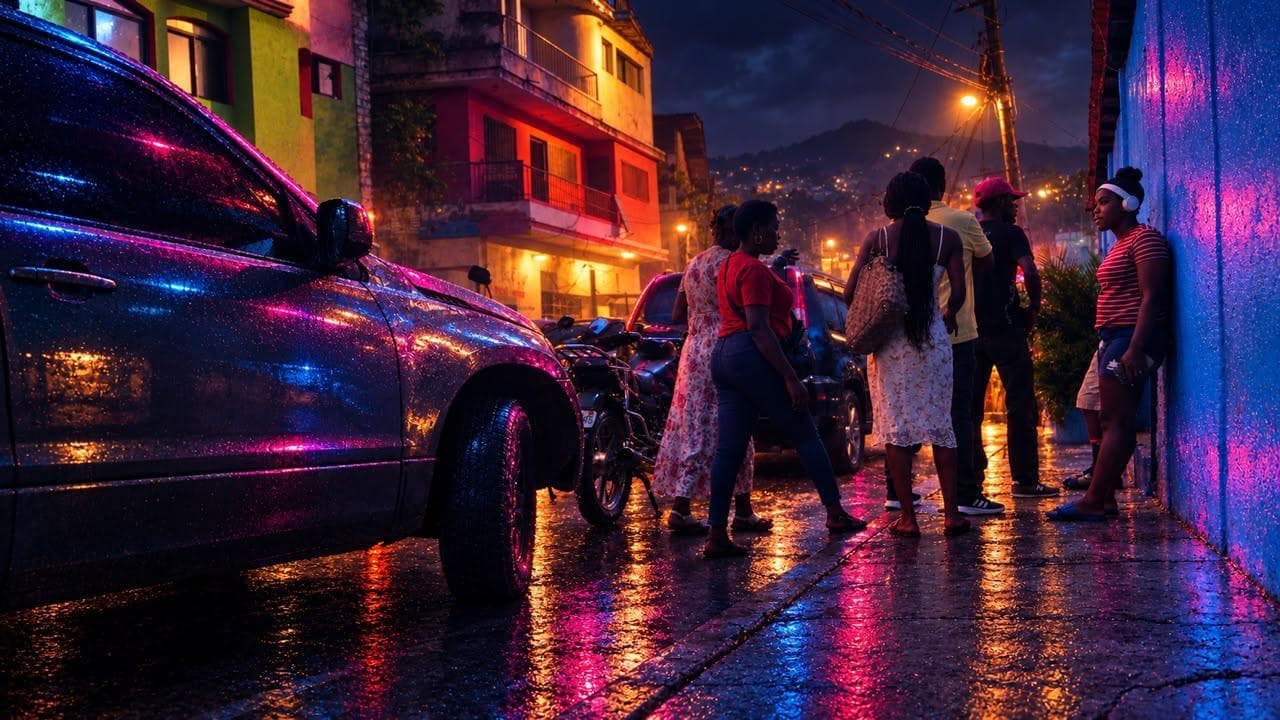
Luxury cars, borrowed villas, female bodies reduced to accessories, saturated colors, and incessant camera movements: a large part of the video clips produced in Haiti seems trapped in repetitive visual recipes. However, the richness of Haitian music, the beauty of the landscapes, and the complexity of social reality offer considerable cinematographic material. For Gaël (Mø Øn) Jean-Baptiste, it is time to rethink audiovisual creation, break away from imported models, and turn the image into a true space of artistic expression.<\/strong><\/p> Images trapped in ready-made recipes<\/strong><\/p> Photography has often been presented as a way to preserve the moment and defy the passage of time. Cinema, on the other hand, allows for the revelation of reality, the exploration of emotions, and the giving shape to the imaginary. Filming, therefore, is not just about placing a camera in front of bodies and settings. It requires a gaze, an intention, and a mastery of visual language.<\/p> However, for over a decade, a significant part of the video clip production in Haiti seems to prioritize appearance at the expense of artistic exploration. Luxury cars, villas, swimming pools, and young women staged according to hypersexualized codes have become almost unavoidable in the repertoire. These images, often inspired by American hip-hop clips from the 2000s, are reproduced without true adaptation to Haitian reality.<\/p> The problem does not lie in showing wealth, seduction, or desire. These themes have their rightful place in musical creation. It rather concerns their mechanical repetition and the frequent absence of a vision capable of giving them meaning. The image then merely illustrates the lyrics, without enriching, nuancing, or offering another reading of the song.<\/p> This poverty of the imaginary is also reflected in technical choices. Excessively saturated colors, artificial lighting, and multiplied transitions sometimes give the impression that visual effects serve as staging. Fast editing, incessant camera movements, and systematic aerial shots do not necessarily convey an artistic intention. They can also mask the absence of composition, actor direction, and reflection on the frame.<\/p> A high-definition camera or a drone is not enough to make a filmmaker. The history of cinema reminds us that the quality of a work depends less on the sophistication of the equipment than on how its creator sees the world, organizes space, and masters time. A well-constructed static shot can be more expressive than a succession of spectacular movements. A face filmed accurately can tell more than a luxurious setting.<\/p> The question is therefore less about the available technical means than about their use. What does the director want to show? What emotion does he seek to evoke? What universe does he wish to reveal to the viewer? Without answers to these questions, the clip risks becoming a simple commercial showcase.<\/p> Filming Haiti rather than copying it<\/strong><\/p> Haiti possesses a visual richness that should serve as a major source of inspiration for its creators. The particular light of the country, the landscapes of Jacmel, the popular markets, the alleys of the capital, the rural faces, and the energy of the neighborhoods offer many narrative and aesthetic possibilities.<\/p> Yet, these elements often remain on the margins of the representations proposed in the clips. Some directors seem to prefer settings meant to evoke Atlanta or Miami, as if artistic success required replicating the outward signs of foreign wealth.<\/p> This trend reflects a form of cultural alienation: instead of transforming their environment into creative material, artists and directors seek to imitate models whose codes they adopt without always understanding their logic. Pétion-Ville does not necessarily have to resemble Atlanta, nor does Cap-Haïtien need to evoke a Miami suburb to become an interesting cinematic setting.<\/p> The Haitian reality, with its contradictions, difficulties, beauty, and tensions, offers stories to tell. It can feed passionate dramas, political satires, narratives rooted in daily life, or surreal proposals inspired by folklore. It can also give birth to poetic images that do not seek to hide the dust, the wind, the texture of the skin, or the truth of the streets.<\/p> Filming one’s country does not mean presenting a systematically miserabilist representation. It is not about reducing Haiti to its difficulties or turning each clip into a social documentary. It is rather about recognizing that reality, even when harsh, can become aesthetic material. Creation consists precisely of transforming this material through framing, light, movement, editing, and narration.<\/p> The representation of the female body also deserves special attention. In many clips, women appear less as characters than as decorative elements meant to highlight the artist. Their gestures, expressions, and presence are often subordinated to a staging that prioritizes the exposure of the body at the expense of any real characterization.<\/p> However, sensuality is not incompatible with art. It can even constitute a powerful aesthetic resource when it is based on intention, atmosphere, and understanding of the characters. But when the camera systematically reduces the woman to certain parts of her body, seduction becomes a repetitive formula, and the image loses part of its human richness.<\/p> The challenge is therefore to invent a more nuanced representation of bodies, places, and experiences. By making Haitian reality a starting point rather than a setting to be erased, creators can build a unique visual language, capable of conversing with the world without renouncing their own identity.<\/p> For a true culture of the image<\/strong><\/p> The responsibility for this situation cannot rest solely with directors. The artists commissioning the clips, the producers, broadcasters, and the public also participate in a system where immediate visibility and reactions on social media sometimes take precedence over artistic demands.<\/p> When a singer expects a sequence of cars, models, and spectacular effects from his director, he limits the possibilities of creation. When the public becomes accustomed to these recipes, it risks considering their repetition as a norm. And when criticism does not take the time to question the images, works have fewer spaces to provoke debate and encourage new approaches.<\/p> However, a video clip should not be merely a derivative product of the song or a promotional tool. It can become a standalone work, a short film capable of existing by itself, providing a new reading of the lyrics, playing with narration, and enriching the visual heritage of an artist, a band, or a country.<\/p> The example of Michael Jackson and his clip Thriller<\/i> reminds us how an audiovisual work can surpass its promotional function and leave a lasting mark on popular culture. The image fully participates in the construction of an artistic universe. It does not simply accompany the music: it gives it another dimension.<\/p> Creators from West Africa, Jamaica, and some Latin American countries also show that economic constraints do not preclude all aesthetic ambition. By drawing from their landscapes, traditions, myths, and daily lives, they develop forms of expression that are their own. Their approach reminds us that it is not necessary to have considerable budgets to propose an original gaze.<\/p> A change of perspective<\/strong><\/p> Haiti has a remarkable artistic tradition, particularly represented by its painters, writers, and filmmakers. The names of Frankétienne, Hector Hyppolite, and Raoul Peck testify, each in their field, to the country’s ability to produce works that transcend its borders. This richness should encourage clip creators to deepen their visual culture and explore the possibilities offered by painting, photography, literature, theater, and cinema.<\/p> The director must thus be more than a technician tasked with executing the requests of an interpreter. It is up to him to develop a vision, to defend artistic choices, and to propose images that add something to the music. For their part, singers must understand that a successful clip is not measured solely by the number of views or the appearance of its settings, but also by its ability to touch the audience and leave an imprint.<\/p> Rethinking video clips in Haiti therefore requires a change of perspective. It is necessary to dare to tell different stories, to consider thoughtful framings, controlled colors, and characters who exist other than as accessories. It is also essential to encourage critique, training, and dialogue between artists, directors, and viewers.<\/p> Cinema is often described as a window opened onto the world. The Haitian video clip would benefit from abandoning the artificial mirror in which it sometimes seeks to reproduce others’ images, to open this window onto its own reality. The wind, the dust, the streets, the landscapes, the faces, the pains, and the hopes of the country represent just as many materials capable of nourishing a singular creation.<\/p> Art does not always require considerable means. It demands above all conviction, culture, boldness, and true attention to the filmed subject. It is under these conditions that Haitian video clips can transcend the repetition of formulas and become works capable of moving, disturbing, uplifting, and surprising.<\/p>



Commentaires
Aucun commentaire pour le moment. Soyez le premier à réagir.