
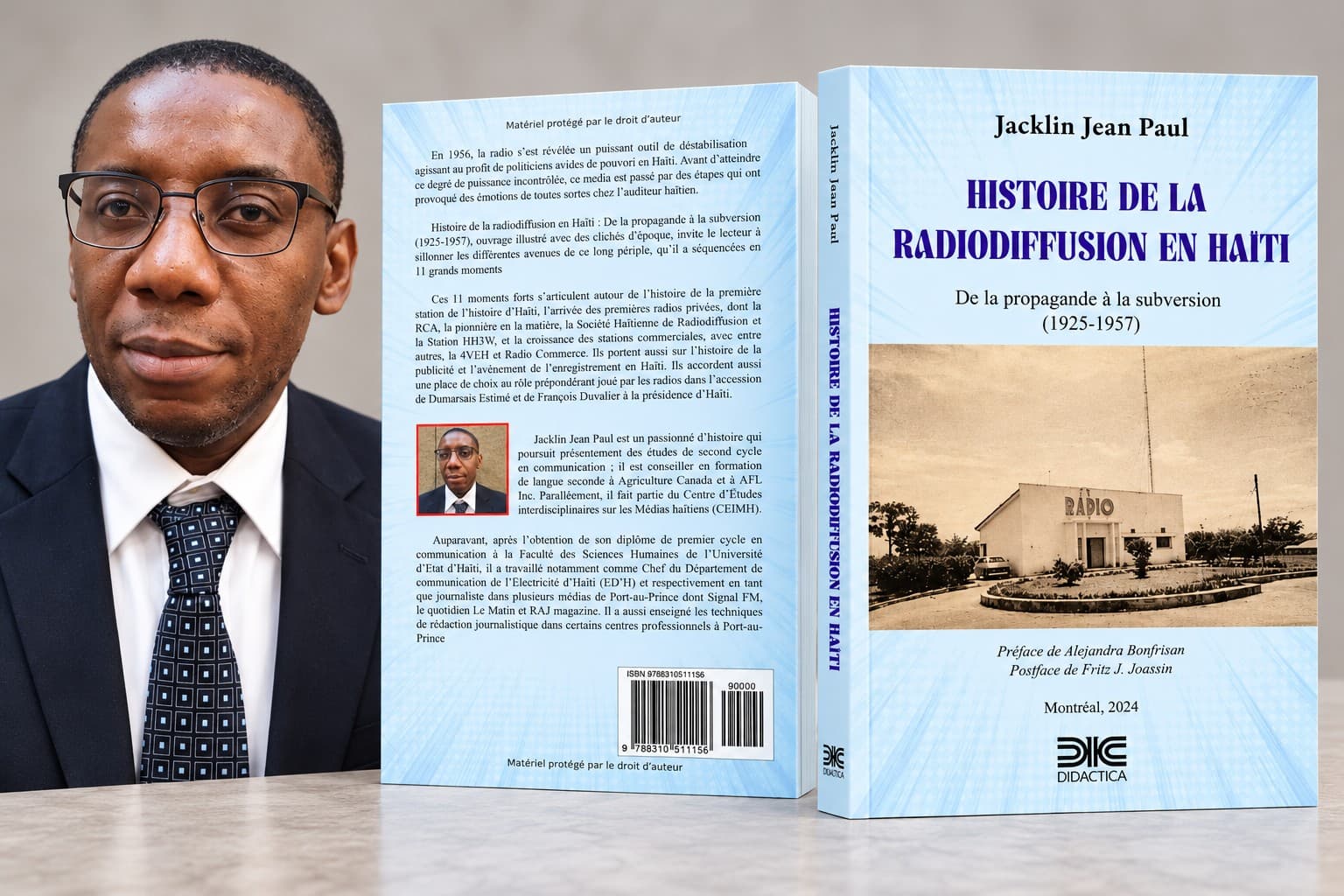
Published in 2025 by Éditions du CIDIHCA, History of Broadcasting. From Propaganda to Subversion (1925-1957)<\/i> has 309 pages. It begins with an abandoned station project in 1925 and concludes with the election of François Duvalier in 1957.<\/p>
Journalist and researcher, former contributor to Matin and Signal FM, Jacklin Jean Paul is a graduate of the Faculty of Human Sciences (FASCH) at the State University of Haiti. He is the General Secretary of the Interdisciplinary Center for Media History Studies (CEIHM), and is preparing a master's degree in communication at TÉLUQ University in Quebec.<\/p>
In an interview he granted us, he summarizes his book in two sentences: “At the beginning, radio was primarily used as a propaganda tool for the benefit of the authorities. But starting in 1957, it escaped their control and gradually transformed into an instrument of dissent, even acting against their interests.”<\/p>
It all starts from a thesis that never saw the light of day. In 2003, as a student at FASCH, he prepares a preliminary project on the history of radio. The following year, his workshop professor deems the topic unfeasible. “Finally, in 2010, I wondered why not use all this information I had compiled,” he recounts. It would take him “a little over fifteen years of research” to complete it.<\/p>
The dates are not random. By going back to 1925, he aims to go further than David N. Hartt, founder of Radio Lumière and author of the thesis Broadcasting in Haiti<\/i>, which he considers “the first major work on the history of radio in Haiti.” He wanted to know “if, before 1926, there had been any other radio projects.”<\/p>
He stops in 1957, the year the country shifts with the election of Duvalier. He prefers a narrower subject, studied in depth, and expresses it with a proverb: “Who grasps too much, holds little.”<\/p>
Archives, witnesses, and QSL cards<\/strong><\/p> Hartt remains his starting point. Invited this Friday, October 23, to Panel Magik, the author reminded that this pastor had traced the history of Haitian radio during a conference at the International Summer Course in 1980. Jacklin Jean Paul first read the summary written by Me Osner Févry, preserved at the FASCH library.<\/p> Herby Widmaier, founder of Radio Métropole, then lent him his copy of the thesis for two weeks. “I read and reread this work, without which my book would undoubtedly not have been as rich,” he acknowledges.<\/p> He sifted through the press of the time: Le Nouvelliste, Le Matin, Le Moniteur, Haiti Sun, Haïti Journal. To this are added foreign specialized journals, including Radio News.<\/p> Part of these collections can be consulted online, notably thanks to the University of Florida. For the rest, he traveled to the National Library in Haiti, to CIDIHCA and to Library and Archives Canada. He also bought many old magazines.<\/p> Another treasure: the QSL card collection of Abdel Nassar. Stations sent these cards to listeners to confirm they had been received. A mutual friend connected him with the collector.<\/p> Finally come the witnesses. Jacklin Jean Paul interviewed Herby Widmaier, Philippe Jean François, engineer Fritz Joassin, Bob Lemoine, Jean Sorel, Marcus Garcia, Jacques Sampeur, Claude Dambreville, Roland Dupoux, Jacques Jean-Baptiste, and Édouard Gentil fils, who passed away two years ago, he specified on Magik 9.<\/p> “As I did not interview them at the same time, it was relatively easy to compare their versions,” he explains. He then verified their memories in the newspapers and magazines.<\/p> Not everything was straightforward. The relocation of the Haitian Institute of Statistics and Computer Science (IHSI) denied him access to certain reports.<\/p> From HHK to the first private stations<\/strong><\/p> The book proceeds chronologically. After a survey of the world's radio history, it focuses on The Radio Corporation of Haiti, established in 1925 according to Le Moniteur. The company never launched its station.<\/p> Then comes HHK, the state station inaugurated in 1926 under the American Occupation. Officially, it is supposed to serve agricultural education. Jacklin Jean Paul is skeptical. “I base a large part of my work on the statements of journalists and writers of the time,” he specifies, citing notably Ernest Chauvet. “They all almost echoed the same sentiment.”<\/p> In his view, HHK paved the way without bringing radio into daily life. “It was born with HHK, but it truly took flight with HH2S and HH3W,” he asserts.<\/p> These two private stations, launched in 1935, hold a significant place in the book. HH2S is launched by the Société Mallebranche, Gentil, Bogat et Cie, which represents RCA-Victor receivers. Its problem is commercial: how to sell radios when no local station broadcasts every day? HH3W, on the other hand, is the work of Ricardo Widmaier.<\/p> On the question of the first commercial station in the country, the author leaves no room for doubt. “There is no longer any debate: HH2S is the first commercial station in our history,” he asserts. He found traces of test broadcasts by HH2S as early as April 1935. The HH2W, an amateur station by Widmaier, only started on September 17 and became HH3W on November 7.<\/p> The narrative then follows the arrival of HHBM, the future MBC, of HHCA, and of HHCP, better known as La Voix du Nord, launched in Cap-Haïtien on May 1, 1945. Religious stations also have their chapter, with 4VEH, founded in Cap-Haïtien on June 2, 1950, and Radio Fidès, linked to the Archdiocese of Port-au-Prince.<\/p> The book also revives the voices of the time. On Magik 9, the author presented Clément Coicou, known as Papa Youte, as the first to have spoken Creole on the radio in Haiti. This humorist is also, according to the book, the father of radio advertising: denied a raise at HHK, he left the station in 1931, then returned with sponsors whom he presented their products. Théophile Salnave later became the great Creole voice of the late 1930s and 1940s. Still on Magik 9, the author recalled that President Sténio Vincent's speech on January 1, 1938 had been translated into Creole on the radio, at a time when official speeches were delivered in French.<\/p> The printed press has its great figures, often intertwined with the history of radio. The author cited on Magik 9 Ernest Chauvet, from Nouvelliste, Clément Magloire, founder of Matin, and lawyer Antoine Rodolphe Hérard, owner of Radio Port-au-Prince.<\/p> Radio becomes power<\/p> Politics is never far away. HH2S broadcasts the election of Élie Lescot in 1941. Antoine Rodolphe Hérard, a star presenter since 1939, participates in 1946 in the campaign of Dumarsais Estimé. In February 1947, the station launches an official program, “The Voice of the Republic of Haiti”.<\/p> Radio Commerce holds a unique place. The Port-au-Prince Chamber of Commerce offers it to President Paul Eugène Magloire, and it is inaugurated on July 19, 1953. Privately owned on paper, it operates in reality, according to the author, as a public service.<\/p> Its first director, Guy Douyon, comes from the National Office of Tourism. In December 1955, he is transferred to the Haitian embassy in Washington.<\/p> For the researcher, this example speaks volumes. “What surprised me the most was the degree of entrenchment of corruption among us,” he confides. The station, he explains, “was managed as a decentralized body and followed the personnel movements of the public administration.” Hence his conclusion about the nationalization of 1957: it “was not an injustice in itself, since it was already functioning as a public entity.”<\/p> The last part of the book narrates the upheavals of the 1957 campaign. After the departure of Magloire on December 12, 1956, politicians equip themselves with stations. The Jumelle family launches Radio Jean-Jacques Dessalines. Louis Déjoie inaugurates La Voix du Sud in Cayes on March 1, 1957.<\/p> At the end of March, police cut off an MBC broadcast of candidate Clément Jumelle. On April 1, armed police storm the studios.<\/p> On May 13, 1957, the Executive Council bans by decree broadcasts deemed “subversive”. Radio Caraïbes, Radio Port-au-Prince, and the MBC ignore it. Radio, the author writes, “had already established itself as a power.”<\/p> He sees this as the legacy of 1946. Antoine Rodolphe Hérard and other figures of that generation, who became press barons, spoke freely since the fall of Élie Lescot. From 1950 to 1956, Hérard could even oppose Magloire without being bothered. “They believed they were authorized to continue down this path in 1957,” summarizes the researcher.<\/p> The paradox arrives quickly. That same year, radio, notably Radio Port-au-Prince according to the book, helps François Duvalier get elected. “Unbeknownst to them, broadcasting had just made a pact with the devil and entrusted it with its freedom,” writes the author. Interviewed by Le Nouvelliste, he had an even more vivid image: “It was as if we had handed François Duvalier the keys to our own handcuffs.”<\/p> The sequel will be the subject of the second volume. It will discuss the closure of La Voix du Sud, the persecutions against Anacréon Émile and Daniel Pélissier, owners of La Voix du Nord and La Voix des Gonaïves, forced to sell their stations, and the obligation made to all radios to relay “The Voice of the Republic”.<\/p> Questions still open<\/strong><\/p> Fifteen years of research have not clarified everything. We still do not know why The Radio Corporation of Haiti failed in 1925. The date when HH3W takes the name Radio Haïti remains unknown, as do those for the founding of Radio Fidès and La Voix des Gonaïves. Jacklin Jean Paul continues to search. “I will certainly proceed to a reissue,” he announces.<\/p> In the postface of the book, engineer Fritz Joassin praises “a truly exceptional research work” and sees in the book a “Radiograph” of Haitian society. After propaganda and dissent, he will tackle censorship, at the moment when Haitian radio embarks on its second century.<\/p>
On sale on Amazon, the book opens a series. The second volume, History of Broadcasting in Haiti: From Censorship to Self-Censorship (1958-1986)<\/i>, is already in the hands of the publisher. The author does not venture a date, but assures that “its publication is imminent.” On Magik 9, he also announced next week the premiere of a documentary on the history of Haitian broadcasting.<\/p>





Commentaires
Aucun commentaire pour le moment. Soyez le premier à réagir.