
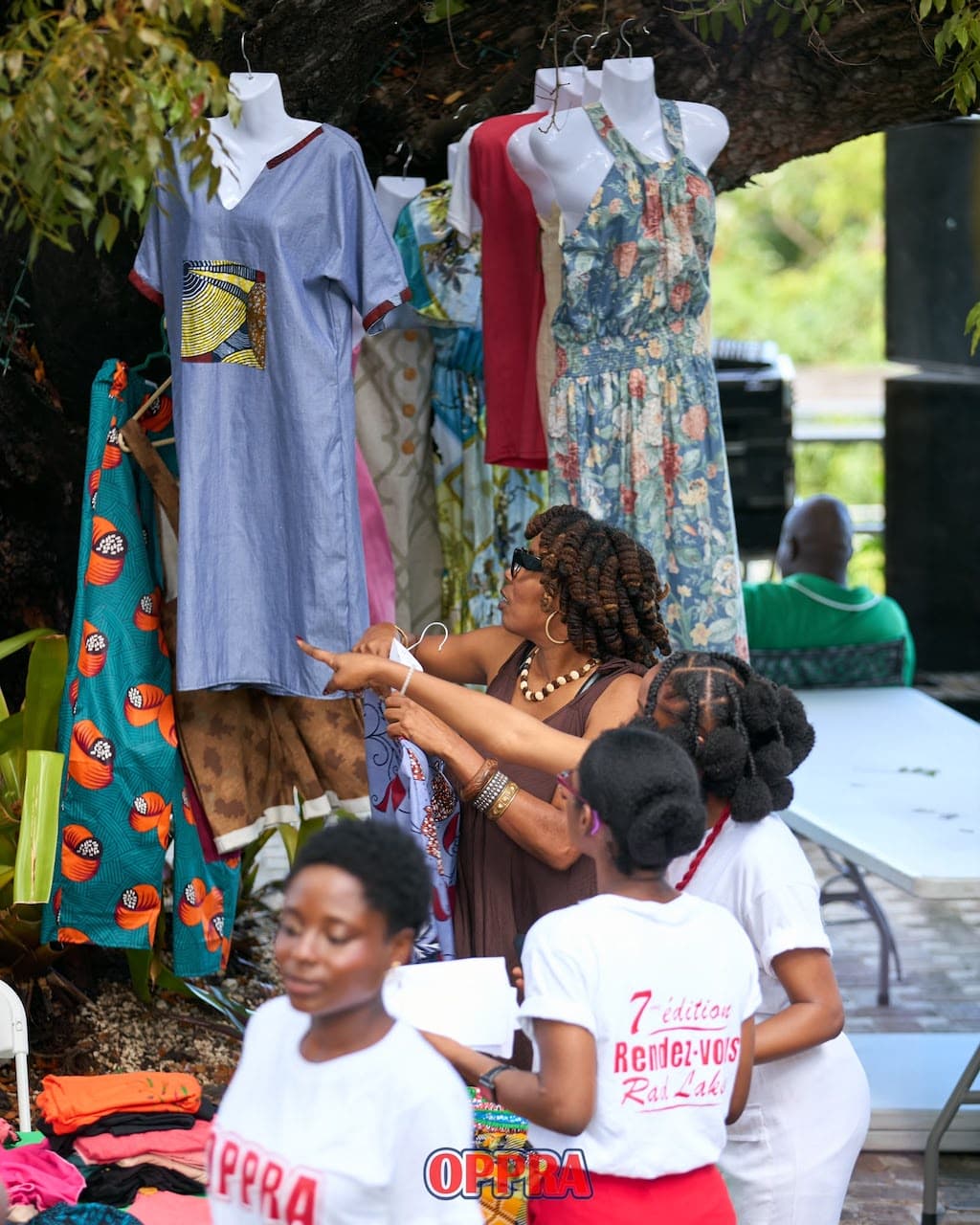
On October 24, at the Montana hotel, the <\/strong>Rad Lakay fair<\/strong><\/i> brought together artisans to showcase their creations to the public. From handmade sandals to clothing inspired by African fabrics and beaded accessories, the exhibitors highlighted their craftsmanship. However, behind these creations, they express the difficulties of selling their products, finding raw materials, and sustaining their small businesses in a challenging economic context.<\/strong><\/p> It is around 10 a.m. when the Rad Lakay fair<\/i> opens its doors at the Montana hotel. The products on display catch the eye with their colors, shapes, and materials. Clothing, sandals, beaded bags, and other accessories are available for visitors. Some items are made from leather or wood, while others showcase fabrics like karabela. The goal is clear: to provide artisans with a space to present their work, raise awareness of their products, and find customers.<\/p> The public has turned out, although visitors sometimes seem hesitant to make purchases. For the artisans, this day represents an opportunity to showcase their creations but also to make sales to continue their activities.<\/p> D’art-line Création<\/strong><\/i>: Handmade Sandals Facing Decreasing Sales<\/strong><\/p> At the booth of D’art-line Création<\/i>, Bien-Aimé Dieuseul presents his company's products, active in the market since 2021. The workshop notably makes handmade sandals from various materials, including palettes, beads, and leather. It also produces accessories and beaded bags.<\/p> "We make sandals with materials like palettes and beads, which are rare to find," he explains.<\/p> The company combines local and imported materials to offer a variety of creations. It has a location in Delmas 64 and also uses social media, particularly TikTok, Facebook, and Instagram, to showcase its products.<\/p> However, sales are not what they used to be. "Due to the country's situation, we are not selling as we used to," Bien-Aimé Dieuseul admits. He also explains that the departure of many clients abroad has contributed to the decline in his customer base.<\/p> Despite these challenges, he encourages young people to learn the craft of sandal-making. According to him, this activity can allow them to earn money while contributing to the development of local products.<\/p> Katrin Flon Production<\/strong><\/i>: Valuing Fabrics Despite Supply Difficulties<\/strong><\/p> Just a few steps away, Margareth Milcé Bien-Aimé introduces the creations of Katrin Flon Production<\/i>, a brand launched in 2024 in honor of her mother and Katrin Flon. Her workshop, located in Pèlerin 11, employs about six artisans.<\/p> The uniqueness of the brand lies in the combination of fabrics from Africa and the United States with materials available in Haiti. The wax from Benin plays an important role in her clothing, which she combines with karabela and siam.<\/p> "I mix the wax from Benin with karabela and siam to highlight the unique aspects of several models of my clothing; it’s my trademark," she explains.<\/p> Through these combinations, she seeks to create original clothing that showcases various cultural influences.<\/p> However, marketing her creations remains challenging. The designer claims she faces difficulties in finding certain materials needed for making her clothing. She also laments the competition from second-hand clothing, commonly referred to as "pèpè," which complicates the sale of local creations even further.<\/p> "Sometimes, I settle for selling to friends," she shares. This situation illustrates the difficulties small workshops face when trying to reach a broader clientele.<\/p> Stella Unique Perle<\/strong><\/i>: Discounting Creations to Sustain Her Business<\/strong><\/p> For Altidor Christella, founder of Stella Unique Perle<\/i>, each creation requires time and patience. She makes beaded bags, keychains, bracelets, eyeglass cords, and small bags that can be attached to a backpack.<\/p> She works alone under her brand. Thus, fairs allow her to showcase her products and attempt to make sales.<\/p> But when customers are scarce, she must lower her prices. "Around 4 p.m., I start to put my products on clearance," she explains.<\/p> A keychain usually sold for 500 gourdes may thus be offered for 200 gourdes at the end of the day. She then seeks to recover enough money to cover the entry fees for the fair and purchase the raw materials needed for her upcoming creations.<\/p> For her, this price reduction is a way to continue her activity despite the difficulties.<\/p> The day was also marked by a performance from singer Jean-Jean Roosevelt, the special guest of the fair. But beyond the musical entertainment, Rad Lakay<\/i> primarily served to give visibility to the artisans and their creations.<\/p> The testimonials gathered on site show that the quality of products does not always guarantee their marketability. Between declining clientele, supply difficulties, and competition, artisans must find solutions to sustain their activities.<\/p> By participating in this fair, they were able to showcase their craftsmanship and connect with the public. However, a challenge remains: ensuring that local products are not just admired at events but also find their place in the purchasing habits of Haitian consumers.<\/p> <\/figure>
 <\/figure>





Commentaires
Aucun commentaire pour le moment. Soyez le premier à réagir.