
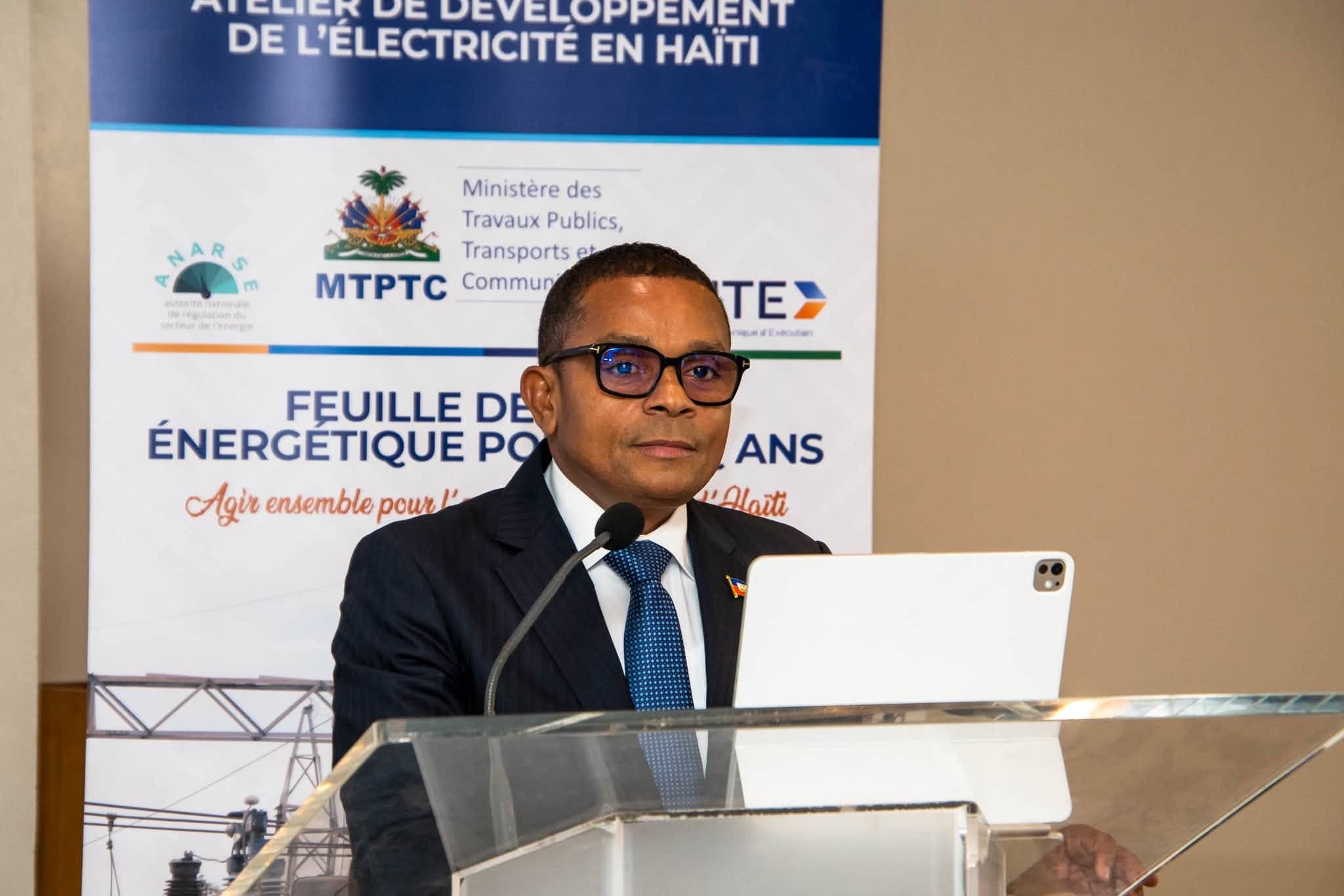
The Ministry of Public Works, Transport, Communications (MTPTC) organized a national workshop on planning and development of the electricity sector this Thursday at the Kinam hotel. The event, held with the Technical Execution Unit (UTE) of the Ministry of Economy and Finance and the National Authority for Regulation of the Electricity Sector (ANARSE), aimed to present two strategic documents: the Electrification Plan for Haiti and the Roadmap for the Transformation of the Electricity Sector. <\/p>
In his speech, Minister Joseph Almathe Pierre Louis advocated for a planning-focused approach, institutional discipline, and measurable results. The head of the MTPTC recalled the commitment he made upon taking office. "Haiti will not rise through improvisation. It will rise through discipline, planning, and institutional rigor," he said.<\/p>
The minister specified that these two instruments marked the transition from ad-hoc interventions to a structured and sustainable public policy. "Our ambition is not to produce more documents, but more electricity, more wealth, more jobs, and more opportunities," he stated, while also praising the work of ANARSE, the Energy Unit, Electricity of Haiti, and the Ministry of Economy and Finance.<\/p>
Energy, a matter of dignity and sovereignty<\/strong><\/p> For the minister, energy is not just about megawatts, power plants, or distribution networks. It is, in his view, a matter of human dignity, territorial justice, economic competitiveness, and national sovereignty. Almathe Pierre Louis mentioned agricultural irrigation in the Artibonite, the processing and preservation of products in the South, the cold chain for fishermen in Jérémie and Port-Salut, and businesses in Cap-Haïtien that could produce without relying on an expensive generator.<\/p> "We do not simply want to light up homes. We want to illuminate the prospects of our population," he asserted. The minister stressed a policy covering all ten departments, 149 communes, and 574 communal sections. "The birthplace of a citizen should never determine their right to progress," he added. <\/p> Six regional networks and decentralized solutions<\/strong><\/p> The plan provides for six regional networks, responsible for gradually ensuring the production, transport, distribution, and connection of users, with possibilities for interconnection when conditions permit. For remote localities and dispersed habitats, it relies on mini-grids and individual solar systems.<\/p> In the first phase, about 50 mini-grids could serve approximately 100,000 households, while autonomous solar systems could equip around 227,000 others.<\/p> The roadmap sets several targets: to raise the electricity access rate to 60%; to achieve 250,000 new connections, of which 150,000 will be through decentralized solutions; to bring technical and commercial losses below 35%; to have a reliable capacity of 200 megawatts in the metropolitan area and 80 megawatts elsewhere; and to train 500 technicians and managers.<\/p> The currently quantified investments are estimated between 5.7 and 5.9 billion US dollars. According to the minister, this envelope forms a basis for programming and mobilizing resources. It will need to be supplemented to meet long-term production needs, as electricity demand is expected to grow with the recovery of national production and improvement in living standards.<\/p> Projects already underway<\/strong><\/p> The minister highlighted that field action did not wait for the plan's completion. In Caracol, a solar power plant of 13.4 megawatts, equipped with a battery storage system, is under construction. It is set to strengthen the supply to Caracol, Limonade, Sainte-Suzanne, Trou-du-Nord, and Terrier-Rouge. In Jacmel, at the Monfleury site, a 4-megawatt solar power plant with storage is also under construction. The two projects together represent 17.4 megawatts of solar capacity.<\/p> Additionally, two pilot projects are in preparation in Les Cayes and Fort-Liberté. At the current stage of studies, each could reach 15 to 20 megawatts of solar production, with storage. Hybrid mini-grids are also planned or underway in Vallières, Mont-Organisé, Capotille, Tiburon, La Cahouane, Marfranc, Moron, Chambellan, Beaumont, Dame-Marie, Anse-d'Hainault, Dondon, Milot, Génipailler, and Carice. These interventions are at different stages: built infrastructure, ongoing construction, or projects in preparation.<\/p> Funding, governance, and training<\/strong><\/p> Engineer Almathe Pierre Louis warned that funding is not enough without effective governance and rigorous monitoring. The strategy will rely on public resources, concessional financing, donations, and private capital, in a transparent framework. He reminded the roles of each party: the government for strategic orientation, ANARSE for regulation, Electricity of Haiti for improving its performance, and the private sector for investment in a clear and predictable framework. Training technicians, engineers, and managers is, in his view, a strategic priority.<\/p> "A built power plant is not yet a victory if electricity does not reach users," noted Minister Pierre Louis, estimating that the true indicator of success will be the number of families and businesses sustainably served.<\/p>




Commentaires
Aucun commentaire pour le moment. Soyez le premier à réagir.