
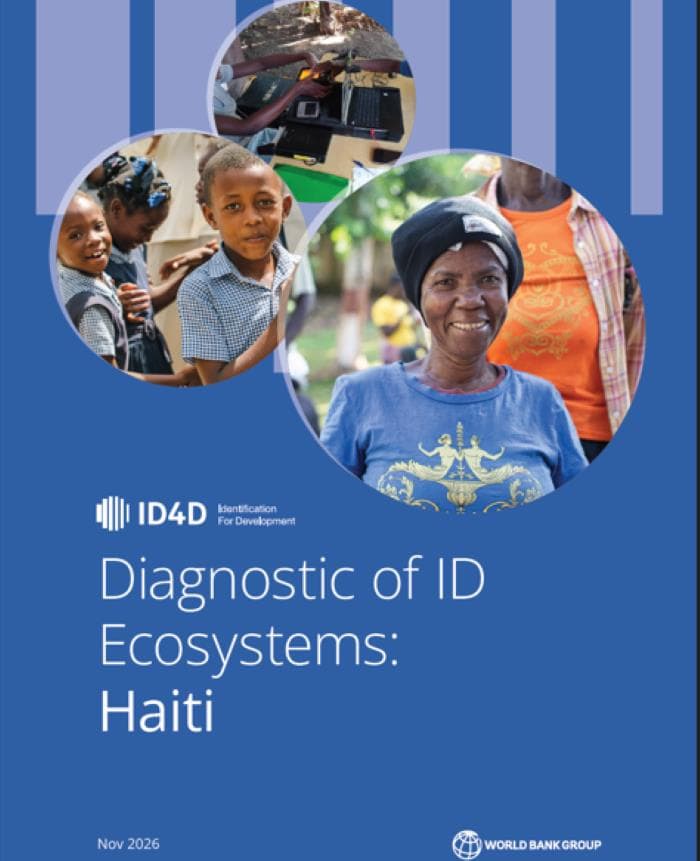
Between 2.7 and 3.1 million adult Haitians do not possess a valid Unique National Identification Card, according to estimates reported by the World Bank. Behind this administrative gap lie challenges in accessing financial services, formal employment, and social protection, which a new diagnosis aims to address.<\/strong><\/p> About one in three adults in Haiti still does not have a valid ID card. This estimate, presented by the World Bank in a statement dated October 27, 2026, announcing its "Ecosystem Identification Diagnosis: Haiti," highlights an obstacle to the economic participation of millions of citizens, namely being able to verify their identity to access services.<\/p> The issue goes beyond just having a document. According to the World Bank, identification gaps complicate the opening of a bank account or mobile money, access to formal employment, and the benefit of social assistance programs. A valid card does not guarantee credit or employment. Its absence can, however, add an administrative barrier to the economic difficulties already faced by households.<\/p> The problem also affects the institutions responsible for providing services. Insufficient identification systems make it more difficult to verify beneficiaries' identities and, according to the presented diagnosis, reduce the effectiveness of social protection programs.<\/p> "The weakness of identification systems also reduces the effectiveness of social protection programs," emphasizes Alexandre Amard, digital specialist at the World Bank Group and co-author of the report, quoted in the statement.<\/p> A Free Service That Leaves Costs for Households<\/strong><\/p> ID cards are officially free. However, according to the statement, obtaining them can nonetheless incur expenses: transport, repeated trips, informal fees, and lost income during the process.<\/p> For households with limited resources, the cost of a procedure is not just limited to the price of the document. The distance to the service point, delays, and the need to return can make a free procedure difficult to access.<\/p> The World Bank advocates bringing services closer to rural communities and areas affected by insecurity. It also recommends reducing wait times, ensuring the availability of materials, and enhancing service accountability to users.<\/p> The populations to prioritize include the 40% of the poorest households, residents of remote areas, internally displaced persons, and those who have been evicted. The diagnosis also highlights cultural obstacles that some women face in registering a birth and recommends support for single mothers.<\/p> These difficulties show that expanding coverage requires more than a national campaign: access modalities must take into account the specific constraints faced by the affected populations.<\/p> Real Progress, Indicators to Distinguish<\/strong><\/p> The World Bank highlights several advances. Unique National Identification Cards have been issued to about 67% of adults. Among children under five, 85% have been registered at birth, and 77% possess a birth certificate. These indicators describe two distinct situations: the registration of an event in the civil registry and the possession of the document that proves it.<\/p> Similarly, the absence of a valid card in an adult does not necessarily mean they have never been registered in the civil registry. Confusing these situations would obscure the diversity of processes and difficulties to be resolved, the statement specifies.<\/p> The statement also cites the 2020 decree establishing biometric cards equipped with a chip, as well as efforts to decentralize printing and increase service points. For the World Bank, these measures represent a foundation on which to continue reforms.<\/p> Financing and Governing the Reform<\/strong><\/p> The proposed program revolves around three pillars: inclusion, system design, and governance. It combines decentralization of services, registration campaigns, long-term funding, and clarification of institutional responsibilities.<\/p> The objective also includes making identification usable by public and private providers to verify the authenticity of titles and the validity of information. Anne-Lucie Lefebvre, World Bank Group Operations Manager in Haiti, presents this investment as "a strategic opportunity to promote inclusive and sustainable access to employment in Haiti."<\/p> However, modernization requires adapted rules. The diagnosis recommends clarifying the legal framework and adopting laws on data protection and cybersecurity. The capacity to verify identities must thus be accompanied by guarantees regarding the use of personal information.<\/p> The statement announces a diagnosis and recommendations, without a new financial envelope or detailed execution timeline. Translating this roadmap into accessible services will depend on a quantified national strategy, predictable resources, and clearly allocated responsibilities. It will remain essential to measure how many people actually obtain a valid title, at what cost to them, and within what timeframe.<\/p> Patrick SAINT-PRÉ <\/p>



Commentaires
Aucun commentaire pour le moment. Soyez le premier à réagir.