
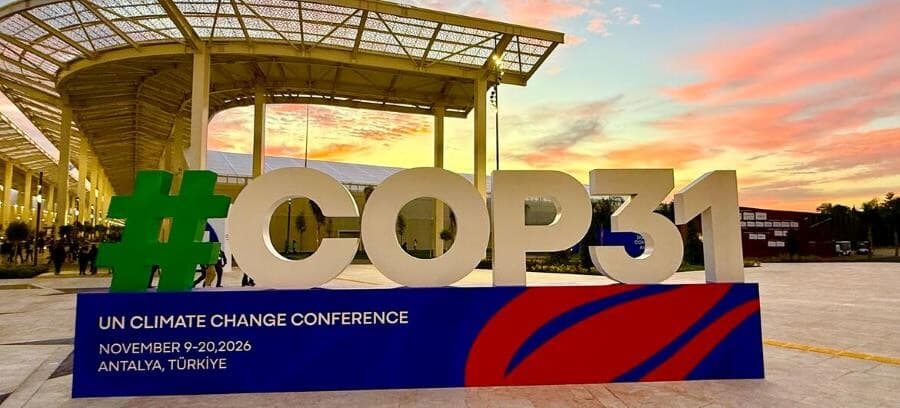
At COP31, negotiations are still stumbling over climate finance, fossil fuels, and adaptation. As ministers prepare to take over, new initiatives on artificial intelligence and green industrialization illustrate the growing role of technology in combating climate change.<\/strong><\/i><\/h2>As the United Nations Climate Conference (COP31) enters its second and final week, the halls of the conference center in Antalya, Turkey, are buzzing with activity once again. Ministers are arriving ahead of the high-level segment set to open on Tuesday, after seven days of technical negotiations, announcements, and speeches.<\/p>
The issues awaiting them are particularly sensitive. Who should finance climate action? How can the most vulnerable countries be helped to adapt? How can workers be protected during the energy transition? And most importantly, what will the final agreement say about the phased-out use of fossil fuels?<\/p>
Late Monday, Australia, a co-organizer of COP31 and responsible for presiding over the negotiations, presented an initial draft of a comprehensive decision. But this text serves only as a basis for discussion: countries remain divided over its content and even about the necessity of adopting such a decision.<\/p>
Ministers are expected to meet in a "Divan" — a term of Ottoman origin referring to an imperial assembly — to attempt to reach political compromises on the most contentious issues.<\/p>
A Mixed First Week<\/strong><\/h2>According to Soenke Kreft, a climate policy expert at the United Nations University, the negotiations resemble a football match entering its second half.<\/p>
"It is very likely there will be extra time too," he told UN News<\/i>.<\/p>
While some technical issues have progressed, much of the political arbitration remains to be done. "The first week has been somewhat slow," he acknowledged, stressing that it is "essential for the momentum to pick up during the second week."<\/p>
The dispute over the timeline for the next assessment report from the Intergovernmental Panel on Climate Change (IPCC<\/a>) illustrates these tensions. Countries remain divided over the publication date of this major scientific assessment. The most vulnerable nations want its conclusions available by 2028 so they can inform the second global stocktake (Global Stocktake<\/i>), which will evaluate progress made on implementing the 2015 Paris Agreement.<\/p>The current deadlock is delaying decisions on the scientific timeline and raises concerns that governments may approach the next stocktake without the latest comprehensive assessment of climate knowledge.<\/p>
"We must stand up for science. We must stand up for scientists," said Laurence Tubiana, CEO of the European Climate Foundation and one of the architects of the Paris Agreement, during a highly attended plenary session focused on scientific issues.<\/p>
Former Irish president Mary Robinson expressed the same concern: "The world cannot afford to weaken or lose the IPCC." She urged countries to overcome their differences to ensure the next report is published on time.<\/p>
Scientists also warned about the risk of temporarily exceeding the 1.5 °C warming threshold and stressed the need to base COP31 decisions on the most recent scientific data.<\/p>
Activists Warn of Diversion Risk<\/strong><\/h2>On the negotiation front, climate activists are cautioning against the risk that the proposed comprehensive decision might distract from the concrete measures expected from governments.<\/p>
"Ultimately, these framework decisions may become a mere distraction," warned a representative of the Climate Action Network, urging journalists to look beyond political statements.<\/p>
The network has criticized proposals to create a mechanism for "just transition" which would give workers and local communities a voice, while not necessarily providing them with the essential resources.<\/p>
One representative compared this situation to being invited "to sit at a table without food, without cutlery, without a plate, and with very bad wine."<\/p>
"Coal miners in Australia, lithium, cobalt, and platinum miners in Africa, as well as steelworkers in Germany, India, and the UK can no longer settle for mere dialogues," he added.<\/p>
Climate finance is also raising questions. Activists are particularly worried about the replenishment of key climate funds. The Solomon Islands, a small island state that is particularly vulnerable, were the first country to announce a contribution to the Green Climate Fund at this COP31, while commitments from wealthier nations were still awaited.<\/p>
 <\/figure><\/div>
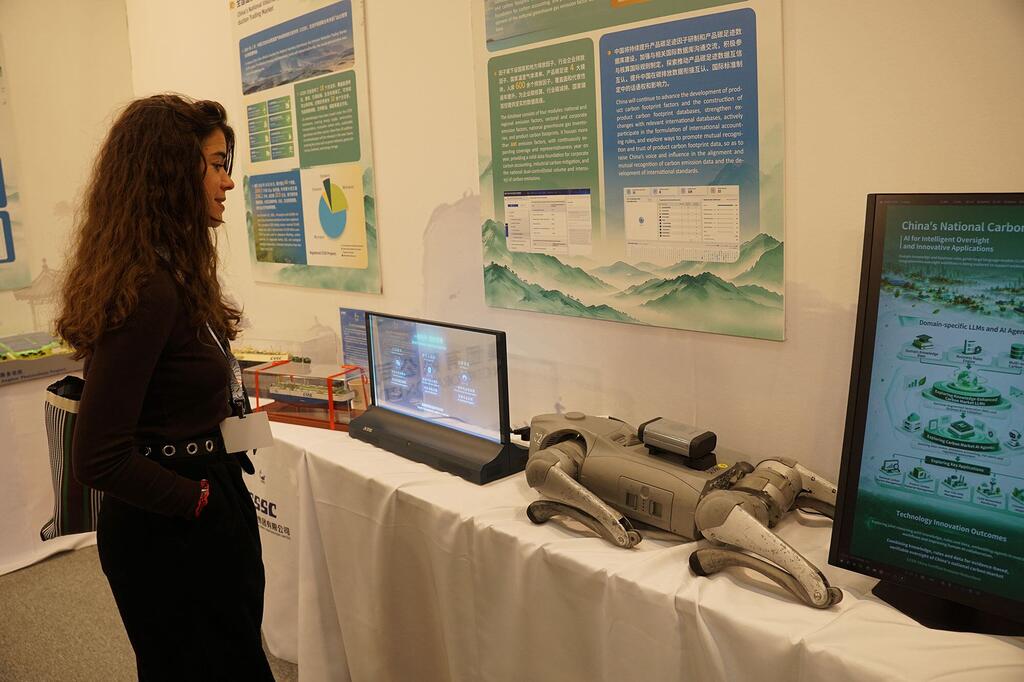
. An AI-powered technology showcased at the Chinese pavilion of COP31.<\/i><\/p>Can Artificial Intelligence Be a Climate Ally?<\/strong><\/h2>Predicting extreme weather phenomena, identifying vulnerable communities, or improving energy efficiency: artificial intelligence offers new opportunities to strengthen climate action. However, its development also has a significant environmental cost, due to the amounts of electricity and water needed to power models and data centers.<\/p>
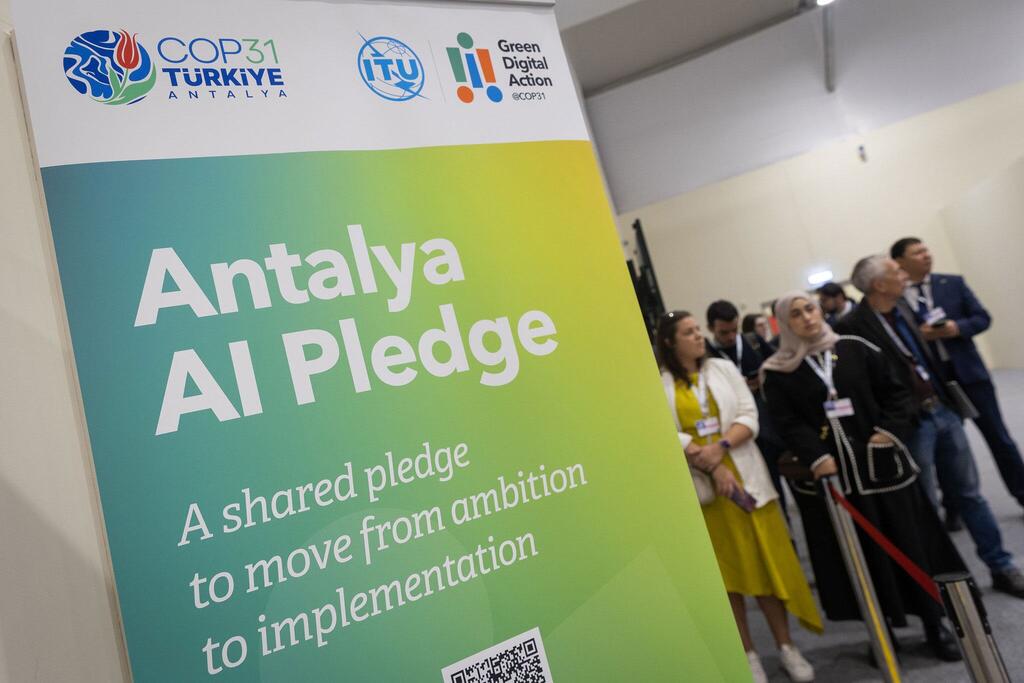
It is in this context that Turkey and the International Telecommunication Union (ITU) launched, during a ministerial meeting, the Antalya Commitment for Artificial Intelligence. The initiative had garnered 80 supporters and 271 commitments by Monday morning.<\/p>
This voluntary commitment aims to reduce the environmental footprint of AI by utilizing cleaner energy, more efficient infrastructures, better emissions monitoring, and expanded access to technologies, particularly in developing countries.<\/p>
ITU Deputy Secretary-General Tomas Lamanauskas warned that energy consumption from data centers powering AI could double by 2030. Some tech companies have already reported a 50% increase in their emissions in recent years.<\/p>
"This is a major challenge we must tackle if we want to […] ensure that AI is a solution and not the problem," he stated. However, he warned that the real test would be in implementation. The ITU intends to monitor progress and ensure that participants are held accountable for their commitments.<\/p>
 <\/figure><\/div>
AI is a topic of discussion at the United Nations Climate Conference in Antalya, Turkey.<\/p>
From Risk Management to Information Reliability<\/strong><\/h2>AI can already help governments better anticipate climate risks. Álvaro Rojas, from the United Nations University in Bonn, explained that his team used this technology to analyze 1,600 national disaster risk management documents. The exercise identified areas where countries need help facing climate-related loss and damage, as well as those where expertise is already available.<\/p>
"Technology is a tool," he reminded UN News<\/i>. "The tool itself is only useful if the users understand how it works."<\/p>
But the risks are also very real. A study conducted jointly by UNESCO<\/a> and University College London found that chatbots can challenge established climate facts when contested, and their reliability varies across languages.<\/p>These findings reinforce concerns that led to a joint initiative by the United Nations, Brazil, and UNESCO aimed at preserving the integrity of climate information, particularly in disaster situations.<\/p>
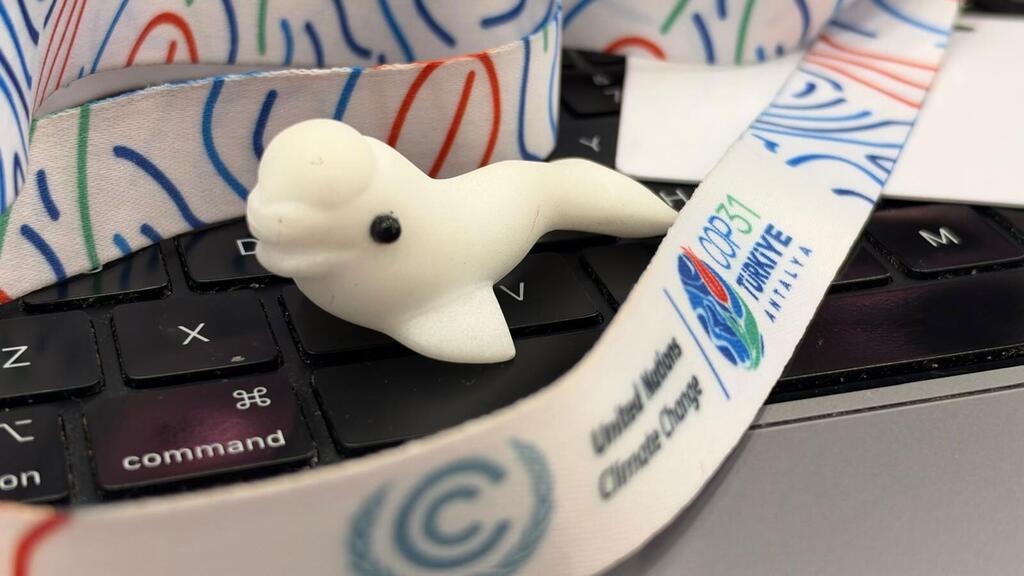
Artificial intelligence could also help solve the problem of fragmented scientific data. Brigitte Perrin, founder of Earth Info Hub and former UN official, is developing Beluga, a platform designed to centralize reliable scientific information.<\/p>
"All the scientific data produced daily by UN agencies and scientific organizations tends to be scattered and fragmented across multiple platforms and websites," she explains.<\/p>
The ambition is to create a centralized and secure space where decision-makers, journalists, and the general public can access reliable environmental research.<\/p>
 <\/figure><\/div>
ONG Earth Info Hub is developing Beluga, an AI platform designed to gather reliable scientific information.<\/p>
Decarbonizing the Industries that Shaped the Modern World<\/strong><\/h2>AI is not the only technology playing an increasingly significant role in discussions at COP31. Decarbonizing particularly polluting industrial sectors, such as steel and cement, is also among the priorities.<\/p>
During a ministerial meeting, several governments launched the Antalya Pact for Green Industrialization. This initiative aims to mobilize investments, develop markets for less polluting industrial products, and facilitate access for developing countries to new technologies.<\/p>
"Green industrialization is about transforming the dynamics of renewable energy into job-creating industrial opportunities, attracting investments, and enhancing energy security," explained Ciyong Zou, Deputy Director-General of the United Nations Industrial Development Organization (UNIDO<\/a>).<\/p>For Michael Apicelli, director of the Climate Club Secretariat, a coalition of 53 countries committed to reducing industrial emissions, solutions already exist.<\/p>
"This is not a new technology that we are all waiting for. It is already here. These technologies exist today. We just need to invest," he told UN News<\/i>.<\/p>
The urgency is heightened because investments in steel and cement production facilities can lock in technological choices for 30 to 40 years. The decisions made today will therefore significantly impact emissions for the coming decades.<\/p>
What might a cleaner industry look like? Peter Schniering, founder of Future Cleantech Architects, a German think tank specializing in climate innovation, mentions buildings designed to require less concrete and steel, as well as electric furnaces capable of reducing emissions related to steel production.<\/p>
"We have much more effective methods for designing buildings and using more low-carbon construction materials," he emphasizes.<\/p>
The challenge now is to make these technologies affordable and accessible at scale, especially in developing economies, where much of the new global infrastructure will be built.<\/p>
Other sectors, such as long-haul aviation, still require major technological advances. However, many of these solutions have a common prerequisite: access to more clean electricity.<\/p>
"Without electricity, it will be difficult to produce green hydrogen and decarbonize sectors such as aviation, maritime transport, or steel production," concluded Mr. Schniering.<\/p><\/div><\/div><\/div><\/div><\/div><\/div><\/div><\/div><\/div><\/div><\/div><\/div><\/div><\/div><\/div><\/div><\/div><\/div><\/div><\/div><\/div><\/div><\/div><\/div>
Lire aussi
 .com
Si vous avez déjà créé un compte, connectez-vous GRATUITEMENT pour lire la suite de cet article.
Connectez-vousPas encore de compte ? Inscrivez-vous
EconomieL’IFOS : 25 ans d’existence dans le renforcement du développement en Haïti
According to Soenke Kreft, a climate policy expert at the United Nations University, the negotiations resemble a football match entering its second half.<\/p>
"It is very likely there will be extra time too," he told UN News<\/i>.<\/p>
While some technical issues have progressed, much of the political arbitration remains to be done. "The first week has been somewhat slow," he acknowledged, stressing that it is "essential for the momentum to pick up during the second week."<\/p>
The dispute over the timeline for the next assessment report from the Intergovernmental Panel on Climate Change (IPCC<\/a>) illustrates these tensions. Countries remain divided over the publication date of this major scientific assessment. The most vulnerable nations want its conclusions available by 2028 so they can inform the second global stocktake (Global Stocktake<\/i>), which will evaluate progress made on implementing the 2015 Paris Agreement.<\/p> The current deadlock is delaying decisions on the scientific timeline and raises concerns that governments may approach the next stocktake without the latest comprehensive assessment of climate knowledge.<\/p> "We must stand up for science. We must stand up for scientists," said Laurence Tubiana, CEO of the European Climate Foundation and one of the architects of the Paris Agreement, during a highly attended plenary session focused on scientific issues.<\/p> Former Irish president Mary Robinson expressed the same concern: "The world cannot afford to weaken or lose the IPCC." She urged countries to overcome their differences to ensure the next report is published on time.<\/p> Scientists also warned about the risk of temporarily exceeding the 1.5 °C warming threshold and stressed the need to base COP31 decisions on the most recent scientific data.<\/p> On the negotiation front, climate activists are cautioning against the risk that the proposed comprehensive decision might distract from the concrete measures expected from governments.<\/p> "Ultimately, these framework decisions may become a mere distraction," warned a representative of the Climate Action Network, urging journalists to look beyond political statements.<\/p> The network has criticized proposals to create a mechanism for "just transition" which would give workers and local communities a voice, while not necessarily providing them with the essential resources.<\/p> One representative compared this situation to being invited "to sit at a table without food, without cutlery, without a plate, and with very bad wine."<\/p> "Coal miners in Australia, lithium, cobalt, and platinum miners in Africa, as well as steelworkers in Germany, India, and the UK can no longer settle for mere dialogues," he added.<\/p> Climate finance is also raising questions. Activists are particularly worried about the replenishment of key climate funds. The Solomon Islands, a small island state that is particularly vulnerable, were the first country to announce a contribution to the Green Climate Fund at this COP31, while commitments from wealthier nations were still awaited.<\/p> . An AI-powered technology showcased at the Chinese pavilion of COP31.<\/i><\/p> Predicting extreme weather phenomena, identifying vulnerable communities, or improving energy efficiency: artificial intelligence offers new opportunities to strengthen climate action. However, its development also has a significant environmental cost, due to the amounts of electricity and water needed to power models and data centers.<\/p> It is in this context that Turkey and the International Telecommunication Union (ITU) launched, during a ministerial meeting, the Antalya Commitment for Artificial Intelligence. The initiative had garnered 80 supporters and 271 commitments by Monday morning.<\/p> This voluntary commitment aims to reduce the environmental footprint of AI by utilizing cleaner energy, more efficient infrastructures, better emissions monitoring, and expanded access to technologies, particularly in developing countries.<\/p> ITU Deputy Secretary-General Tomas Lamanauskas warned that energy consumption from data centers powering AI could double by 2030. Some tech companies have already reported a 50% increase in their emissions in recent years.<\/p> "This is a major challenge we must tackle if we want to […] ensure that AI is a solution and not the problem," he stated. However, he warned that the real test would be in implementation. The ITU intends to monitor progress and ensure that participants are held accountable for their commitments.<\/p> AI is a topic of discussion at the United Nations Climate Conference in Antalya, Turkey.<\/p> AI can already help governments better anticipate climate risks. Álvaro Rojas, from the United Nations University in Bonn, explained that his team used this technology to analyze 1,600 national disaster risk management documents. The exercise identified areas where countries need help facing climate-related loss and damage, as well as those where expertise is already available.<\/p> "Technology is a tool," he reminded UN News<\/i>. "The tool itself is only useful if the users understand how it works."<\/p> But the risks are also very real. A study conducted jointly by UNESCO<\/a> and University College London found that chatbots can challenge established climate facts when contested, and their reliability varies across languages.<\/p> These findings reinforce concerns that led to a joint initiative by the United Nations, Brazil, and UNESCO aimed at preserving the integrity of climate information, particularly in disaster situations.<\/p> Artificial intelligence could also help solve the problem of fragmented scientific data. Brigitte Perrin, founder of Earth Info Hub and former UN official, is developing Beluga, a platform designed to centralize reliable scientific information.<\/p> "All the scientific data produced daily by UN agencies and scientific organizations tends to be scattered and fragmented across multiple platforms and websites," she explains.<\/p> The ambition is to create a centralized and secure space where decision-makers, journalists, and the general public can access reliable environmental research.<\/p> ONG Earth Info Hub is developing Beluga, an AI platform designed to gather reliable scientific information.<\/p> AI is not the only technology playing an increasingly significant role in discussions at COP31. Decarbonizing particularly polluting industrial sectors, such as steel and cement, is also among the priorities.<\/p> During a ministerial meeting, several governments launched the Antalya Pact for Green Industrialization. This initiative aims to mobilize investments, develop markets for less polluting industrial products, and facilitate access for developing countries to new technologies.<\/p> "Green industrialization is about transforming the dynamics of renewable energy into job-creating industrial opportunities, attracting investments, and enhancing energy security," explained Ciyong Zou, Deputy Director-General of the United Nations Industrial Development Organization (UNIDO<\/a>).<\/p> For Michael Apicelli, director of the Climate Club Secretariat, a coalition of 53 countries committed to reducing industrial emissions, solutions already exist.<\/p> "This is not a new technology that we are all waiting for. It is already here. These technologies exist today. We just need to invest," he told UN News<\/i>.<\/p> The urgency is heightened because investments in steel and cement production facilities can lock in technological choices for 30 to 40 years. The decisions made today will therefore significantly impact emissions for the coming decades.<\/p> What might a cleaner industry look like? Peter Schniering, founder of Future Cleantech Architects, a German think tank specializing in climate innovation, mentions buildings designed to require less concrete and steel, as well as electric furnaces capable of reducing emissions related to steel production.<\/p> "We have much more effective methods for designing buildings and using more low-carbon construction materials," he emphasizes.<\/p> The challenge now is to make these technologies affordable and accessible at scale, especially in developing economies, where much of the new global infrastructure will be built.<\/p> Other sectors, such as long-haul aviation, still require major technological advances. However, many of these solutions have a common prerequisite: access to more clean electricity.<\/p> "Without electricity, it will be difficult to produce green hydrogen and decarbonize sectors such as aviation, maritime transport, or steel production," concluded Mr. Schniering.<\/p><\/div><\/div><\/div><\/div><\/div><\/div><\/div><\/div><\/div><\/div><\/div><\/div><\/div><\/div><\/div><\/div><\/div><\/div><\/div><\/div><\/div><\/div><\/div><\/div> Si vous avez déjà créé un compte, connectez-vous GRATUITEMENT pour lire la suite de cet article. Pas encore de compte ? Inscrivez-vousActivists Warn of Diversion Risk<\/strong><\/h2>
<\/figure><\/div>Can Artificial Intelligence Be a Climate Ally?<\/strong><\/h2>
<\/figure><\/div>From Risk Management to Information Reliability<\/strong><\/h2>
<\/figure><\/div>Decarbonizing the Industries that Shaped the Modern World<\/strong><\/h2>
Lire aussi
.comL’IFOS : 25 ans d’existence dans le renforcement du développement en Haïti




Commentaires
Aucun commentaire pour le moment. Soyez le premier à réagir.