
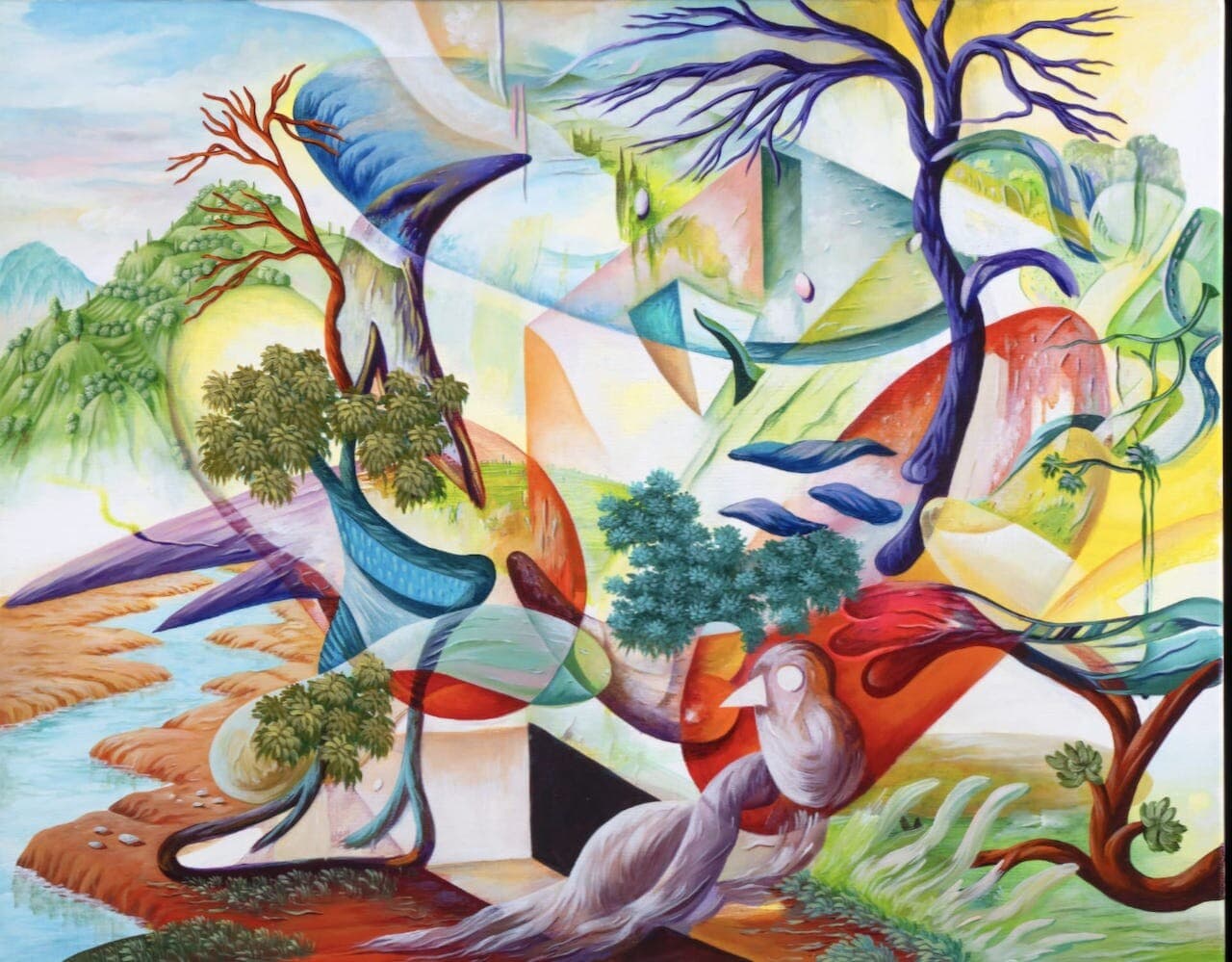
On the occasion of his visit to the exhibition <\/strong>“From Chaos to Light”<\/strong><\/i> by Haitian artist Kévens Prévaris, presented at the Brachot Gallery in Brussels from November 5 to 14, 2026, H.E. Dr. Alrich Nicolas, Ambassador of the Republic of Haiti to Belgium, provides an illuminating reading of the artist's pictorial universe. Amidst a break from traditional currents, chromatic boldness, and a dialogue with Western modernity, he highlights a singular artistic adventure driven by a quest for freedom and the reinvention of Haitian painting.<\/strong><\/p> Haitian painting is marked by a constant tension between tradition and modernity, between the quest for authenticity and openness to external currents, causing it to oscillate from one pole to the other. Kévens Prévaris' painting uniquely fits into this tension. After adopting, in his early works, the dominant pictorial language (naïve art and indigenism), he has been undertaking a radical break from these currents for over a decade, clearly asserting his ambition to participate in the reinvention of painting and its codes. The canvases in this exhibition bear the traces of this particular journey: they testify to the power of an aesthetic that seeks to deconstruct the classical registers of Haitian painting in order to reinvent them.<\/p> From Pictorial Indigenism to Modernist Break<\/strong><\/i><\/p> The paintings from the first period are all imbued with naïve art. Kévens Prévaris explores the iconography particular to this current: the thatched cottage, the dirt road running through the village, the sea and the wooden boats, a lush landscape, perspective and horizon blocked by mountains, all bathed in a reddish light. The earthquake of 2010 shifts this naïve view and imposes a chaotic approach to reality. The collapse of several museums and galleries, the destruction of numerous artworks, the experience of urban chaos hasten the emergence of new pictorial approaches and evoke a new imagery.<\/p> This movement does not really disrupt the other side of Haitian painting, which has developed since the 1950s within the Foyer des Arts plastiques<\/i> or the Galerie Brochette<\/i>, pioneers of Haitian modernism. The best-known painters of this current, Max Pinchinat and Lucien Price, establish another tension in Haitian painting: between the affirmation of abstract expressionism and surrealism, between the spirituality of a Saint-Soleil and Western avant-garde.<\/p> Experimental Landscape. 2008<\/strong><\/p> The Loray<\/i> movement, created in 2004 and of which Kévens Prévaris is one of the founders, is permeated by this same tension. Some canvases produced in 2012 and 2013, such as The Dancer<\/i> or Bike and Eye<\/i>, whose lines recall the cubism or abstract expressionism of Télémaque, bear witness to the negotiation that the painter engages with these currents. The exhibition presented in Canada during his residency in 2018 marks a moment of exchange with surrealism, in paintings filled with hybrid signs, Haitian and European. Prévaris also integrates into his painting from this time one of the central figures of voodoo, Kouzen Zaka, without truly incorporating this religion into his iconography. It is also during this time that the painter discusses, in interviews, themes of environment, injustice, and political oppression.<\/p> The European Experience and Transformations of the Work<\/strong><\/i><\/p> Kévens Prévaris arrives in Brussels in 2011, bringing with him the still-fresh memory of the earthquake, the ENARTS years, and the teaching of the humanities. This stage of his career is decisive. He undertakes studies at the École nationale supérieure des arts visuels de La Cambre and engages in what can be termed a long pedagogy of sight: regular attendance at museums and galleries, critical observation of Western painting, encounters with major currents of European modernism, friendships with contemporary painters.<\/p> Until then, the painter had only approached this painting through the prism of art books and catalogs, never exploring it up close in galleries or museums. His presence in Brussels and his higher studies in visual arts allow him to develop an intimate knowledge of European painting and to establish an intense dialogue with Western pictorial schools. However, no clear filiation can be discerned in his work, except for surrealism, which he often claims, and a few figures like Picasso and Salvador Dalí. Prévaris blurs the tracks of his confrontation with Western painting and erases its traces.<\/p> It is as if the painter, while opening up to Western tradition, simultaneously opposed a resistance to preserve his sensitivity and freedom, preventing it from reaching his identity core. Prévaris thus imposes the terms of an open and demanding dialogue with the West, conducive to the construction of a unique pictorial discourse, which he masterfully asserts in the works of the exhibition.<\/p> The Marks of Kévens Prévaris' Originality<\/strong><\/i><\/p> The confrontation with Western painting is manifested by an original treatment of the space of the canvas. The dominance of flat areas of color, mostly reds and yellows, that characterize all the paintings in the exhibition participates in a critique of representation. These flat areas do not refer to any external place to the canvas; they take up all the space. The painter barely spares, in an accessory manner, in a corner of the canvas or in its center, a tree as a sign of a clear reference to Haiti.<\/p> Kévens Prévaris' painting deconstructs the notion of representation. It is not afraid to be opaque, self-referential. Faced with this abstract painting, eager to grasp its meaning, the viewer may be tempted to resort to a grammar of colors or to spot in the canvas codes that would enable them to understand the paintings. But the painter offers them no key. The viewer is free to interpret; the painter does not bother to guide their gaze with clues or leads. On the contrary, the variety of perspectives inscribed in the canvas and the profusion of colors oppose any immediate readability. What, at first glance, appears as an abandonment must be understood as a mark of respect. Before the canvas, the viewer enjoys their full autonomy and becomes, alongside the painter, the co-creator of the work.<\/p> It is this freedom of vision that gives strength to Kévens Prévaris' painting. His paintings contribute to an enterprise of rehabilitation of painting as art. The representation of the real world is like buried under the flat areas of color, a way of restoring to painting its autonomy. According to him, it should not be a vector for mediating meaning, nor decorative or narrative, but open to interpretation and dialogue.<\/p> The painter's involvement in the Brussels space and his active participation in the artistic life of this city place him within a transnational network of cultural exchanges and plastic experimentation. The exhibited paintings are those of maturity. They affirm the choice, made for many years, to trace an untroubled dialogue path between Western painting, the internal Haitian painting, and that of the diaspora.<\/p> <\/figure>
 <\/figure>
 <\/figure>
 <\/figure>

Commentaires
Aucun commentaire pour le moment. Soyez le premier à réagir.