
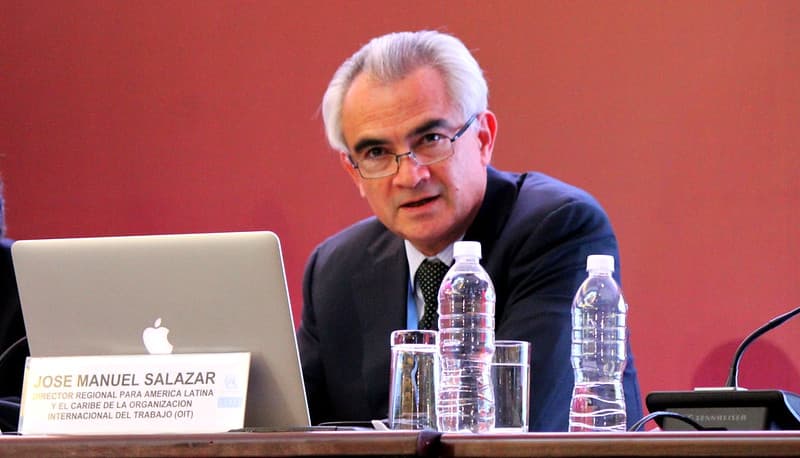
The fifth meeting of the Conference on Science, Innovation and ICT of ECLAC opened on November 24, 2026, in Brasilia, Brazil, bringing together policymakers, representatives of international organizations, and specialists from the region.<\/i><\/p>
Latin America and the Caribbean need policies in science, technology, and innovation (STI) articulated with productive development policies, as well as a regional cooperation program with concrete priorities and effective implementation mechanisms. This was affirmed by the participants at the opening on Tuesday, November 24, 2026, of the fifth meeting of the Conference on Science, Innovation and Information and Communication Technologies (ICT) of the Economic Commission for Latin America and the Caribbean (ECLAC), organized in collaboration with the Ministry of Science, Technology and Innovation (MCTI) of Brazil.<\/p>
“Latin America and the Caribbean must strengthen their capacity for growth in a more dynamic, inclusive, and sustainable manner. Science, technology, and innovation are essential to achieve this,” said José Manuel Salazar-Xirinachs, Executive Secretary of ECLAC, during the inaugural session of the Conference. Also present were Marlova Jovchelovitch Noleto, Director and Representative of the United Nations Educational, Scientific and Cultural Organization (UNESCO) in Brazil; Claudia Benavides, Minister of Science, Technology and Innovation of Colombia; and Luciana Santos, Minister of Science, Technology and Innovation of Brazil.<\/p>
Increasing investment in science, technology, and innovation remains necessary in Latin America and the Caribbean, but it is not enough, emphasized ECLAC's highest official. “We need STI policies that are much better articulated with productive development policies, with concrete priorities and effective coordination and implementation mechanisms. It is not just about producing more knowledge, but about transforming that knowledge into innovation, productivity, new business opportunities, and solutions to the challenges our societies face. The Conference on Science, Innovation and Information and Communication Technologies has provided a privileged space to advance in this direction,” highlighted José Manuel Salazar-Xirinachs.<\/p>
“The fifth meeting of the Conference on Science, Technology and ICT of ECLAC, which we inaugurate today,” insisted Mr. Salazar-Xirinachs, “must allow us to take a new step in regional cooperation: moving from a program primarily focused on analysis and capacity building to a program more oriented towards implementation, institutional strengthening, cooperation, and the production of regional public goods. It is in this spirit that we envision the 2027-2028 period.”<\/p>
Marlova Jovchelovitch Noleto, Director and Representative of UNESCO in Brazil, noted that the fifth meeting of the Conference on Science, Innovation and ICT is being held jointly with the fifth edition of the Open Forum on Science in Latin America and the Caribbean (CILAC). While commending “the development of a common program” between ECLAC and UNESCO, Ms. Jovchelovitch Noleto stated that “this convergence marks a historic milestone for our region. It is not merely an organizational coincidence but a strategic decision aimed at strengthening coordination between multilateral organizations and responding to a legitimate demand from our member states for greater coherence, better efficiency, and increased collective impact.”<\/p>
For her part, Claudia Benavides, Minister of Science, Technology and Innovation of Colombia — the country that holds the presidency of the Conference for the period 2024-2026 — stated: “We have reached this new stage with a conviction that the Colombian government has embraced: science, technology, and innovation are not just an additional sector within public policies but a development axis for every country.”<\/p>
She further added, “A particularly crucial responsibility unites us: that of contributing to defining the role that Latin America and the Caribbean will play in an increasingly knowledge-driven and technologically-capable global economy.”<\/p>
During the inauguration, the Minister of Science, Technology and Innovation, Luciana Santos, emphasized that Brazil will chair the Conference for the next biennium, with a commitment to strengthen regional integration, broaden scientific cooperation, and reduce inequalities among countries in Latin America and the Caribbean.<\/p>
“Our region is rich in valuable initiatives in the fields of science, technology, and innovation; however, we must avoid the dispersion of efforts and the duplication of programs. Our goal is to channel these energies, establish strong regional governance, and give the common will of Latin America and the Caribbean more weight and a leading role in international forums and organizations, in order to influence the global agenda in the interest of our populations,” the minister indicated.<\/p>
At the inaugural session, Marco Llinás, Director of the Division of Productive and Entrepreneurial Development at ECLAC, presented a reference document titled *Policies for Science, Technology, and Innovation for Sustainable and Inclusive Productive Development: Challenges, Regional Coordination, and Guidelines for the 2027-2028 Period*.<\/p>
This publication reviews the work of the Conference for the period 2024-2026, evaluates policies in information and communication technologies (ICT), analyzes the regional governance of science, technology, and innovation, and proposes a regional work program for the biennium 2027-2028.<\/p>
“The gap with the most technologically advanced economies has widened at a time when the accumulation of scientific and technological capabilities has become an increasingly central issue in geopolitics and geo-economics. To put regional efforts into perspective, one can compare the research and development (R&D) expenditures of Latin America and the Caribbean to those of major tech companies. In 2024, for example, Amazon spent about $89 billion on R&D, nearly double the total amount of the region’s spending,” emphasizes the document.<\/p>
Brazil is above the regional average, with spending of around 1.2% of its GDP in 2023. Uruguay shows an upward trend, increasing from about 0.3% at the beginning of the period to nearly 0.7%. Most countries in the region are below 0.4%, and several remain below the 0.2% mark. Argentina, Brazil, and Mexico account for about four-fifths of total regional spending, highlighting a strong dependence on a small number of economies.<\/p>
The document highlights that the region has the opportunity to spur cooperation efforts, connect them, and ensure their continuity. Latin America and the Caribbean have valuable knowledge, institutions, networks, and experiences. The challenge lies in better linking these efforts, ensuring the continuity of cooperation — while maintaining focus on the contribution of ICT to productive development — and mobilizing them to develop policies that can promote a more dynamic, inclusive, and sustainable productive transformation.<\/p>
The meeting in Brasilia includes five panels on themes such as: regional governance in science, technology, and innovation (STI); developing new forms of links between universities and businesses; challenges related to technology diffusion and technology transfer services; STI policies adapted to territories with varied dimensions and geographical contexts; as well as strategic and technological agendas.<\/p>
Source: cepal.org<\/p>



Commentaires
Aucun commentaire pour le moment. Soyez le premier à réagir.