
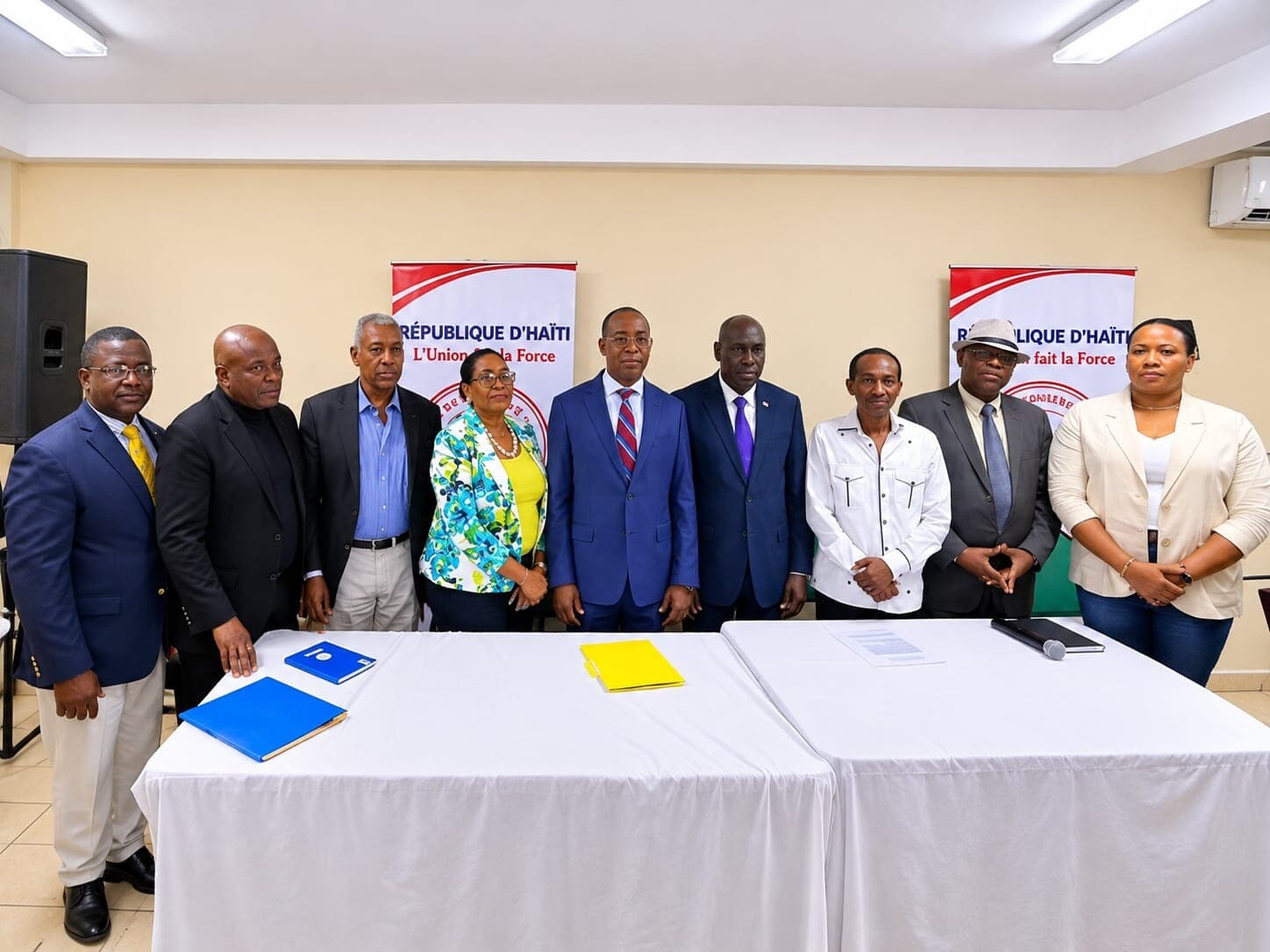
The National Consensus Assembly (NCA) announced, on Thursday, November 26, 2026, the establishment of its Orientation and Monitoring Council (OMC). The new body brings together "representatives from the ten geographical departments, the diaspora, political parties and churches and religious communities, socio-professional organizations, civil society, and other vital forces of the nation." In total, 33 personalities would be part of the OMC: 11 are from civil society, 11 come from the political world, while the remaining 11 are representatives from the ten departments of the country and the diaspora. "The process has not been easy. We had to travel to the departments, meet with local dignitaries, form departmental councils which, in turn, chose a president, and each of these councils sent a representative," explains the NCA president, Jean Lucien Ligondé.
The council's role, according to NCA officials, revolves around four main axes: coordinating the NCA, reflecting on proposals aimed at pulling the country out of the crisis, mobilizing actors, and coordinated action. Far from setting unrealistic goals, council members will be tasked with ensuring the implementation of the directions of the National Consensus Assembly, recorded in the NCA Manifesto, adopted during the meetings on October 8 and 9, 2026. "Our goal is not to take power," assures Mr. Ligondé. The objective, according to him, would be to unite Haitians from all walks of life and to forge a consensus to pull the country out of the political, economic, and social morass it finds itself in while creating the conditions to prevent the country from sinking back into it in the future. Meanwhile, Jimmy Albert, the executive director of the Gathering for National Understanding (REN), a civil society organization that initiated the meetings which led to the formation of the NCA, speaks of a "national awakening" to re-enter the country into a "new cycle."

Commentaires
Aucun commentaire pour le moment. Soyez le premier à réagir.