
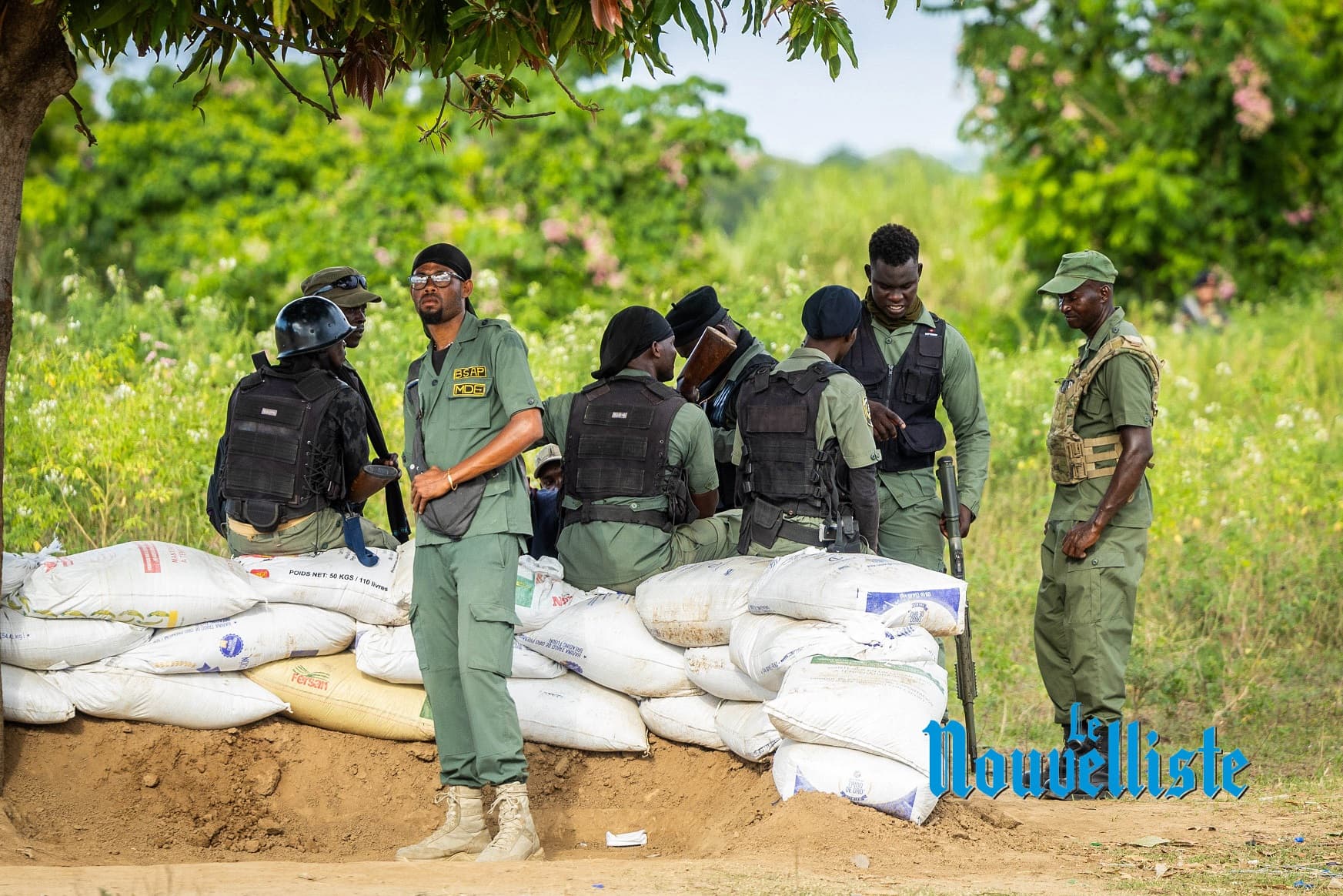
The pride lies not in the old shotgun slung over the back of a young man in camouflage, but in the cause he defends. This young BSAP agent in his twenties sits under a mango tree in the locality of Pitobert in Ouanaminthe, where construction work on the Massacre River is underway. In front of him, bags of earth serve as fortifications to shield against "the enemy." However, onlookers seated on the sandbags block his view. He is reprimanded by his superior. "Guard, you mustn't let people obstruct your view. Your gaze must be fixed on the Dominican military right in front," orders the troop leader. The young man, nervous, clears everyone from the area. "Only journalists are allowed to stay here, just for five minutes," he asserts.
There is no tension, no signs of aggression on either side of the border. On the opposite side, Dominican military personnel, who have also erected their wall of sandbags, secure workers in the finalization of a border fence. The Haitians tend to their own affairs. In the absence of the Haitian National Police or the Haitian Armed Forces, the agents of the Protected Areas Surveillance Brigade are the only "armed forces" on the Haitian side. They escort political figures, artists, donors... In their behavior, attitude, demeanor, and attire, they resemble military personnel or agents of specialized units in a police force. Everything is about pride and determination. "We are neither soldiers nor police officers, but environmental guards," reminds the one who identifies as the leader of his team. Guards who have been alongside the population since August 30, 2023, the first day of the 2023 version of the Massacre River canal project by local farmers. The troop leader is unable to specify the number of "guards." "We are numerous. Some work during the day, others at night," he reveals.



Commentaires
Aucun commentaire pour le moment. Soyez le premier à réagir.