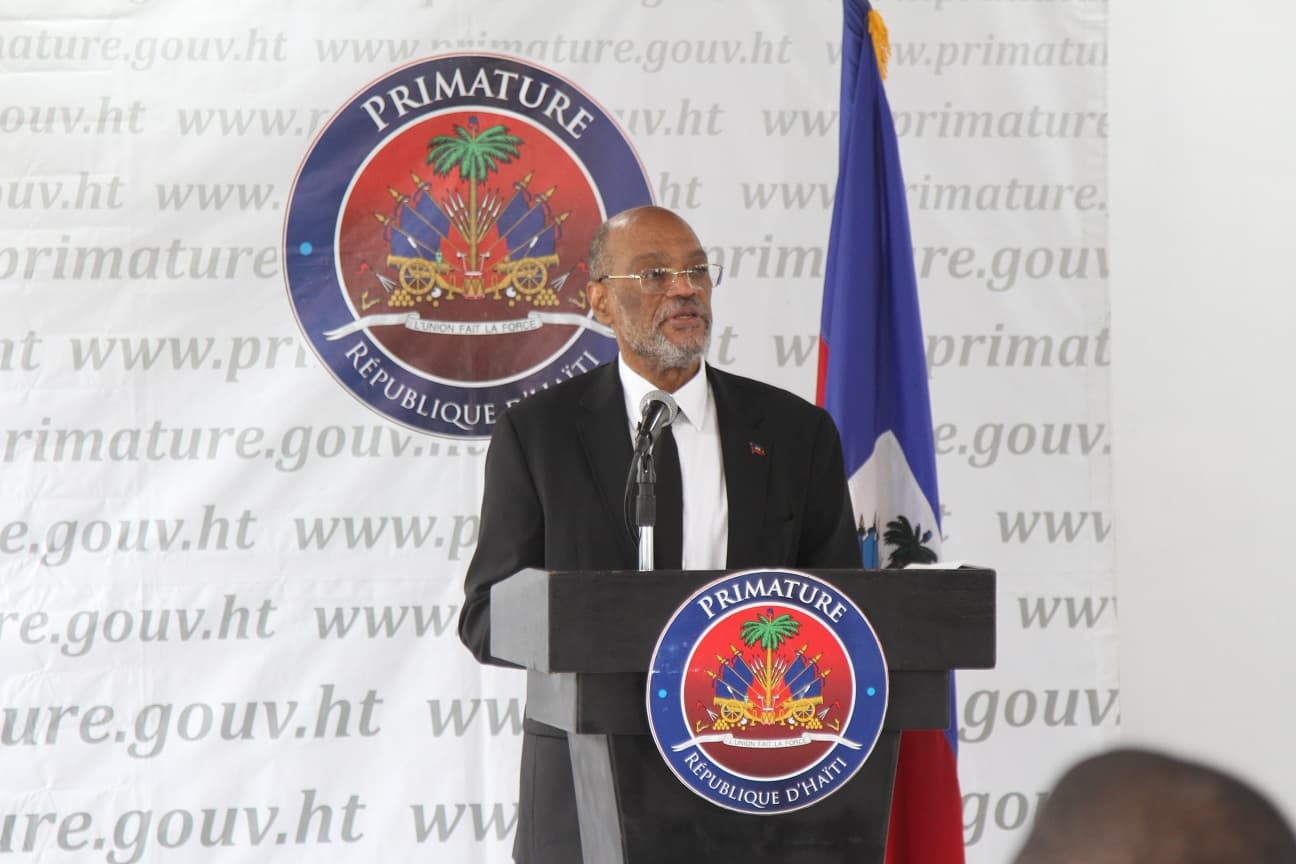
The United States and a significant portion of the international community have provided political support to Prime Minister Ariel Henry's government since he came into power. Encouraged by his "mentors," Prime Minister Henry has waged a battle against smugglers with some success. His performances have been praised by the IMF.
Prime Minister Ariel Henry has aligned himself with the stance of his mentors, imposing sanctions against gang leaders, highly influential politicians for their ties to gangs, and others for their involvement in international drug trafficking. Prominent figures from the private business sector have also faced sanctions. Under Ariel Henry's leadership, the judiciary has recently charged other key figures belonging to the inner circle of associates, friends, and collaborators of President Jovenel Moïse, who was assassinated on July 7, 2021. The country has become a cage in which the population finds itself amidst enraged lions.
Prime Minister Ariel Henry, trapped within the prison of power ambitions of some of his allies – himself drawn to power – has failed to understand that in politics, one must do everything to orchestrate a graceful exit. His own is chaotic. He is tossed about, diminished, humiliated. He stands alone facing his fate, only partially exploring the distress of those forced to flee gang violence. As hatred and burning anger crystallize, almost everyone forgets willingly that this Ariel Henry is the current representative of Haiti, a country slipping, and being allowed to slip further, into chaos and terror.
In light of what is unfolding, there are only a few boxes left to tick to arrive at the understanding that we may be facing a classic coup d'état.
The time the country lacks is the time Mr. Henry and his allies have taken to play their petty political maneuvers, intoxicated by power. The time wasted is the time squandered by oppositions seizing the opportunity amid chaos. Time, fundamentally, is the greatest enemy of politicians of all stripes, with their destructive practices, their petty tactics always leading to disastrous consequences for the Haitian population.
That said, the leaders who rise to power with pomp, who flee shamefully in the night aboard a "Foreign" chartered plane, who are killed in power, are numerous in our history. While waiting for more clarity to understand the ins and outs of what has been unfolding in Haiti since February 29, the most troubling aspect lies elsewhere.
Why have Prime Minister Ariel Henry's mentors given him political support but not the security backing to tackle Haiti's main problem, insecurity, the deadly violence of armed gangs? The Henry government acknowledged its incapacity, cried out for help on October 6, 2022, when it requested the UN to send an international force to support the PNH. In March 2024, this support is in the limbo of diplomatic bureaucracy. A health crisis is looming with an unprecedented event in Haiti's recent history, the looting of public and private hospitals, the problem of access or lack of supplies such as oxygen, blood products, fuel, water. The impossible connection between provincial and foreign markets with those of Port-au-Prince reduces the availability of food and other products. An international port, home to the National Port Authority (APN), and an international airport are on the verge of falling under the control of armed gangs. If this happens, it will constitute a clear breach of regional security.
At the moment, hours, not even days, are wasted on the peripherals of an almost manufactured problem with Ariel Henry, stranded in Porto Rico. This created embarrassment is at the very least surprising. Generally, Haitian politicians do not resist when the Americans signal the end of their regime. Ariel Henry, who does not even lace his shoes without informing the relevant party (the White), could he be showing resistance to the Americans' new plan to initiate the second phase of political transition without him? There is no known answer to this question.
But there are evidences. Firstly, the post-July 7, 2021 management is terrible, deadly for the population. The private business sector, from the neighborhood shop to the department store, suffers the consequences of a terrible crisis. It becomes impoverished, is impoverished. If this is intentional, one should then wonder why? Why do we let these killings, these destructions of property continue? The blood of all humans, regardless of race, has the same color. Perhaps not the same value in everyone's eyes. And that's a shame.
Nevertheless, we must face the coming days. It will undoubtedly be difficult for many to speak out without fear of reprisals. Port-au-Prince could well resemble Kabul. But those who can must emphasize that we must be careful about how the post-Ariel Henry situation unfolds.Even though this hated Prime Minister failed to generate any consensus, his overthrow by armed gangs simply heralds the return to the armed conflicts and government overthrows witnessed throughout the 19th and early 20th centuries in Haiti. Force imposes itself. It does not necessarily create consensus. The troubling history of the new strongmen, the perplexing opportunism of politicians willing to associate with anything to gain or enjoy power, is nothing new. The truth is that the balance of power is not in favor of progressives. Nor is it in favor of this tired, exasperated people, ready to endure the rule of new masters just to live another day, just to be able to return home. As usual, some are laughing. They amuse themselves with the troubles of a hated head of government, without considering their own fate. Today more than ever, the country's disintegration is evident. The saddest part is that the worst is still possible.
 .com



Commentaires
Aucun commentaire pour le moment. Soyez le premier à réagir.