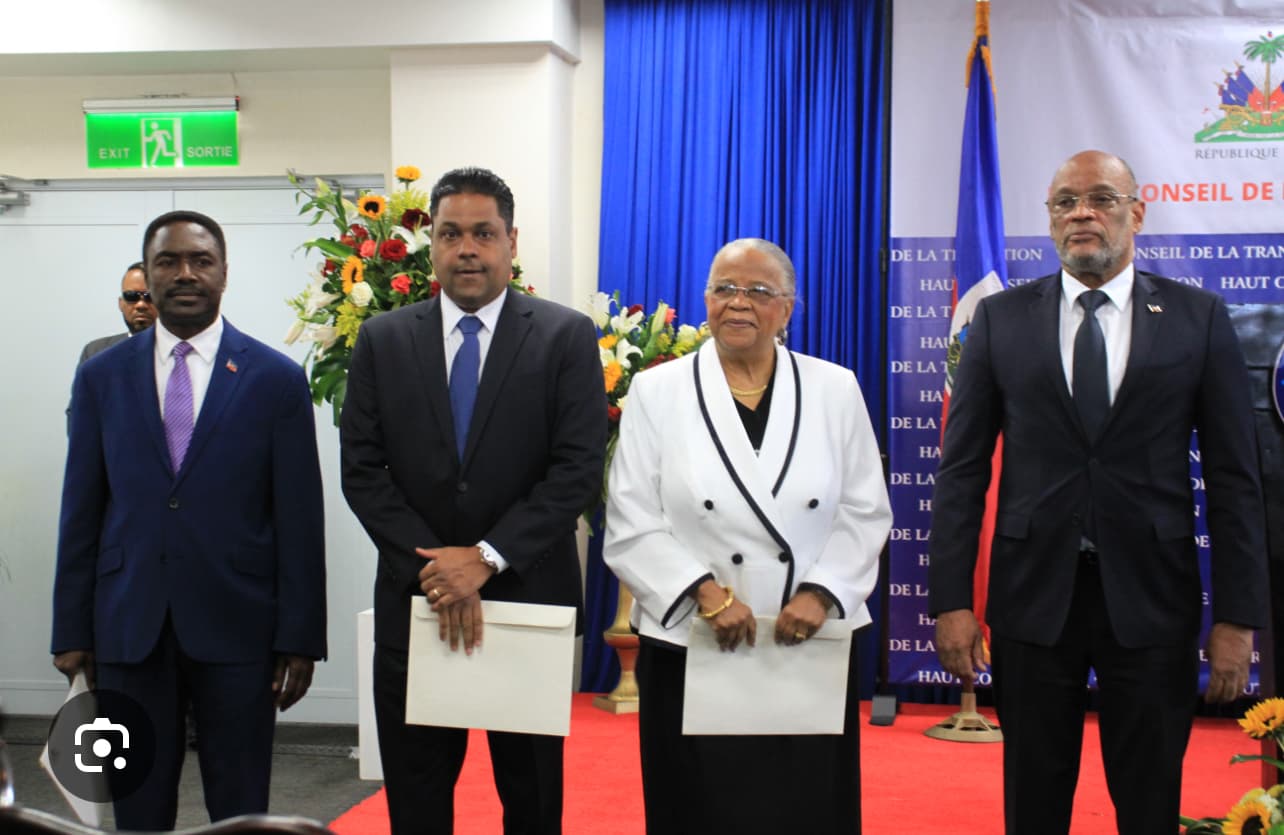
Nowhere in the negotiations among political actors under the auspices of the Caricom heads of government has the High Transitional Council been mentioned. Even the signatories of the December 21 Agreement, which gave birth to the HTC, do not refer to this entity. So, where are Mirlande Manigat, Laurent St-Cyr, and Calixte Fleuridor, the three members of the High Transitional Council?
In the initial stages of negotiations among political actors under the auspices of the Eminent Personalities of the Caricom last year, there was talk that the High Transitional Council would expand to become the five-member Presidential Council. In the second round of negotiations, this time with the Caricom heads of government, the HTC was completely sidelined, much like Prime Minister Ariel Henry.
Divided, the signatories of the December 21 Agreement, who were supposed to be the advocates of the HTC, have sent not one, but three names as representatives to the Transitional Presidential Council. Each branch of this agreement is trying to assert itself.
"The government and the Prime Minister being resigned, the members of the High Transitional Council should individually step down as well for the good of the country," said a member of the High Transitional Council to Le Nouvelliste.
The said member admitted that the High Transitional Council was not able to fulfill its mission. "There are explanations for this, but it is not necessary to elaborate on this subject at the moment. We need to find a solution to this situation. The members of the HTC are not attached to their positions," our contact within the High Transitional Council advanced.
At the moment, the members of the HTC have not yet made any decision about their future. The sectors that designated them have not yet commented on the situation either.
Initially, according to the December 21 Agreement published in the official journal, Le Moniteur, the High Transitional Council had the mission to contribute to the definition of the strategic orientations of public authorities through: creating political and social conditions for the return to constitutional order through free, credible, and transparent elections; promoting political dialogue for the participation of various actors in the management of the state during the transition period; creating the necessary conditions for a return to a climate of security and peace; defining, monitoring, and evaluating responses to public policy emergencies.
The HTC was also supposed to facilitate national dialogue in seeking consensus on the milestones to be set to signify the breaking points with bad practices and on the major projects of the transition period, including public security, the Constitution and elections, economic reforms, justice, rule of law, and social and food security.
The HTC was to ensure the credibility and integrity of elections by participating in the selection of members of the Provisional Electoral Council and by organizing milestone evaluations with recommendations for the performance of the electoral process, and also to choose the committee of experts responsible for the revision of the Constitution. More than 12 months later, the HTC has achieved none of this.
 .com

Commentaires
Aucun commentaire pour le moment. Soyez le premier à réagir.