
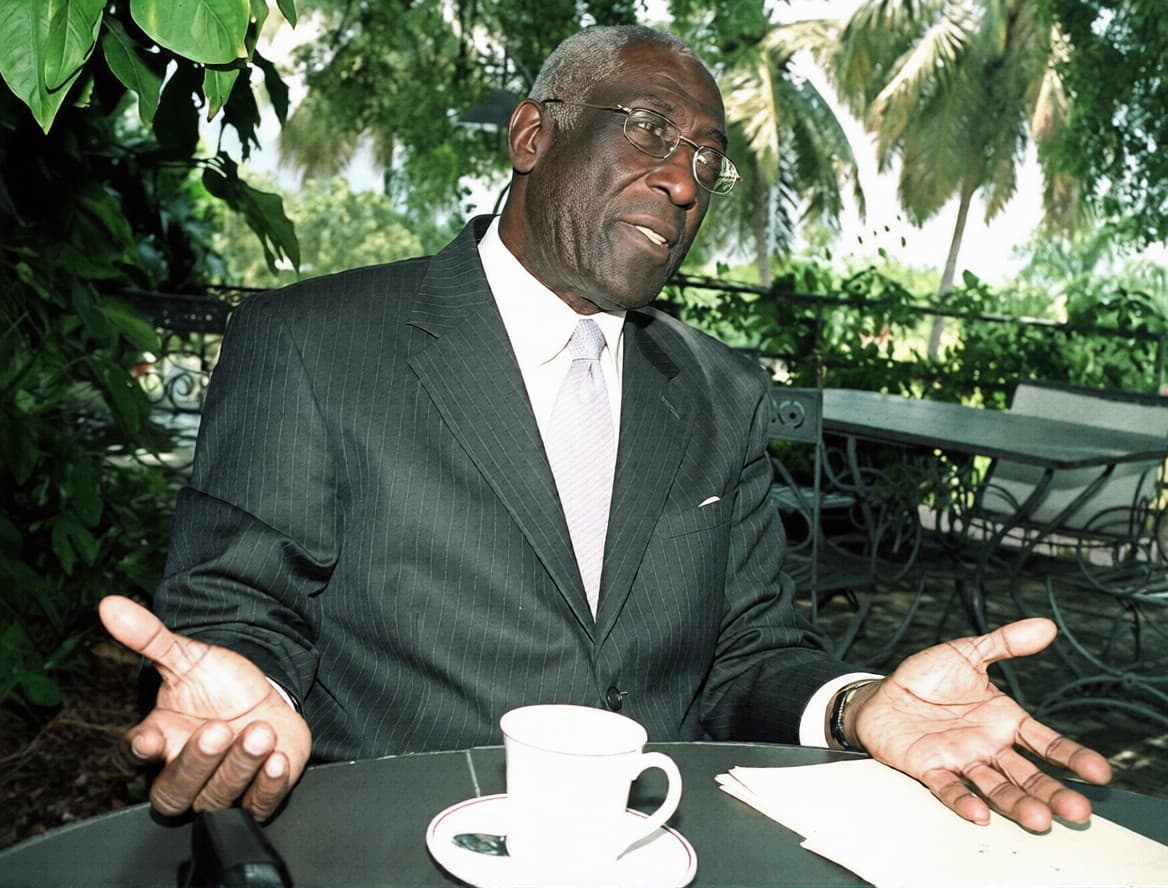
On the occasion of the funeral of Pastor Sylvio Claude, assassinated on September 30, 1991, in an ambush in the city of Les Cayes, the leader of MIDH, Marc Louis Bazin, cast a luminous glance at the particular and often disconcerting modalities of this long transition. In this colorful message, filled with truths and points for discussion, Marc Louis Bazin specified that “our country must confront the pitfalls of three transitions at once: the transition from autocratic order to democracy, the transition from a feverish economy to a pure and hard market economy, with its train of adjustments, and the transition from the regime of the Republic of Port-au-Prince to the decentralization of powers, which alone can make local elected officials accountable.” It is important to underline the accuracy and depth of these programmatic remarks, which are all the more fruitful and stimulating as they are the result of long-matured reflection. As Marc Louis Bazin’s observation shows, it is by no means necessary to always deliver a highly polished or expressive speech—although the choice of key political concepts never has a purely terminological meaning—for however inconsistent the discourse of the vast majority of our politicians may be, it also possesses an expressiveness placed at the service of sensationalist and misleading communication. One understands that such remarks, coming from a controversial statesman, a sharp and tenacious party leader, should provoke intense discussions in the milieu, for what has been lacking throughout this transition is precisely this conceptual consistency, this discursive presence, this analytical depth. Certainly, Marc Louis Bazin’s approach presents itself in the form of a shortcut that has the virtue of defining the principal structural and directional reforms facing the nation. The rest is mere detail.
This rigorous stance toward a democratization process whose very course departs from the normal path of institutional stability, national state formation, and modernization makes the critical mind sensitive to two things: on the one hand, to the loss of doctrinal substance that a brutally progressing governance demands of a society visibly disintegrating; but on the other hand, also to the necessity of forcing this democratization in a backward country in order to combat the ignorance of archaic sectors, ignorance that stands out even more starkly against the backdrop of an erratic transition.




Commentaires
Aucun commentaire pour le moment. Soyez le premier à réagir.